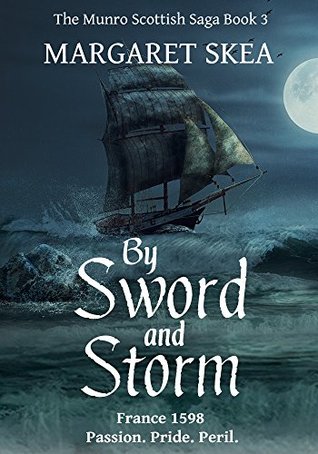
By Sword and Storm by Margaret Skea

This is the third novel in Margaret Skea’s Munro Scottish Saga set in 16th century Scotland and France and based on the history of a clan feud known as the Ayrshire Vendetta. I haven’t read the first two, Turn of the Tide and A House Divided, but that didn’t affect my enjoyment of this third book.

The novel opens in 1598 with Adam Munro, a colonel in the Scots Gardes, living in France with his wife Kate, who has skills as a healer, and their three children, Robbie, Maggie and Ellie. One of the functions of Adam’s regiment is to provide protection to Henri IV of France and when Adam saves the king’s life while risking his own in the process, the Munro family are rewarded with an invitation to come and live at the French court.

In Scotland, meanwhile, the feud between the Cunninghames and Montgomeries is supposedly at an end and the Scottish king, James VI, has banned unauthorised duelling. Most of the family members are trying to keep the peace, but two of them – Hugh Montgomerie and William Cunninghame – are still not prepared to let things rest. The Scottish storyline and the French one alternate throughout the book, eventually coming together as the novel heads towards its conclusion.

By Sword and Storm is a mixture of fact and fiction; many of the characters are real historical figures while others come from the author’s imagination – if you want to know who really existed and who didn’t, there’s a character list at the beginning of the book. Apart from the storylines involving the fictional characters, the novel is grounded in historical fact and has obviously been well researched. I loved the portrayal of life at the court of France, where Kate gets to know the king’s mistress, Gabrielle d’Estrées, and I sympathised with Maggie, who longs to study medicine and despite being given opportunities in France that would not have been open to her in Scotland, still faces obstacles because of her sex.

The political and religious situation in France at that time also plays a part in the story. At the beginning of the novel we see Henri IV issuing the Edict of Nantes, bringing the French Wars of Religion to an end and giving the Huguenots more freedom. However, it is still not safe for people in Paris to worship as they wish, as Kate and Adam’s son, Robbie, discovers when he becomes romantically involved with a Huguenot girl. I think Margaret Skea does a good job of showing the many dangers of 16th century life, not only where religion was concerned, but also for pregnant women before and during childbirth, patients with the sort of illness or injury that could be easily treated today, and anyone who had to travel by ship. It’s a period I love to read about but would not have liked to have lived through!

I really enjoyed By Sword and Storm. I liked the characters and even though I hadn’t been with them from the beginning, I found it easy enough to jump into their story and follow what was happening. Although this was meant to be the third in a trilogy, at the end of the novel I felt that there was still scope for more, so I was pleased to find that Margaret Skea has said she may return to this story again in the future.

Thanks to the publisher Corazon Books for providing a copy of this book for review.

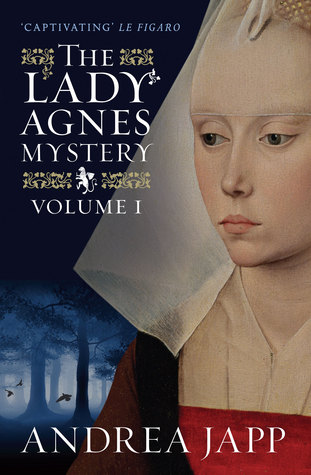
The Lady Agnès Mystery Volume 1 by Andrea Japp – #WITMonth

I hadn’t made any plans for taking part in Women in Translation Month, but when I came across this book which had almost disappeared into the black hole of my Kindle, I decided to join in. Andrea Japp is a French crime novelist and this, the first volume of her Lady Agnès Mystery (originally published in 2006), has been translated into English by Lorenza Garcia. Japp herself is also a translator and produced the French translations of Patricia Cornwell’s Kay Scarpetta novels, which I think makes her a perfect choice for Women in Translation.

There are actually two books included in this volume – The Season of the Beast and The Breath of the Rose – but they do not stand alone and although they can be bought separately, there is not much point in reading one without the other. Together, the two books tell the story of Lady Agnès de Souarcy, a young widow living in 14th century France with her eleven-year-old daughter Mathilde and ten-year-old Clément, a servant’s child whom she has raised as her own son. Left with only a small dowry to live on, Agnès is struggling financially and reliant on the support of her half-brother, Eudes de Larnay. Unfortunately she and Eudes have always had a difficult relationship and when Inquisitors arrive in the area to hunt down heretics, Eudes sees this as the perfect opportunity to rid himself of his troublesome sister.

Agnès may have some powerful enemies but, unknown to her, she also has some powerful friends who are prepared to do everything they can to protect her from the horrors of the Inquisition. But is there any connection with the murders that have been carried out on Agnès’s land – dead bodies which have been discovered with the letter A marked on the ground beside them – and with the poisoning of several nuns at nearby Clairets Abbey? It seems that all of these things must be linked..but how?

The Lady Agnès Mystery is a book with many layers. First, there’s the richness of the historical setting. Set in the Perche region of France in 1304, the story takes places at a time of religious conflict and of power struggles between King Philip IV the Fair, his various advisers and their rivals, and the two religious orders, the Knights Templar and the Knights Hospitaller. We meet characters who belong to each of these groups and are given a range of different views and perspectives. It’s exactly the same period of history as I’ve previously read about in Maurice Druon’s Accursed Kings series and I loved revisiting it here. If you’re not familiar with this period, though, it shouldn’t be a problem; everything you need to know to understand the story is clearly explained in the text – and if you do want to know more, there are several appendices at the back of the book which provide definitions, explanations and brief biographies of historical figures.

This is not a dry, heavy read, though. There’s always something happening – a clandestine meeting in a dark tavern, a coded message being deciphered or a hidden room being explored, not to mention the vivid scenes depicting Agnès’s ordeals at the hands of the Inquisitors. My favourite aspect of the book was the mystery surrounding the deaths of the nuns…I particularly enjoyed watching the apothecary nun Sister Annelette using her knowledge of plants and herbs to try to catch the murderer.

So far so good. However, there is another storyline involving the Knights Templar, a secret prophecy and a missing manuscript which didn’t really interest me at all. I thought there was already enough going on with Agnès’s personal story and the murder mystery…and I’m sure I’m not the only one who finds it difficult to read this sort of storyline without making comparisons with The Da Vinci Code.

Volume 1 ends, not on a cliffhanger exactly, but with some of the many plot threads still unresolved. I would like to know what happens next to Lady Agnès and her family, and I would love to see more of the nuns of Clairets Abbey, but I have a feeling Volume 2 will be dominated by the prophecy storyline. Will I read it? At the moment I don’t think so, but I could change my mind.

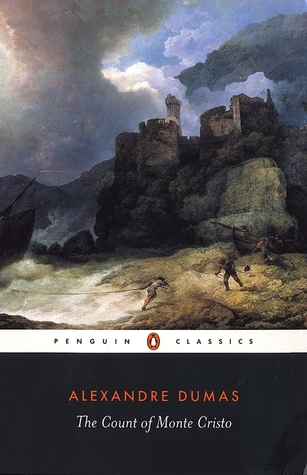
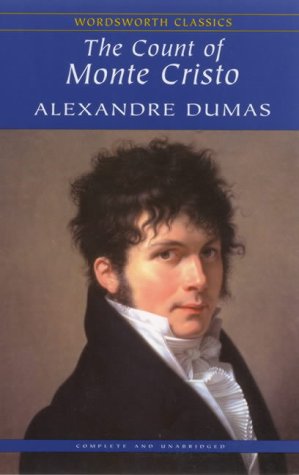
The Count of Monte Cristo by Alexandre Dumas (re-read)

When I joined the Classics Club in 2012 and put together the list of books I wanted to read, I decided that, whichever order I read the others in, I would save my re-read of The Count of Monte Cristo until last. It’s one of my favourite books (I had already read it twice) and I thought it would be something to look forward to, even if some of the other classics on my list turned out to be disappointing.

Picking it up to start reading for the third time, I did have a few doubts – there’s always a chance that a book you once loved might have lost its magic – but of course I needn’t have worried. The opening line (“On the 24th of February 1815, the lookout at Notre-Dame de la Garde signalled the arrival of the three-master Pharaon, coming from Smyrna, Trieste and Naples”) is hardly the most scintillating or memorable in literature but reading it, knowing what is to come, gives me the same feeling as when I re-read the first line of other favourite books, such as Rebecca (“Last night I dreamt I went to Manderley again”), Jane Eyre (“There was no possibility of taking a walk that day”) or Watership Down (“The primroses were over”).
Anyway, back to The Count of Monte Cristo! Our hero, or anti-hero (he can be considered to be both), is Edmond Dantès, a young sailor who, at the beginning of the novel, feels that he is the luckiest man in the world. Not only is his marriage to the beautiful Mercédès approaching, but following the death of his captain, he is also about to be given a ship to command. Things couldn’t be better…until the day of his wedding, when he is arrested on suspicion of conspiring against the king with the exiled Napoleon Bonaparte. Of course, Edmond has done nothing of the sort – it is all part of a plot by his jealous shipmate, Danglars, and his rival for Mercédès’ love, Fernand Mondego.

A third man, Villefort, has reasons of his own for wanting Dantès imprisoned and safely out of the way, so with these three enemies ranged against him, Edmond is thrown into a dungeon in the Château d’If where he remains for the next fourteen years. Although he does eventually find a way to escape, his life has been ruined: all of his hopes and dreams have been destroyed, Mercédès is lost to him and he can never get back the years of his youth that have been stolen from him. Vowing to punish his enemies for what they have done, Edmond transforms himself into the Count of Monte Cristo and launches an intricate and carefully planned system of revenge.

The events I have described above take up only a relatively small section of the novel; most of the book is devoted to following the Count as he sets his plans into action. It takes a long time before he begins to see results, but if there is one thing he has learned in prison it is how to be patient – and so he is prepared to spend years devising the perfect methods of revenge. This means the reader is faced with a series of seemingly unrelated subplots and a huge cast of characters; it can be quite overwhelming on a first read, but when you’re reading for the second or third time you can appreciate how things that appear to be irrelevant actually have great significance. This time round, without the same urgency to turn the pages to ‘see what happens next’, I was able to read at a slower pace and enjoy some of the episodes I had previously seen as unnecessarily long digressions, such as Franz and Albert’s adventures in Rome, La Carconte and the diamond ring, and the story of the bandit Luigi Vampa.

Does the Count achieve his aims – and is he happy with the final outcome? I’m not going to tell you (and if you haven’t read the book I’m sure you don’t want me to) but I will say that he does have some doubts along the way, particularly when he discovers that innocent people he never intended to hurt have also become caught up in his web of revenge. “What a fool I was,” said he, “not to tear my heart out on the day I resolved to avenge myself”. I always find it sad to see how he has changed as a result of his imprisonment – when we first meet him again after his escape from the Château d’If, the lively, optimistic young man has disappeared, to be replaced by someone much more cynical and bitter – but towards the end of the book there are signs that the old Edmond is still there, beneath the surface. Most people think of this as a revenge novel, which it certainly is, but we should remember that the Count also takes care to help and reward the friends who stayed loyal to him throughout everything.
Although The Count of Monte Cristo was published around the same time as Dumas’ d’Artagnan series, I think this is a much more mature novel, dealing with serious issues and raising some thought-provoking questions. There are moments of reflection and philosophy like this:

“The friends that we have lost do not repose in the bosom of the earth, but are buried deep in our hearts, and it has been thus ordained that we may always be accompanied by them.”

And this:

“It is the way of weakened minds to see everything through a black cloud. The soul forms its own horizons; your soul is darkened, and consequently the sky of the future appears stormy and unpromising.”

And this:

“Joy to hearts which have suffered long is like the dew on the ground after a long drought; both the heart and the ground absorb that beneficent moisture falling on them, and nothing is outwardly apparent.”

The novel takes the reader through a range of emotions, from anger to pity to frustration to sadness (some of Edmond’s scenes with a certain other character always bring tears to my eyes, thinking of everything he has lost and can never regain). As always with Dumas, though, you can expect an exciting and entertaining read, so there are also murders, poisonings, court cases and duels, thefts, anonymous letters, illegitimate children and searches for buried treasure. Not everything that happens feels entirely realistic and you do need to suspend disbelief now and then, but I don’t mind that when a book is so enjoyable to read.

I haven’t said very much about the other characters in the book (and apart from Edmond Dantès himself, whom I have always found fascinating and complex), I have to admit that most of them don’t have a lot of depth. There are two, however, that I do particularly love. The first is the Abbé Faria, a fellow prisoner of Edmond’s in the Château d’If, an extraordinary man who acts as inspiration, adviser and teacher to Edmond and without whom he would have lost the will to live. The other is Monsieur Noirtier, an elderly man who has been left unable to walk and talk, but who devises an unusual form of communication and forms a special bond with his granddaughter, Valentine.

There is so much more I would like to say about this wonderful book, but I would have to give spoiler warnings, and I think this post is long enough now anyway! I will leave you to read The Count of Monte Cristo for yourself, if you haven’t already. I know the length of the book can seem off-putting, but I wouldn’t recommend reading an abridged edition as the story is so complex I think you would be missing out on a lot.

This is book 100/100 read for the Classics Club, which means I have now completed my list! I’ll be posting a summary of my Classics Club experience soon.
Death in Bordeaux by Allan Massie

As some of you may know, I am currently working my way through all of the titles shortlisted for the Walter Scott Prize for Historical Fiction since the prize began in 2010. Allan Massie’s End Games in Bordeaux appeared on the 2016 list, but on discovering that it was the final book in a series of four, I was faced with a dilemma: should I just read the book that I needed to read for the prize or should I do as I usually prefer to do and start from the beginning of the series? In the end I decided to at least try the first book, Death in Bordeaux, in the hope that I would enjoy it enough to want to read the other three anyway.

The novel opens in Bordeaux in March 1940, with Superintendent Jean Lannes investigating the death of an old friend, Gaston Chambolley, whose mutilated body has been found in a street near the railway station. Gaston was homosexual and Lannes’s superiors are happy to assume that this was some sort of sex crime, but Lannes himself is sure there must be another explanation. The dead man’s sister-in-law has gone missing after becoming caught up in the political intrigue surrounding the Spanish Civil War, but as soon as Lannes suggests that her disappearance could be linked in some way with Gaston’s murder, he is ordered to drop his investigations immediately. Lannes, however, knows that he won’t be able to rest until he finds out who killed his friend and why.

In a seemingly unrelated case, he is also called in to help the elderly Comte de Grimaud identify the sender of some threatening letters he has received. As he gets to know the various members of the Comte’s dysfunctional family, Lannes begins to uncover some links with the other case he is working on – and that is all I will say about the plot, as it quickly becomes quite complex and I couldn’t go any further without spoiling the story.

All of this unfolds during the early stages of World War II – a period in which, at first, very little seems to be happening despite France having declared war on Germany. Soon, though, France becomes occupied, refugees from Paris begin to arrive in Bordeaux, and Lannes and his wife become increasingly afraid for their eldest son, Dominique, who is at the Front. While the author does provide a lot of historical detail, describing the major events and political decisions, and setting the story in its context, the focus is always on how the war is affecting the lives of our main characters: Lannes’ wife, Marguerite, writes letters to Dominique which she knows she’ll never send; their younger children, Alain and Clothilde, try to decide how they feel about the occupation of their country; and Alain’s new Jewish friend, Léon, wonders for how much longer he will be safe in France.

By the end of the novel, the war is still in progress and the personal stories of the characters mentioned above (and many others) have not been resolved. I believe that in the next book in the series, Dark Summer in Bordeaux, we rejoin some of the characters introduced in this one, so for that reason I’m glad I decided to start at the beginning. I can’t say that I loved this book – I found it slow and a bit too drawn out in places and it didn’t really work for me as a murder mystery. As a portrayal of life in Occupied France, though, it is an interesting, quietly atmospheric read. I liked it enough to want to continue with the second novel – and hopefully then the third and the fourth.

This is Book #3 for the R.I.P. XII challenge.

A Desperate Fortune by Susanna Kearsley

It’s been a few years since I last read a Susanna Kearsley book and as I still have two or three left to read I decided to include her most recent, A Desperate Fortune, on my 20 Books of Summer list. There are some connections between this book and her previous one, The Firebird, but they both stand alone and it’s not necessary to read them in order.

Like many of Kearsley’s novels, A Desperate Fortune is set in two different time periods. First, in the modern day, we meet Sara Thomas, a young woman with a special talent for solving mathematical puzzles and breaking codes. Sara also has Asperger’s and relies on the friendship and support of her cousin Jacqui. Jacqui works in the publishing business and when one of her authors, the historian Alistair Scott, asks for help in deciphering a journal written in code, it is Sara who gets the job.

The other thread of the novel takes place in 1732 and follows the story of the diary-writer, twenty-one-year-old Mary Dundas, who is half French and half Scottish. Mary’s family are Jacobites – supporters of the exiled James Stuart, who they believe is the rightful King James VIII of Scotland and III of England. Setting off on a journey across France with her brother Nicolas one day, Mary has no idea what he has planned for her, and is shocked to find herself caught up in a plot to protect a fellow Jacobite who is on the run from the law. Her diary tells of the lengths she goes to, the disguises she adopts and the dangers she faces in trying to conceal her companion’s true identity.

These two storylines alternate throughout the book, so that we read several entries from Mary’s journal, followed by Sara’s experiences in decoding it. Both women are interesting characters – and there are a few parallels between the two – but I found Mary’s story much more gripping and couldn’t help thinking that it would have worked just as well on its own without Sara’s framing it. There’s a romance for each woman too, but again, it was Mary’s that I found most convincing; although I did like Sara’s love interest, it all seemed to happen too quickly and too conveniently.

It was interesting to revisit the subject of the Jacobites, who also feature in The Firebird – although the two books explore the topic from very different perspectives, with this one being set in France and the other in Russia. The author’s note at the end of the book is long and comprehensive, discussing some of the choices made in writing this novel and explaining which parts of the story are based on fact and which are fictional. I was surprised to see how many of the characters I’d assumed were purely imaginary were actually inspired by real people!

I did enjoy A Desperate Fortune, though not as much as most of the other Susanna Kearsley novels I’ve read. My favourites seem to be the ones with supernatural elements, such as The Firebird, The Rose Garden and Mariana. I always like Kearsley’s writing style, though – there’s something so comforting about it, so easy and effortless to read. It’s the same feeling that I get when I pick up a book by Mary Stewart. I’m looking forward now to reading my remaining two Kearsley novels, The Shadowy Horses and Sophia’s Secret (the UK title for The Winter Sea).

This is book 12/20 for my 20 Books of Summer challenge. (I’m aiming for 15 now, I think – anything over that will be a bonus!)

A French Trio: Mediterranean Summer; Eugenie; A Week in Paris

Coincidentally, three of my recent reads have been set in France, so I thought I would combine my thoughts on them into one French-themed post. It’s a good way for me to get through my review backlog too!

Mediterranean Summer by Jane MacKenzie was a nice surprise; a book I knew nothing about, by an author I’d never come across before, but one that I ended up really enjoying. It tells the story of Laure, a young art student who finds herself caught up in the excitement of the 1968 student demonstrations at her university in Paris. When the rebellion is over, with her future as an artist in doubt due to her involvement in the protests, Laure returns home for the summer to her parents’ house in the Mediterranean village of Vermeilla. Here, in the small Catalan community of her childhood, she is reacquainted with old friends as well as making new ones – and with the help of Robert, a lawyer, she begins to search for a way to rescue her career.

This is a lovely summer read; the descriptions of the fictional Vermeilla and the surrounding area are so beautiful I wished I could go and spend the rest of the summer there myself! There’s an interesting selection of characters to get to know too, mostly very likeable, but with one or two who could be considered villains. As for the historical background, I knew almost nothing about the Paris student protests in the 1960s, so I learned something new there, and I was also interested to read about the Nobel dynamite factory in Paulilles and the shocking lack of regard for the health and safety of the employees. I loved Mediterranean Summer and would be happy to try Jane MacKenzie’s previous novels.

The next book I want to talk about takes us further back in time, to the French Revolution. Published in 1917 (originally titled The Third Estate), Eugenie by Marjorie Bowen introduces us to two sisters, Eugenie and Pélagie Haultpenne. Pélagie, the eldest, is heiress to a fortune and, at the beginning of the book, is engaged to a handsome young nobleman, the Marquis de Sarcey. As soon as the Marquis sees her beautiful sister Eugenie, however, Pélagie is forgotten. Can he find a way to be with Eugenie without giving up his claim to the Haultpenne fortune?

I have read a few of Marjorie Bowen’s other historical novels and have found them to vary widely in style and quality. This is not one of the better ones, but despite the off-putting cover, it’s still an entertaining read. The historical aspect of the story is interesting; it focuses less on the Revolution itself than on the factors leading to it, such as the Estates General and the role of the Comte de Mirabeau. This is a novel that you would read more for the plot than because you wanted to learn some history, though. It reminded me slightly of Louisa May Alcott’s A Long Fatal Love Chase; it’s fun, as long as you don’t mind lots of melodrama, swooning heroines and an anti-hero who is “a creature expert in every vice, used to every dishonour, useless, arrogant, a parasite on the labour of others!”

Finally, I read A Week in Paris by Rachel Hore, a dual timeline novel. One thread of the story is set in 1961 and follows music student Fay Knox who is in Paris for a week with her orchestra. Fay has grown up knowing very little about her early childhood as her mother refuses to talk about it or to tell her what happened to her father, other than that he was killed during the war. However, when memories start coming back to her, she has reason to believe that the first years of her life may have been spent in France. Over the course of her week in Paris, Fay decides to find out the truth about her past – and is shocked by what she discovers. Meanwhile, she is reacquainted with an old friend, Adam, but could he also be hiding secrets?

The other storyline is written from the perspective of Fay’s mother, Kitty, who falls in love with Gene, an American doctor, during World War II. The two end up trapped in occupied Paris – and their actions during this period will have consequences that live on into the next generation.

I found this an enjoyable novel, after a slow start, though not as good as similar books by other authors such as Lucinda Riley or Susanna Kearsley. The 1940s storyline is much more engaging than the 1960s one, not just because of the drama of the war itself, but also because the romance between Kitty and Gene is more convincing than the one between Fay and Adam (and less reliant on coincidence and chance meetings). I really cared about what happened to the wartime characters and was gripped by the details of life in a city under Nazi occupation, but I wouldn’t have minded if the framing story involving Fay had been left out altogether.

Three very different books, but I found different things to like about all of them!

Thanks to Jane MacKenzie for the copy of Mediterranean Summer; the other two were both taken from the outstanding titles on my NetGalley shelf.

Mata Hari by Michelle Moran

So far my feelings about Michelle Moran’s novels have been very mixed. Cleopatra’s Daughter was interesting, but felt too light and insubstantial, The Second Empress was much better, but I had one or two problems again with Rebel Queen. I had hoped Mata Hari (also published as Mata Hari’s Last Dance) would be another good one, but unfortunately it turned out to be my least favourite of the four that I’ve read.

Before I read this book, all I knew about Mata Hari was that she was an exotic dancer who was accused of spying during the First World War. I felt sure that she must have been a fascinating woman and I was looking forward to learning more about her. And I did learn a lot from this novel. Mata Hari narrates her story (fictional, but based on fact) in her own words and tells us all about her dancing career, her experiences of life in European cities such as Paris and Berlin, and her many romantic relationships, including several with military personnel which led to her being accused of passing secrets to Germany.

However, I wanted to get to know the woman behind the newspaper headlines and the seductive costumes – Margaretha Zelle, or M’greet as she is called in the novel – and although she does confide in us now and then about her childhood in the Netherlands (she did not come from an Indian background, as she tried to claim), her time in Java during her unhappy marriage to Rudolf MacLeod and her heartbreak at the loss of her children, I never felt very close to Mata Hari and didn’t gain a very good understanding of the person she really was.

The one aspect of Mata Hari’s life that Moran does successfully capture is her loneliness; I didn’t like her and had very little sympathy for her as she seemed so immature and selfish, but I could see that she was not a happy person and that her character had been shaped by her earlier experiences. The descriptions of Mata Hari’s various dances are also well done, particularly one that she performs with a live snake while dressed as Cleopatra. The novel is strangely lacking in period detail, though, and apart from the obvious references to the war and to other famous people of the time – her rival dancer, Isadora Duncan, for example – I didn’t feel that there was much sense of time or place at all.

The book is also disappointingly short, with under 300 pages in the edition I read. If you just want a basic overview of Mata Hari’s life and career, it’s perfectly adequate, but for something deeper you will need to look elsewhere. The section of the novel covering her spying activities is very brief and feels almost like an afterthought, which is a shame as this is the part of the story which should have been the most interesting. Even on finishing the book, I’m not completely clear on what we are supposed to assume; was Mata Hari really a spy or was she just someone who had made some poor decisions and been carried along by events outside her control? To be honest, long before we reached this point I had lost interest anyway and had already decided that I would need to look for another book on Mata Hari one day. Has anyone read The Spy by Paulo Coelho?