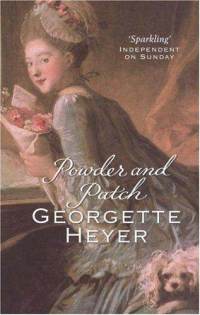
 Philip Jettan has grown up in the country on his family estate and has never shown any interest in fashionable society. As he grows older he falls in love with his childhood friend and neighbour, Cleone Charteris, but Cleone is unimpressed by Philip’s simple country ways and makes it clear she’s looking for a man with better manners and nicer clothes. And so, with the help of his Uncle Tom, Philip goes to Paris to learn how to be a gentleman…but when ‘le petite Philippe’ returns wearing powder and patches, writing French poetry and fighting duels, Cleone starts to wish she could have the old Philip back.
Powder and Patch is a very early Georgette Heyer novel and in my opinion not an example of her best work. If this had been my first experience of Heyer I think I would have been disappointed, but because I’ve read and enjoyed some of her other novels I’m prepared to accept that I’ll come across the occasional book that’s not as good. And having read some of her later books, it was interesting to see an early indication of her storytelling ability and talent for witty dialogue. There’s a lot of humour in the story but I didn’t find it as amusing as it was obviously intended to be – although I have to say, the final few chapters were quite funny and redeemed the book for me.
None of the characters in this book seemed to have much depth, with Cleone being particularly silly, especially in comparison to some of the stronger, more complex heroines in the other Heyer books I’ve read. I found it difficult to warm to her from the start because I thought Philip was fine the way he was: sincere, honest and reliable, and Cleone’s inability to accept him made me feel annoyed with her. The moral of the story is obvious: that outward appearances can be deceiving and it’s what’s inside that counts.
This book is set in the Georgian era, rather than the Regency period which Heyer is more famous for, and this gives the story a slightly different feel, although I don’t personally have any preference for one period over the other. I should point out that if you’re like me and have only a very basic knowledge of the French language (or none at all) be warned that there are a lot of French phrases scattered throughout the book, including an entire poem written in French. I don’t think it actually affected my understanding of the plot at all but I did keep wondering if I might be missing something.
Powder and Patch is a short novel but just the right length really because I don’t think the plot would have been strong enough to sustain a longer book. I found it a very quick and easy read which kept me entertained for a while, but definitely the weakest of the Heyer novels I’ve read so far.
 She Reads Novels