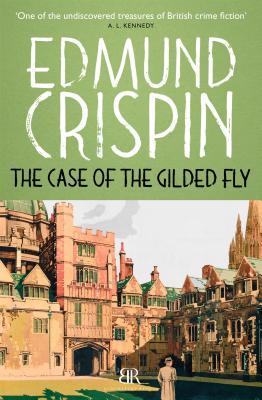
 Like many people, I first encountered Edmund Crispin’s Oxford don detective Gervase Fen in The Moving Toyshop, the third in the series and the one which is usually said to be his best. I loved it and wanted to read more, so going back to the beginning of the series and reading The Case of the Gilded Fly seemed a good idea. As it was published in 1944 I had hoped to read it for last month’s 1944 Club but didn’t have time and ended up reading it after the event was over.
The novel opens with an introduction to each of the main characters as they travel to Oxford on the train. Among them are Gervase Fen, Professor of English Language and Literature at Oxford University, and his old friend the Chief Constable, Sir Richard Freeman. Ironically, Fen’s passion is for detection, while Sir Richard’s is for literature, which leads to some interesting conversations between the two of them. Although this is the first book in the series, it is implied that Fen already has some experience of solving mysteries. He certainly has no difficulty in solving the ‘Case of the Gilded Fly’, even though everyone else finds it baffling.
Also arriving on the same train as Fen and Sir Richard are Robert Warner, a playwright who has chosen an Oxford theatre for the premiere of his new play, and several members of the cast. One of these is the aspiring young actress Yseut Haskell, a spiteful, self-obsessed person who seems to cause trouble everywhere she goes. As we get to know the characters better during their first night in Oxford, we discover that almost everyone has a reason to dislike her, so when Yseut is found dead in a room in the college the next day, there’s no shortage of people with motives. The problem is, none of them seemed to have had an opportunity to enter the room unobserved and carry out the murder. How did the killer manage it? And what is the significance of the Egyptian-style gilded ring found on Yseut’s finger?
This is a complex locked-room-style mystery with a lot of discussion of alibis, floor plans and the timings of events. I didn’t come close to solving it, although Fen works it out very early on but has no proof and keeps us waiting until the end to find out who did it and how it was done. He also faces a moral dilemma: as Yseut was such an unpleasant person and nobody is particularly sorry to see her dead, does he really want the killer to be punished – especially as the police have already decided it was suicide? In my opinion Yseut had done nothing to deserve being murdered, but I suppose this provides a reason why Fen doesn’t immediately tell the police what he knows and bring the novel to an end before it even begins!
I enjoyed this book, but I found it slightly disappointing in comparison to The Moving Toyshop. As a more conventional sort of mystery, it doesn’t have quite the same feeling of originality and novelty, and although there are still plenty of witty comments and literary allusions flying back and forth between Fen and his friends, they are not as much fun as the limericks and ‘Detestable Characters in Fiction’ game in The Moving Toyshop. It’s possible that I would have liked The Case of the Gilded Fly more if I’d read it first and had nothing to compare it with.
Have you read any of the Gervase Fen mysteries? Which ones are your favourites?

 She Reads Novels