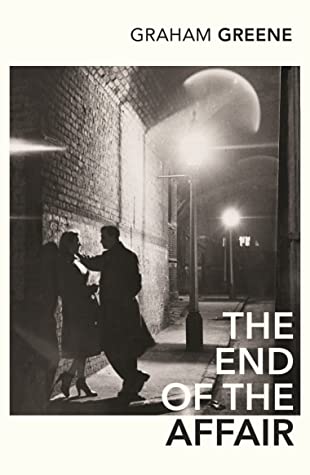
 Graham Greene’s 1951 novel, The End of the Affair, was one of the final unread books on my Classics Club list, which I’ve been neglecting recently. As I had left a few empty slots on my 20 Books of Summer list for random reads, I decided this would be a good opportunity to read it.
The End of the Affair is narrated by Maurice Bendrix, a writer living in London. As the title suggests, the novel begins at the end of an affair between Bendrix and neighbour Sarah, the wife of Henry Miles, a civil servant. It was Sarah who ended the relationship, leaving Bendrix confused, hurt and bitter. In January 1946, almost two years after the affair ends, Bendrix meets Henry by chance crossing the Common that separates their two houses. Henry never knew about the affair, but he now confides in Bendrix that he suspects Sarah is seeing another man. This revives Bendrix’s suppressed feelings for Sarah and he decides to hire a private detective to follow her and try to find out who her new lover is.
I really enjoyed the first half of this book. Greene writes so convincingly about Bendrix’s regret for his lost love and the mixture of emotions it provokes in him: disappointment, anger, resentment and – after hearing Henry’s suspicions – jealousy. The private detective he employs, Alfred Parkis, is a wonderful character and I wished he’d played a bigger part in the book. Although he’s not particularly successful in his detecting, he’s so eager to please and to set a good example for his young son, Lance, that I found him very endearing. He also adds a touch of comedy to what is otherwise a very serious story.
In the middle of the novel, the focus switches to Sarah and through some passages from her diary, we see her side of the story and discover her reasons for ending the affair with Bendrix. I found the second half of the book less compelling as discussions of Catholicism, religious conversion and the existence of God begin to dominate. There are lots of interesting ideas being explored, but I felt that it completely changed the direction and the feel of the story I had previously been enjoying. Still, I liked the book overall, loved the quality of the writing and thought the 1940s setting was perfectly evoked.
This is the first book I’ve read by Graham Greene and maybe it wasn’t the best place to start with him, but I do want to read more. Any recommendations are welcome!

Book 14/20 for 20 Books of Summer 2025.
This is also book 47/50 from my second Classics Club list.
 She Reads Novels