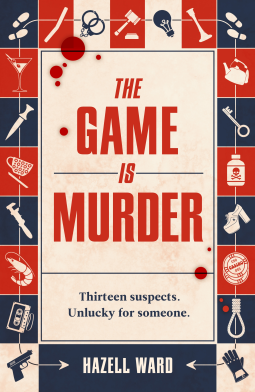
 Described by the publisher as a murder mystery in which the reader ‘plays the role of the Great Detective’, The Game is Murder sounded fun. I expected an interactive Choose Your Own Adventure style book like Max Nightingale’s Murder in Tinseltown (although hopefully better executed than that book, which didn’t quite work). It turned out to be nothing like that, but something very different.
The novel is written in the second person with an unnamed narrator – presumably the author – directly addressing you, the reader, and positioning you as a character in the story. It begins with you arriving for a murder mystery party at the London home of David Verreman and his brother Daniel:
The lights are on at 8 Broad Way. The steps have been swept and the brass door-knocker has been polished. For this is an occasion. Walk up the steps and tap lightly open the door. They are expecting you.
Before you take your seat at the dinner table, David addresses you and the other guests, explaining the purpose of the party. You’re gathered here tonight to attempt to solve an historic crime involving the Verreman family – one evening in 1974, a servant was found murdered in the basement of 8 Broad Way. Everything points to the killer being Lord Verreman, David and Daniel’s father, who was believed to have mistaken the woman for his wife. Lord Verreman fled before he could be arrested and the crime has remained unsolved ever since. Your fellow guests include suspects, witnesses and medical experts; your task as the Great Detective is to listen to their evidence and try to solve the mystery.
This may sound straightforward enough so far, but you quickly discover that the author is playing games with you and nothing is really as it seems. Without wanting to spoil too much, the direction of the story changes several times and so does your role in it. This is not the sort of book you can really become immersed in as it’s impossible to forget that you are, in fact, reading a book and are being manipulated by the author/narrator into believing or not believing certain things. It’s something people will either enjoy or they won’t and I’m sure it’s a book that’s going to massively divide opinion!
There are lots of nice little touches, such as quotes from classic mystery novels at the start of each chapter, a ‘contract’ between author and reader laying out the rules of the investigation and some games and quizzes (which I suppose form the interactive element of the book). However, there were other things I just found irritating, such as naming characters after real crime authors: Wilkie Collins, Gaston Leroux etc. And there’s no real opportunity for the reader to actually direct the course of the investigation or solve the crime for themselves, which is the impression I’d been given by the blurb (and why I was hoping for more of a choose-your-own-adventure structure).
The mystery itself is interesting, with several suspects and lots of clues, alibis and red herrings. Because it’s a crime that has already taken place, though, we only see it unfold through the statements and testimonies of the people involved, which means things become quite repetitive in the middle as we hear the same incidents described by several different characters. Overall, I found the book entertaining in places, but too ambitious and not really what I’d expected or wanted. I think other readers will love it!
Thanks to Michael Joseph for providing a copy of this book for review via NetGalley.
 She Reads Novels