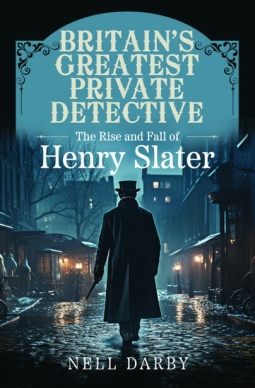
 As someone who enjoys detective novels, I was naturally drawn to this non-fiction book about a real life private detective who achieved fame and success in the late Victorian era. His name (at least the one by which he was best known) was Henry Slater and he was the owner of Britain’s leading detective agency. This new book by Nell Darby explores Henry Slater’s life and career and looks at the world of the early private detective in general – the backgrounds they came from, the type of cases they dealt with, the methods they used and the problems that could arise from those methods.
The Matrimonial Causes Act 1857 is one of the key factors that gave rise to the private detective in the second half of the 19th century. This made it possible for people to request a divorce through the law courts (rather than through a private Act of Parliament as previously) as long as they could prove their spouse had committed adultery. Women would also need to prove one other offence, such as desertion or cruelty. But how could people obtain evidence to show that their partner had been unfaithful? By employing a private detective, of course, and asking them to shadow their husband or wife and look for proof of infidelities. And what do you think happened if the detective couldn’t find any proof – and their client was paying them to deliver results?
Slater’s Detective Agency, who operated from offices in London’s Basinghall Street, advertised all sorts of detective work, but most of their business relied on divorce cases. It was one case in particular that brought about their downfall. Having been hired on behalf of a Mrs Kate Pollard to help her divorce her husband, the agency resorted to underhand methods to get the evidence they needed and were betrayed by a former employee with a personal grudge against Henry Slater. This led to a trial which damaged Slater’s business and exposed his true identity. The Pollard case and the trial which followed form a large part of the book, although Darby moves back and forth between that story, a personal biography of Henry Slater himself and a general history of private detective agencies.
This is a fascinating book and has clearly been very well researched (there’s a long bibliography and an extensive section of notes), but it wasn’t quite what I expected. I thought there would be details of more of Slater’s cases than just the Pollard one and more discussion of the other types of work the agency carried out as well as divorces, but maybe there just wasn’t enough information available to do that. I can’t agree with other reviews saying the book reads like a detective novel as there’s very little actual ‘detecting’ being done and certainly not much similarity between Henry Slater and Sherlock Holmes, whose adventures were appearing in print during the same period that Slater was operating. The jumping around from one topic to another also disrupts the flow of the book and meant I couldn’t become as immersed in it as I would have liked.
Still, I enjoyed learning about Henry Slater and how he established his agency, how he found work first through advertising and then through the strength of his fame and reputation, and how he faced challenges from rival companies. It seems that although Slater can be admired for what he achieved in building his business up from nothing and reaching the very top in his chosen profession, he was less skilled in handling his personal relationships with friends and employees – and this, together with his determination to keep his perfect record in winning divorce cases, is what led to his demise.
I was intrigued by the occasional mentions of the women detectives Slater employed, particularly the ones described as ‘cyclist detectives’ who followed their suspects by bicycle. I’ve discovered that Nell Darby has written another book, Sister Sleuths: Female Detectives in Britain, which sounds like a good companion to this one and I’m sure it would be an interesting read as well.
Thanks to Pen & Sword for providing a copy of this book for review via NetGalley.





 She Reads Novels