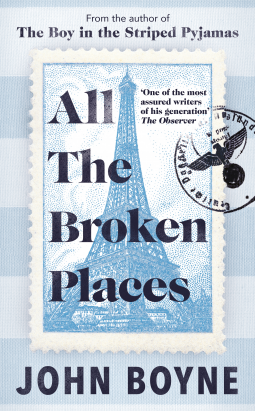
 I love John Boyne’s books and couldn’t wait to read his new one, All the Broken Places. It’s a sequel to his 2006 children’s novel The Boy in the Striped Pyjamas, but this time it’s aimed at adults. Although I haven’t read the first book, I have seen the film and that helped me understand the background of the characters and the references to things that had happened in the past. If you’re not familiar with The Boy in the Striped Pyjamas, though, I don’t think it would matter too much as this book does work on its own.
All the Broken Places begins in the present day, 2022, and is narrated by ninety-one-year-old Gretel Fernsby. Gretel has lived in the same luxury apartment building in London since the 1960s; most of the other residents have also been there for a long time, so when a new family move into the flat below, Gretel is curious to meet her new neighbours. However, she is alarmed to discover that the family includes a nine-year-old boy, Henry, who brings back memories of her own brother at the same age – memories Gretel has spent her whole life trying to suppress.
As she gets to know Henry and his parents, Gretel quickly becomes aware that something is not right. She wants to help, but is afraid of making the situation worse. At the same time, she is forced to confront her own past when, as the young daughter of a Nazi commandant of a Polish concentration camp, she and her mother fled to France at the end of the war and tried to build new lives for themselves under new identities. Gretel has lived with the shame and guilt ever since, but now it seems she might have an opportunity to redeem herself.
As the story of Gretel’s life unfolds, we are taken on a journey from Poland to France, Australia and then England. Chapters set in the past alternate with chapters set in the present as Gretel battles with her conscience again to try to do the right thing for Henry. There are not many books with protagonists in their nineties and I admired her for the courage, resilience and wisdom she displays in old age, despite what she may have done or not done when she was younger.
I really enjoyed this book, although at times it’s an uncomfortable read and often a moving one. John Boyne has shown previously that he’s not afraid to tackle controversial subjects in his novels and I’m sure this is another one that will divide opinion. Some readers will take the view that anyone with any connection to the atrocities of the Holocaust deserves no pity; others will have sympathy for a twelve-year-old girl who, although she was at least partly aware of what was happening, lacked the strength, will and opportunity to do anything about it and has regretted it ever since. This is a theme Boyne has explored several times before, particularly in A History of Loneliness (a novel about the child abuse scandal within the Catholic church and probably my favourite of his books) – whether by turning a blind eye to the actions of others we are as much to blame as they are and whether it’s our responsibility to speak out if we know something is wrong.
This is a fascinating novel; it’s published today and I look forward to hearing what other people think of it.
Thanks to Doubleday for providing a copy of this book for review via NetGalley.

This is book 49/50 read for the Historical Fiction Reading Challenge 2022.



 She Reads Novels