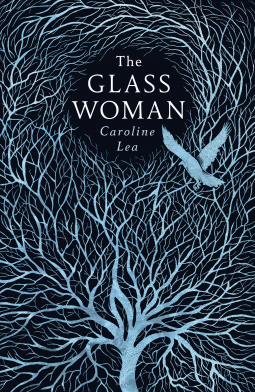
 With its cold Icelandic setting, dark atmosphere and shades of classic Gothic novels, this would have been an ideal winter read, but for me it was a spring one, finished towards the end of April – and now here I am writing about it in June, at the beginning of summer. An indication of how far behind I am with everything, but I know I will catch up eventually!
Anyway, The Glass Woman opens in November 1686 with a body rising to the surface of the frozen sea just off the coast of Iceland. Amongst the crowd who gather to watch and to try to pull the body from the water is one man who knows more than he’s willing to admit. A man who ‘remembers carrying the heavy body in the winding sheet, weighted with stones; remembers his wound paining him as they scraped through the snow and smashed the ice with long staves before sliding the body in’.
We then go back a few months to the August of that year, when Rósa comes to live in the village of Stykkishólmur with her new husband, Jón. She knows very little about Jón but he had promised to see that her ailing mother was cared for if she married him, so she felt she had to accept his proposal. Rósa finds it difficult to settle into her new life; she misses her mother and her childhood friend Páll and her husband is proving to be disappointingly cold and distant. The other women of the village seem to be reluctant to befriend Rósa and she soon discovers that this is because there is some sort of mystery surrounding the death of Jón’s first wife, Anna.
Alone and isolated in Jón’s croft, Rósa listens to strange noises coming from the loft above but she is unable to investigate because her husband keeps the loft door locked and has forbidden her to try to enter. He expects her to be meek and obedient, as symbolised by the small glass woman he gave her as a wedding present, but Rósa has other ideas. She has questions that must be answered. Who or what has been hidden away in that secret locked room? What really happened to Anna? And what sort of man has she married?
The Glass Woman is a beautifully written novel; Iceland is a setting I always find atmospheric and interesting and in this book it is more than just a setting – the landscape itself plays a part in the development of the story. I liked Rósa and understood how difficult the situation was that she found herself in, unable to trust her husband yet doing her best to make the marriage work, while suspecting that he may have done something terrible and that she herself could be in danger.
Most of the novel is written from Rósa’s point of view, but there are also some chapters narrated by another character and set at a slightly earlier time. Although this did help to fill in some of the gaps in Rósa’s knowledge, I thought it was done in a way that confused things rather than clarified them. The structure seemed to slow the story down and I didn’t find myself becoming fully absorbed until near the end of the book when the various threads began to come together and the truth started to emerge.
Overall, though, I did enjoy reading The Glass Woman. Some of the plot elements in the first half of the book made me think of Jane Eyre and others of Rebecca, but as the story moved forward I knew it wasn’t going to be exactly like either of those other novels and that Caroline Lea had written something quite different.
Thanks to the publisher Michael Joseph for providing a copy of this book for review via NetGalley.



 She Reads Novels