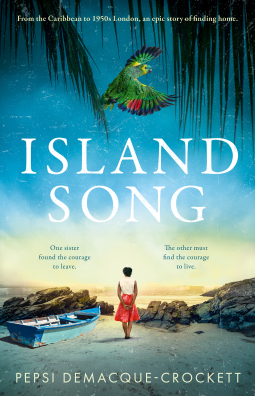
 Pepsi Demacque-Crockett has had a successful career in music as a backing singer for Wham! and then as a member of the duo Pepsi and Shirlie. Although she was born in London, her parents came to England from St Lucia in the Caribbean, and this forms the inspiration for Island Song, her debut novel.
Island Song is set in the 1950s. Agnes Deterville and her sister, Ella, who live in the village of Canaries on the island of St Lucia, are two very different people. As the quiet, cautious older sister, Ella can’t imagine leaving her island home and knows that she’ll never want to live anywhere else. Agnes is bolder and more adventurous, ready to follow her dreams and seize new opportunities. Working as a housekeeper for an English family, the Chesters, Agnes is captivated by Mrs Chester’s descriptions of her home country and longs to see it for herself. Hearing that people from the Caribbean have been invited to help rebuild post-war Britain, she decides to use her savings to travel to London.
Agnes has two young children from a failed relationship, whom she leaves behind with Ella, and her intention is to return to St Lucia as soon as she’s made enough money to improve the lives of the whole family. However, everything changes when, soon after arriving in England, she falls in love with another new immigrant, Raphael Toussaint. Agnes and Raphael come from the same village and she knows him by his bad reputation, but meeting him again in London he seems to be a different person and assures her that he has changed. Agnes wants to believe him, but how can she know he’s telling the truth?
Island Song is a fascinating exploration of the experiences of immigrants and the way in which people often build up an image of something in their mind that isn’t matched by reality. Having listened to Mrs Chester’s idyllic tales of her life in Dorset, Agnes expects something similar when she arrives in London and is shocked to find that this isn’t the case. Rather than sipping tea in elegant drawing rooms, she’s working in a kitchen making tea for other people, while being bullied by her boss. Similarly, Raphael comes to London hoping to make a fortune, but instead spends several months unemployed before eventually finding a lowly job painting walls for a construction company. They – like the rest of the Caribbean community – face racism, discrimination and even violence, but also make new friends amongst both immigrants and white British people who give them the confidence that not everyone in their new country wants them to leave.
Agnes is a strong character and I did like her, but I found Raphael more interesting because he goes through more growth and development throughout the novel. He has a drinking problem and is easily influenced by his friends, but he also has a kind heart and does genuinely seem to want to change and be a good partner to Agnes. I really wanted them to find happiness, both in their relationship and in their working lives. Ella is another character who grows as a person as the book progresses. Although most of the focus is on the characters who have left the island, we do catch up with Ella now and then and see how she’s gradually able to move on from some bad experiences in her past and gain the confidence to take control of her own life.
Demacque-Crockett writes beautifully about St Lucia and her love for her own heritage shines through in the London sections of the novel as well. The English spoken by her St Lucian characters is peppered with Kwéyòl, a French-based Creole language, and we see the immigrants trying to adapt to British culture while at the same time trying to retain parts of their own culture, such as their favourite foods and music. I really enjoyed this book and I hope Demacque-Crockett will write another one!
Thanks to HarperCollins for providing a copy of this book for review via NetGalley.


 She Reads Novels