Arctic Summer by Damon Galgut

Arctic Summer As someone who has only read one novel by E.M. Forster – A Room with a View – I wasn’t sure whether reading Arctic Summer would be a good idea. It’s a fictional biography of Forster, concentrating on the period during which he was working on his novel A Passage to India, so I thought it might be more sensible to wait until I had read that book first. Arctic Summer is on the list of books I need to read for my Walter Scott Prize Project, though, so when I saw it in the library I couldn’t resist picking it up and taking it home.

I should start by saying that as well as not having read much of Forster’s work, I also – before reading this novel – knew almost nothing about the man himself. The first thing I discovered was that Galgut refers to his main character not as Forster or Edward but as Morgan, which was his middle name. Forster went by this name to distinguish himself from his father, another Edward (and apparently he was originally supposed to be called Henry anyway – there was some confusion over names at the baptism).

We first meet Forster in 1912 as he sets sail on his first trip to India at the age of thirty-three. He is planning to visit his friend Syed Ross Masood, whom he had tutored in Latin several years earlier while Masood was a student in England. Forster is becoming increasingly aware that what he feels for Masood is not just friendship but also love. However, he is not entirely comfortable with his feelings yet and is plagued by doubts and frustrations; this was a time when homosexuality was neither legal nor seen as socially acceptable and we are reminded that fewer than twenty years have passed since Oscar Wilde’s imprisonment for ‘gross indecency’.

Later, during World War I, Forster travels to Egypt to work for the Red Cross, and here he falls in love again, this time with Mohammed el-Adl. His love for Masood and Mohammed forms the main focus of Arctic Summer – and this, to me, was slightly disappointing. Obviously his relationships with these two men (and others) were very important to Forster and had an influence on his writing, but I would have preferred to read a more balanced novel that also explored other aspects of his life, rather than just page after page describing his sexual experiences and desires.

I did enjoy reading about Egypt and India (the visit to the Barabar Caves was particularly memorable) and I was also pleased to see brief appearances from other writers of the period such as D.H. Lawrence and Virginia and Leonard Woolf. The writing was of a high quality too and Galgut tells Forster’s story with sensitivity and understanding. Too much of the book bored me, though, and it failed to move me as much as I would have liked and expected. I had difficulty relating the story of Morgan’s love affairs to what little I know of Forster’s writing and I think I should definitely have waited to read this until I’d at least read A Passage to India and possibly Maurice as well.

This was one of the few disappointments I’ve had during my reading from the Walter Scott Prize shortlists, but don’t let me put you off. Looking at other reviews it seems that a lot of people have read it and loved it. As I’ve mentioned, my own lack of familiarity with Forster’s life and work could have been part of my problem. If nothing else, reading Arctic Summer has made me want to read more of E.M. Forster’s novels sooner rather than later.
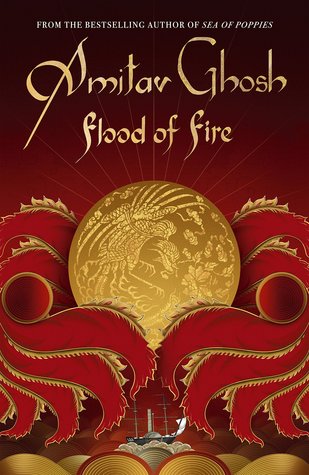
Flood of Fire by Amitav Ghosh

Flood of Fire Flood of Fire is the third and final part of Amitav Ghosh’s Ibis Trilogy and I think it’s probably my favourite of the three books. Set in India and China before and during the First Opium War, the trilogy follows the adventures of a group of people thrown together on board a former slaving ship called the Ibis.

This third novel pulls together threads from the first two and while it may be possible to still enjoy this book without having read the others, I would strongly recommend reading all three in order. While Sea of Poppies and River of Smoke took us through the build up to the conflict, describing the disputes over the trade of opium and the deterioration of relations between Britain and China, Flood of Fire covers the war itself.

The novel opens in 1839 and the first character we meet is Kesri Singh, brother of our old friend, Deeti. Kesri is a havildar (a rank equivalent to sergeant) in the Bengal Native Infantry, part of the East India Company, and through his storyline we are given some insights into army life and the contribution made by Indian regiments to Britain’s military victories in China. Next we are reunited with Zachary Reid, the American carpenter-turned-sailor who played a major part in Sea of Poppies but was absent from River of Smoke. In this book, Zachary begins an affair with his new employer, Mrs Burnham, before setting his sights on becoming a successful businessman.

We also rejoin Neel Rattan Halder, the former Raja of Raskhali, who is now living in Canton where he is able to use his skills as an interpreter to assist China’s war effort. Neel’s story is told mainly in the form of a journal and gives us a Chinese perspective of events. Finally, the widowed Shireen Modi is travelling to Hong Kong to visit the grave of her husband, Bahram, and to try to recover some of the money he lost when his cargo of opium was confiscated in River of Smoke. These are the four main characters in Flood of Fire, but other characters from the previous two novels also make appearances, including the French botanist Paulette Lambert; her childhood friend, Jodu; Bahram Modi’s illegitimate son, Ah Fatt (known as Freddie); and Baboo Nob Kissin, the Burnhams’ agent.

Before reading these books I knew nothing at all about the First Opium War, so this trilogy has provided a perfect introduction. Devoting three long novels to a relatively short period of history allows the author to go into a lot of depth, describing first the production of opium in India (Sea of Poppies), the merchants who transported the drug to China (River of Smoke) and finally, in Flood of Fire, the reasons why Britain went to war with China after the trading of opium was banned in Canton. The events of the war itself are given a lot of attention too, from descriptions of battles and strategies to the negotiations that would lead to the British acquisition of Hong Kong.

Although there were times when I felt too much time was being spent on one character and not enough on another, I did find all of their storylines compelling and interesting – with the exception of Zachary’s affair. It was obviously intended to add some comedy to the book, but it didn’t work for me at all and I didn’t think it fit the tone of the rest of the trilogy. Zachary is the character who changes the most over the course of the three novels – and not for the better; his transformation in Flood of Fire could be seen as an example of how greed and ambition can lead to corruption, and is written quite convincingly, but I still found it disappointing as he was such a likeable person at first. As for the other characters, some of their stories end in happiness and others in sadness or tragedy, but I was pleased that they were all given a proper resolution.

The book finishes with a very long list of sources, showing the amount of research which must have gone into the writing of the Ibis Trilogy. We are told that these sources were taken from the archives of Neel Rattan Halder (one of the characters in the story) and that Neel and his descendants have left behind more information which has not yet been used. This gave me hope that, although Flood of Fire is the last of this particular trilogy, it would be possible for Amitav Ghosh to continue the story by moving forward to another period of history. Whether he does or not, I am still happy to have had the opportunity to read these three wonderful novels!

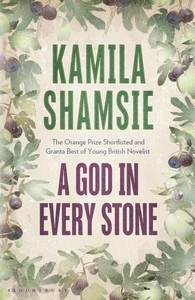
A God in Every Stone by Kamila Shamsie

A God in Every Stone When choosing what to read for this year’s #Diversiverse event, A God in Every Stone was the obvious choice as it also counts towards my Reading the Walter Scott Prize project (it was shortlisted for the 2015 prize). It’s the sixth novel by Pakistani author Kamila Shamsie, but the first one I have read.

The novel opens in July 1914 in Turkey, where twenty-two-year-old Vivian Rose Spencer is working on an archaeological dig led by Tahsin Bey, a friend of her father’s. Vivian is intrigued by tales of Scylax, the ancient Greek explorer who sailed down the Indus River from the city of Caspatyrus (now Peshawar in modern-day Pakistan) and was rewarded by King Darius I with a circlet decorated with figs. As Tahsin Bey tells her of his mission to find the legendary circlet, she finds herself falling in love with him, despite the age difference. Soon, though, she and Tahsin Bey are separated; war has broken out in Europe and Vivian must return home to serve as a VAD nurse in a London hospital.

Another thread of the novel follows a young Pashtun soldier from Peshawar, Qayyum Gul, who has been injured while fighting with the British army at Ypres in 1915. Qayyum is on his way home when he briefly meets Vivian on a train. Having been traumatised by her experiences of wartime nursing, Vivian has decided to travel to Peshawar to continue Tahsin Bey’s search for the Circlet of Scylax. In Peshawar, she gets to know a twelve-year-old boy called Najeeb and awakens in him a passion for archaeology and ancient history.

The stories of these three people – Vivian, Qayyum and Najeeb – come together again fifteen years later in 1930s Peshawar. I think I’ve said enough about the plot now, so I won’t tell you how their characters have developed in the intervening years or the circumstances that lead to their paths crossing again. What I will say, though, is that 1930 is a very significant year in the history of Peshawar, as a group known as the Khudai Khidmatgar campaign to end British rule in India through non-violent means. The novel reaches a dramatic conclusion on the Street of Storytellers during one of the defining moments of the Indian independence movement – and one that I confess to knowing nothing about before reading this book.

A God in Every Stone is an ambitious book, spanning three decades, crossing two continents and tackling some big themes, such as the rise and fall of empires and the loyalties of the people living within those empires. The settings – which include Turkish archaeological sites and the old walled city of Peshawar – are vividly described and I loved the way in which the story of Scylax was worked throughout the novel, its relevance not immediately clear but soon becoming obvious.

Although I found a lot to admire about A God in Every Stone, I still felt that there was something missing: an emotional connection to the characters. I found that the only one I really cared about was Najeeb – his innocence and enthusiasm as a twelve-year-old meant he instantly became my favourite character – but I struggled to feel anything for Qayyum and Vivian, despite the ordeals they both go through. It didn’t help that towards the end of the novel they are pushed into the background as two more characters – Zarina and her sister-in-law, Diwa – are introduced. Choosing to focus on new characters at such a late stage of the book meant that the final scenes set on the Street of Storytellers lacked the impact they should have had.

I did enjoy this book but I couldn’t help feeling that the author had tried to include too much in what is really quite a short novel. I think I would have preferred a longer book giving the characters more emotional depth and exploring the themes in more detail – or maybe a shorter book concentrating on just Vivian’s story or just Qayyum’s. Looking at other reviews of this novel, it was possibly the wrong Kamila Shamsie book for me to have started with; I’m looking forward to trying one of her earlier books and I think Burnt Shadows will be the next one I read.

Rebel Queen by Michelle Moran

Rebel Queen I love historical fiction set in India and was instantly intrigued when I saw that Michelle Moran’s new novel, Rebel Queen, was described as the story of Rani Lakshmibai who rebelled against the British by ‘raising two armies — one male, one female — and riding into battle like Joan of Arc.’ Once I started to read the book, I found that it wasn’t quite what I’d expected, although that wasn’t necessarily a bad thing. I have read two of Michelle Moran’s other novels and while I think my favourite of the three is still The Second Empress, I still enjoyed this one and thought it was much better than Cleopatra’s Daughter.

Rani Lakshmibai (or Lakshmi as she is called throughout this novel) rules the state of Jhansi along with her husband, Raja Gangadhar Rao, until his death in 1853. As the raja has died leaving no biological male heir, Jhansi is annexed by the British East India Company, and during the Indian Rebellion of 1857 the rani and her people find themselves caught up in the middle of the conflict. By the rani’s side are her ten Durgavasi – a small, elite group of highly-trained, highly-skilled women who serve as both guards and trusted friends. It is through the eyes of one of these women, Sita Bhosale, that the story of Jhansi unfolds.

Sita Bhosale grows up in a small village many miles from the city of Jhansi and, like the other village girls and women, she lives in purdah, secluded from the view of men outside her family. After her mother dies in childbirth, her father tells her that there will not be enough money to provide a dowry for both Sita and her little sister. With very few options open to a young woman who fails to marry well, he suggests that she begin training for a position in the Durga Dal, the rani’s personal guard. Following several years of hard work, Sita has learned all the skills she needs – she can ride a horse and knows how to use a sword, a pistol and a bow – and soon she is on her way to Jhansi to become the rani’s newest Durgavasi.

As our narrator, Sita is a character who is easy to like. I enjoyed watching her train for the Durga Dal, I was fascinated by her descriptions of her early days in Jhansi where everything – the rani and raja’s court, life in the palace, the absence of purdah – is new and strange, and I sympathised as she found herself the target of the raja’s beautiful, scheming cousin, Kahini, one of her fellow Durgavasi. But from the title, Rebel Queen, and the description of the novel, I had expected this to be the story of Rani Lakshmibai rather than the story of Sita. We don’t really get to know the rani at all until the second half of the novel and only a few chapters at the end are spent on the events of the Sepoy Rebellion (the promised ‘raising of armies and riding into battle’), which was disappointing.

The author assumes the reader has no prior knowledge of Indian culture or history, so she has Sita explain to us how the British East India Company came to be in India, the meanings of customs such as purdah and the Hindu caste system, and the basics of Ayurvedic medicine. While I already knew some of the things Sita tells us, there were still lots of facts and details that were new to me, so this was both an entertaining and an educational read. However, I was surprised to read that the British were flying ‘the red and black Union Jack’ from the buildings of Jhansi, and this made me wonder about the overall accuracy of the novel!

Despite the few problems I’ve mentioned, I did find this an interesting and compelling story. I do think it would have been good to have had at least part of the novel written from the rani’s perspective, but I still enjoyed getting to know Sita and the women of the Durga Dal.

Note: This book has been published in the UK as The Last Queen of India and I think the UK title and description are more appropriate, giving a better idea of what the story is about. However, I have referred to the US edition throughout this post, as this was the version I received for review through NetGalley.

The Goddess and the Thief by Essie Fox

The Goddess and the Thief “A diamond. A curse. An obsession.” These are the words on the front cover of Essie Fox’s third novel and they give us a good idea of the type of story we can expect to find inside. The Goddess and the Thief is a Victorian Gothic novel (like the previous two books by this author – The Somnambulist, which I’ve read, and Elijah’s Mermaid, which I haven’t) and combines a complex plot with an atmospheric setting and a sense of mystery.

The novel begins in colonial India, where a little girl called Alice Willoughby is growing up in the care of her beloved ayah, Mini, having lost her mother in childbirth. Alice loves India – she loves the warmth, the vivid colours, the stories Mini tells of Parvati and Shiva – and is heartbroken when her father decides to take her back to England to live with her Aunt Mercy. Alice is lonely and miserable in her new home and finds Mercy cold and uncaring. Things become even worse when she discovers that her aunt is a medium and that she will be forced to take part in Mercy’s fraudulent séances and other spiritualist activities.

Alice’s life reaches another turning point when she and Mercy meet the mysterious Lucian Tilsbury, a man who has recently returned from India and is planning to involve the two women in an elaborate scheme…a scheme revolving around the Koh-i-Noor diamond, the famous jewel claimed by the British at the end of the Anglo-Sikh war. Some say the diamond is cursed and others that it is blessed, but one thing that is certain is that it exerts a strange power over everyone who comes into contact with it.

You may be thinking that this sounds like The Moonstone, but while there are some similarities with the Wilkie Collins mystery, this is a very different book and the story surrounding the diamond took some surprising twists and turns which I definitely wasn’t expecting! I was particularly intrigued by the occasional appearances of Queen Victoria and the Maharajah Duleep Singh, two people for whom the Koh-i-Noor has a very important significance.

The scenes set in India at the beginning of the book were among my favourites and I was sorry when we left India behind for the gloom of Aunt Mercy’s house in Windsor. The mood of the novel then becomes increasingly dark and oppressive and I was pleased that tales of the Hindu gods and of Alice’s life in Lahore continued to be woven into the plot. I liked Alice as a central character and enjoyed following her adventures, while also feeling afraid and worried for her as she found herself betrayed, badly treated and unsure of whom to trust.

My only problem with The Goddess and the Thief was that there were certain passages which I found confusing and difficult to follow, partly because the use of opium played a role in the story, which meant that the boundaries between reality and unreality often became blurred. I appreciate that this was done intentionally, to make Alice’s situation even more frightening, but it was the one aspect of the novel that didn’t work very well for me. Of course, it could have been my own fault for not concentrating hard enough!

Having enjoyed both this book and The Somnambulist (this one slightly more than the first, I think), I will have to read Elijah’s Mermaid soon!

Sea of Poppies by Amitav Ghosh

Sea of Poppies Sea of Poppies is the first book in the Ibis Trilogy by Amitav Ghosh and introduces us to a large and diverse cast of memorable characters who are thrown together on a voyage from India to Mauritius aboard a former slaving ship, the Ibis. Set in the 1830s just before the First Opium War, this is a long, detailed novel (and also quite a challenging one due to the various styles of dialogue and language Ghosh uses) but once I became familiar with the characters and their stories I found myself enjoying it more and more.

Each of the novel’s main characters comes from a different background and a different set of circumstances has led to each one being on board the Ibis, whether as a migrant, a prisoner or a member of the crew. Inevitably I found some of the characters more interesting than others; I was particularly intrigued by Neel Rattan Halder, the Raja of Raskhali, who is arrested for forgery and dispossessed of his lands, by Deeti, widowed after her husband succumbs to his opium addiction, and by Paulette Lambert, the orphaned daughter of a French botanist. These three people and many others are brought into the story one by one, but eventually their paths meet as the Ibis prepares to set sail for Mauritius.

I’m not really a big fan of novels set on ships (Patrick O’Brian’s Aubrey-Maturin series is one of the few exceptions) so I was pleased to find that there are plenty of land-based sections in this one too. The descriptions of India are colourful and vivid throughout the novel, but the scene that sticks most in my mind is one from the beginning of the book which describes Deeti’s visit to the opium factory where her husband works. The author doesn’t shy away from showing us the horrors of opium addiction and withdrawal, as well as the health problems suffered by those who had to work with the drug and the trouble caused by so much land having to be devoted to poppy growth rather than other crops which could be eaten as food.

I’ve already mentioned that Amitav Ghosh uses language in some unusual ways in this novel, so I’ll try to explain what I mean. As well as Bengali and Hindi words being scattered throughout the pages, the Indian sailors (known as Lascars) have their own terminology, one of them (Serang Ali) speaks a form of pidgin English to communicate with the American second mate, Zachary Reid, while the European characters also draw on a stock of words and slang terms taken from various different languages. As you can imagine, when characters from different cultures are speaking to each other, things often become very complicated! A glossary would have made reading this book a lot easier, but unfortunately there wasn’t one (at least not in the edition that I read) so I just had to struggle along and console myself with the knowledge that sometimes the characters in the book were just as confused as I was!

Sea of Poppies was a fascinating read, but I was left with the feeling that it wasn’t a complete novel in itself – it finishes on a cliffhanger and with so many loose ends that reading the second book in the trilogy really is essential if you want to know what happens to the characters you’ve come to know and care about. I started River of Smoke immediately after finishing this one!

Death in Kashmir by M. M. Kaye

Death in Kashmir I have always thought of M. M. Kaye as an author of historical novels (such as the wonderful Far Pavilions) and although I was vaguely aware that she had also written a series of mystery novels, I had never really thought about reading them. Now that I’ve read the first one, Death in Kashmir, I will certainly be reading the others. What a great book this is!

Death in Kashmir was first published in 1953, but set a few years earlier in 1947, just as India is about to gain independence from Britain. Our heroine, Sarah Parrish, is attending what will probably be the final meeting of the Ski Club of India at Gulmarg, a resort in the mountains of Kashmir. Sarah is hoping for an enjoyable, relaxing holiday but the first sign of trouble ahead comes when another skier has a fatal accident on the slopes. Another death soon follows the first, but this time, the victim – a young woman called Janet Rushton – was able to share an important secret with Sarah before she died.

Sarah is now certain that neither death was accidental but all she wants is to leave Gulmarg and its secrets behind her and have nothing more to do with the whole business. When the skiing party breaks up she visits her aunt in Peshawar and tries to forget what she has learned. Soon, though, her promise to Janet pulls her back to Kashmir where she finds herself caught up in the mission her friend was working on before her death – and this time, Sarah’s own life could be in danger.

I loved this book from the very beginning. It’s so important that a first chapter pulls you straight into the story and this one did, right from the opening line – “Afterwards Sarah could never be quite sure whether it was the moonlight or that soft, furtive sound that had awakened her”. The rest of the story was equally engrossing: a perfect mixture of mystery, suspense, romance and espionage.

The descriptions of Kashmir are stunning. The first part of the book is set in winter on the snow-covered mountain trails of Gulmarg and later the action moves to the Dal Lake in the summer resort of Srinagar where Sarah takes over the lease on a houseboat that once belonged to Janet. Both of these locations are described beautifully, but Kaye also chooses just the right words and images to create a genuinely eerie and unsettling atmosphere. I found myself literally holding my breath as Sarah wondered who was standing outside the ski lodge in the dark, as she watched an unknown figure disappearing up a staircase and as she listened to footsteps on the boards of her houseboat in the night.

What makes Sarah’s situation even more dangerous is that she’s sure the enemy must be one of the group of skiers who were gathered at Gulmarg – the same group who are all now spending the summer in Srinagar. Who should she trust? The hostile Helen Warrender who makes no secret of her dislike for Sarah? The jovial, good-natured Hugo and his long-suffering wife, Fudge? Timid Meril Forbes and her domineering aunt? Or the handsome, polo-playing Captain Charles Mallory? When the villain was eventually revealed it didn’t come as a complete surprise – but I have to admit I had suspected almost everybody at some point, so one of my guesses was bound to be right!

The book is also interesting from the historical viewpoint, being set just before the end of the British Raj and the transfer of powers back to India. Through the stories of Sarah and the rest of the British community in Kashmir, I thought Kaye had perfectly captured the mood of a group of people who knew that their way of life was about to change forever.

I’m now looking forward to reading the other five Death In… mysteries. I just need to decide which one to read next!