Zemindar by Valerie Fitzgerald

Zemindar What a great book! A wonderful setting, a beautiful romance, characters I really cared about, an exciting story and lots of fascinating historical detail…definitely one of my favourite books of the year. I could see the influence of other books that I love – The Far Pavilions, Gone with the Wind and Jane Eyre – so it’s maybe not surprising that I loved this one too!

Zemindar is set in India before and during the Sepoy Mutiny of 1857. Laura Hewitt, a single woman of twenty-four, is accompanying her newly married cousin Emily and her husband Charles Flood on a trip to India as Emily, at eighteen, is considered too young to travel without another female in the party. Laura is happy to accept the position of paid companion – her parents are both dead and she has no money of her own – but she is also aware that it may not be a good idea to be in such close proximity to Charles, whom she had been in love with herself before he turned his attentions to the younger, prettier Emily.

After a brief stay in Calcutta, Laura and the Floods travel to Lucknow where Charles is planning to make the acquaintance of his half-brother Oliver Erskine who lives a few days’ journey away on the estate of Hassanganj. Charles and Oliver have never met but knowing that his brother is unmarried and seems likely to remain that way, Charles hopes to convince Oliver to make him his heir. On arriving at Hassanganj, however, it quickly becomes obvious that this will not be an easy task. As a zemindar (hereditary landowner), Oliver has been used to leading an unconventional lifestyle on his huge and isolated estate and is not the sort of man who can be made to do anything he doesn’t want to do!

Laura and Emily are both fascinated by Oliver Erskine, though while he shows nothing but kindness to Emily, Laura finds him arrogant and annoying. But when mutiny breaks out among the Indian sepoys in the army and Hassanganj comes under attack, she begins to see a different side to Oliver. Taking refuge in the Residency in Lucknow where the British army is preparing to withstand a siege, Laura must decide how she really feels about Oliver and whether she can see a future for herself in India. First, though, she needs to stay alive…

There are so many things I loved about this book it’s difficult to know what to focus on first, but I think I should start by praising Valerie Fitzgerald’s beautiful writing. Zemindar was published in 1981, but I almost felt I was reading something written by Jane Austen or Charlotte Brontë. Laura’s story is told in the first person and her narrative voice sounds exactly as the voice of a 19th century woman should sound. The descriptions of India – the landscape, the culture, the contrast between life in the British colonial communities and the mofussil (the rural areas) – are stunning too.

The story takes place during a turbulent time in the history of British India, but don’t expect this to be a fast-paced novel – some parts are very slow allowing time for character development and fleshing out of the historical background. No previous knowledge is needed as we have the opportunity to learn along with Laura as the events leading up to the Indian Rebellion unfold. Later in the book, when the British begin to crowd into the poorly-fortified Residency for safety there are some quite graphic descriptions of the brutality and atrocities committed by both sides as Lucknow finds itself under siege and tales of even greater horrors suffered by those in Cawnpore reach Laura’s ears. Obviously we are seeing things from a British perspective but there’s some sympathy for the Indian point of view as well; having spent most of his life at Hassanganj, Oliver understands India and its people in a way that most of the other characters don’t and he tries to pass this understanding on to Laura.

The relationship between Laura and Oliver is a lovely and poignant one which takes its time to develop and is not without its difficulties and misunderstandings. At times it reminded me of the romance in Gone with the Wind, though while Oliver is similar in some ways to Rhett Butler, the quiet, sensible Laura is more like Jane Eyre than Scarlett O’Hara. Because I liked Laura and Oliver so much I was completely absorbed in their story and hoping for a happy ending for them both – it was not at all obvious whether they were going to get one so I was kept in suspense right to the end!

I hoped I’ve made it clear, though, that this book is not a fluffy romance or a silly bodice ripper. The romance is only one element of the story and is sometimes pushed into the background while we concentrate on the history, the battles and the sieges. My only disappointment on reaching the end of the book was discovering that Zemindar was Valerie Fitzgerald’s only novel. I know M.M. Kaye’s Shadow of the Moon is set during the same period so I’m hoping to read that one soon and see how it compares.
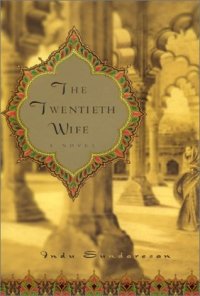
The Twentieth Wife by Indu Sundaresan

The Twentieth Wife This story of seventeenth century Mughal India is the first in a trilogy of novels describing the history behind the construction of the Taj Mahal. In The Twentieth Wife, Indian author Indu Sundaresan introduces us to Mehrunissa, later known as the Empress Nur Jahan. The Taj Mahal was actually built in memory of Nur Jahan’s niece, but that part of the story must be told in the other two books of the trilogy as this one concentrates on the tale of Mehrunissa and her love for Prince Salim, the future Emperor Jahangir.

Born to Persian refugees who are fleeing their country, Mehrunissa is abandoned by her impoverished father, Ghias Beg, on the road to India because with no money, no job and no home, he fears that he and his wife will be unable to take care of her. Luckily, fate steps in and Mehrunissa is rescued by the merchant, Malik, who befriends her parents and helps Ghias Beg find a position at the court of the Emperor Akbar. Growing up at court, Mehrunissa is taken under the wing of Akbar’s favourite wife, Ruqayya, and spends a lot of time in the zenana (harem) listening to gossip and witnessing the rivalries between the Emperor’s other wives and concubines.

Mehrunissa is only eight years old when she has her first glimpse of Prince Salim, who is marrying his first wife. That first glimpse is enough for her to make up her mind that one day she too will marry Salim and become Empress. When Salim falls in love with her several years later, it seems that Mehrunissa’s wish could come true…but of course, things don’t go exactly as planned! The Twentieth Wife follows Mehrunissa and Salim (or Jahangir as he becomes known) through years of separation, unhappy marriages and political intrigue. Do they eventually marry? Well, the title of the novel gives us a big clue so there are no surprises there, but the path that leads to Mehrunissa becoming Jahangir’s twentieth wife is a long and eventful one, and you can expect plenty of drama along the way: rebellions, assassination attempts and the scheming of Mehrunissa’s rival, Jagat Gosini.

I found a lot to like in this novel, but not everything worked for me. My biggest problem was that with the romance between Mehrunissa and Jahangir forming such a central part of the story, I didn’t find that romance convincing enough. I struggled to see the attraction of Jahangir during the first half of the novel. He was an alcoholic and an opium addict, too easily influenced by unscrupulous advisers and was even plotting to have his father murdered. He started to redeem himself later in the book, but is still not high on my list of favourite romantic heroes!

As for Mehrunissa, I found it difficult to accept that she could fall so passionately in love at the age of eight with a man she didn’t even know and that her love for him could continue into her adult life despite only meeting him once or twice more in all that time. I got the impression that she just wanted to marry him because he was a prince rather than who he was as a person and I didn’t start to really believe in their romance until near the end of the book.

I did like the way Sundaresan writes about India. The Twentieth Wife is a very descriptive book: the clothes, the buildings and gardens, the food and drink, the traditions and rituals of court and the zenana are all described in vivid detail. I do enjoy reading historical fiction novels set in India, though I’m sorry to say that most of the others I’ve read were written by non-Indian authors (M.M. Kaye’s The Far Pavilions is my favourite). I wasn’t aware of Indu Sundaresan until I saw The Twentieth Wife listed as one of Aarti’s suggestions for A More Diverse Universe and I’m pleased I decided to give it a chance. I’m not sure I like this book enough to want to continue with the sequel, but it was good to have learned a little bit about a period of Indian history I knew nothing about. While I didn’t love this particular book I would still be happy to try one of Sundaresan’s others outside of the Taj Mahal trilogy.

amdubanner-col2

This was my second read for A More Diverse Universe hosted by BookLust.

The Midnight Rose by Lucinda Riley

The Midnight Rose Anahita (Anni) Chavan’s whole family are gathering at her hill-top bungalow in Darjeeling to celebrate her one-hundredth birthday, but even surrounded by her children, grandchildren and great-grandchildren, there is still one person missing. This is Moh, her beloved son, whom she has not seen since he was a small child. Everyone believes him to be dead…everyone except Anni who is sure that he is still alive somewhere in the world. A year later Anni herself has died, but before her death she had written down her story and entrusted it to her favourite great-grandson, Ari Malik, in the hope that he would try to find out what happened to her missing son.

Anni’s story leads Ari to Astbury Hall in England, where filming is currently taking place for a new period drama set in the 1920s starring the beautiful young American actress, Rebecca Bradley. When Lord Astbury invites her to stay at the Hall for the duration of the filming as a safe haven away from the world’s press, Rebecca gratefully accepts, hoping that the peace and quiet will give her a chance to decide what to do about her equally famous actor boyfriend, Jack, who has just proposed to her.

Soon Rebecca is drawn into Ari’s search for the truth about Anahita’s past and as her tragic story unfolds, we are taken back to India in 1911, where as a young girl Anni becomes friendly with Princess Indira, the daughter of the Maharaja and Maharani of Cooch Behar. She and Indira are sent to school in England just before the beginning of the Great War, and while staying with family friends at Astbury Hall in Devon the relationship Anni forms with Donald Astbury changes her life forever.

This is the third Lucinda Riley novel I’ve read (the other two were The Girl on the Cliff and The Light Behind the Window – I still need to read Hothouse Flower) and it’s my favourite of the three. Although there were times when I found the plot easy to predict and a few coincidences that felt too implausible, there were enough unexpected twists to keep me in suspense wondering what was going to happen next. I particularly loved the parts of the book set in India during the British Raj and also the insights into what life was like for a young woman trying to find a place for herself in a new and unfamiliar country.

Sometimes when a book is set in multiple time periods, the different threads of the story can feel disjointed and unconnected, but that was not the case here. They came together perfectly, with the secrets of Astbury Hall being slowly revealed as Ari and Rebecca discover them. As usual, though, I found myself enjoying the historical sections of the book more than the contemporary ones. The modern day characters do have storylines of their own – Rebecca’s troubled relationship with her boyfriend and Ari’s struggle to find the right balance between his work and his personal life – but they didn’t interest me as much as Anni’s. I thought Lucinda Riley’s writing really came alive in the sections about Anni – the dialogue felt vibrant and the characters were strong and memorable, especially Anni herself, her best friend Indira, and Donald’s cruel and manipulative mother, Maud Astbury, the villain of the book.

The Midnight Rose is a long novel (650 pages – and it’s one of those books that is physically big and heavy too) but once I became swept up into the story I stopped thinking about the number of pages and concentrated on enjoying Anahita Chavan’s fascinating tale.

I received a copy of this book from Pan Macmillan for review

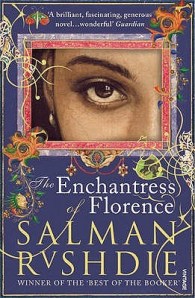
The Enchantress of Florence by Salman Rushdie

A More Diverse Universe I’ve never read anything by Salman Rushdie before and have always felt slightly intimidated by him, but when I was looking for something to read for the A More Diverse Universe blog tour (hosted by Aarti of Booklust) I came across this title on Aarti’s list of suggestions and thought it sounded intriguing.

The Enchantress of Florence is a very imaginative mixture of history and fantasy, with a plot that is almost impossible to describe – though I’ll do my best! The story begins in 16th century India when a mysterious yellow-haired stranger calling himself the Mogor dell’Amore arrives by bullock-cart at the court of the Emperor Akbar in Sikri. Claiming to be related to Akbar, he begins to tell the Emperor the story of the lost Mughal princess, Qara Köz, or Lady Black Eyes, who is captured and after a series of adventures ends up in Florence where she falls in love with the soldier Antonino Argalia. Qara Köz is the enchantress of the title, believed to have powers of sorcery, as well as great beauty, and the entire city of Florence becomes captivated by her presence. In a separate, but connected, storyline we also learn of Argalia’s childhood, growing up in Florence with his friends Ago Vespucci and Il Machia (Niccolò Machiavelli). Will Akbar believe the stories he is told and what effect will they have on the Emperor and his court?

The Enchantress of Florence There are lots of themes and ideas in The Enchantress of Florence and I’m sure I didn’t fully understand all of them. However, one of the main themes, to me, seems to be the power and the magic of storytelling. The novel is made up of lots of separate interlocking stories, not just the three main ones I’ve mentioned above. One character will begin to tell a story and then a character within that story will begin to tell another story and so on, until you almost begin to forget who the original storyteller was and who the listeners are. These stories may or may not be true and all of them are rich in magical realism – we meet the emperor’s favourite wife Jodha, for example, who is imaginary but also seems to have a life of her own; a slave girl who has become a ‘Memory Palace’ (or a device to aid the memory); and an artist hiding inside one of his own paintings.

The fantasy elements and the abundance of princesses, emperors, giants and witches gives the book a fairy tale feel (I was reminded of The Arabian Nights) and there are beautiful, lavish descriptions of both Mughal India and Renaissance Florence, two settings which are very different but also surprisingly alike. I did enjoy this book, especially the sections set in India, and I thought it was beautifully written, but I did find it very complicated and difficult to follow and I think I would probably have needed to read it twice to be able to really appreciate it. People often talk about books having multiple layers, and that’s usually a good thing, but this one has so many layers I was a bit overwhelmed!

I won’t be immediately rushing out to buy the rest of Salman Rushdie’s books but I’m glad I chose to read this one – it was a challenge, but worth the effort, I think.

The Sea Change by Joanna Rossiter

The Sea Change The Sea Change is a novel about many things: love and grief, friendship and betrayal, the devastation caused by war and natural disasters, but perhaps most importantly, the relationships between mothers and daughters.

Violet Fielding lives with her parents and her sister, Freda, in a small Wiltshire village called Imber. In the middle of the Second World War the residents of Imber are forced to evacuate, leaving the village to be requisitioned by army troops and used for military training exercises. As Violet tries to settle into a new life in a new home, she is unable to forget Imber, her childhood friends and Pete, the boy she fell in love with.

Many years later in 1971, Violet’s daughter, Alice, is travelling to India with her boyfriend, James. Alice was not on good terms with Violet when they parted; her mother disapproves of James and isn’t very happy about Alice going so far away. When they reach India, Alice and James get married, but the day after their wedding the coast of India is hit by a tsunami and Alice is separated from her new husband, who had gone out to get breakfast. As she begins to search for him – an almost impossible task, given the scale of the disaster and the number of people who are missing – Alice reflects on her life with James and thinks about what went wrong in her relationship with her mother.

The Sea Change is one of those dual time period novels I’ve complained about so much in the past, but I thought the structure worked quite well in this case. Although the two stories are set in different times and places, I could see parallels between them – in both there is a sense of loss and grief for things and people that are gone forever. I never managed to become as interested in Alice’s story as I was in Violet’s, but I did love the way the two storylines began to merge together towards the end.

I’ve read a lot of books about the war but none that have dealt with this particular aspect: the idea of an entire village that has been abandoned and the effects of this on the people who once lived there. It was so sad to read about a whole community being broken up and forced into a different way of life. The fact that Imber is a real place, still uninhabited today, makes the story even more moving. Alice’s story was also something new for me; I’ve seen images on the news, of course, showing the destruction a tidal wave can cause, but it’s not something I’ve ever read about in fiction.

There are some books that grab me from the first page and don’t let go until the end; other books are gentler and draw me in more slowly. This was one of the second type but that doesn’t mean I liked it any less. The Sea Change is a beautifully written book, filled with emotion and poignancy and a real understanding of complex relationships. There are some beautiful descriptions too, of both England and India. I would never have guessed this was Joanna Rossiter’s first novel as it feels like the work of a much more experienced author! I’m looking forward to seeing what she writes next.

Thanks to Penguin for providing a review copy of this book.

The Sandalwood Tree by Elle Newmark

This is my first book for the Transworld Book Group. I was immediately drawn to The Sandalwood Tree as I love historical fiction set in India – and I’m pleased to say that it didn’t disappoint me at all.

This novel consists of two storylines, both of which take place during an important period of India’s history. In 1947 we meet an American woman, Evie Mitchell, who has moved to India with her husband, Martin, and five-year-old son Billy. Martin, a historian, is planning to study the end of British rule and the process of Partition (the separation of Hindus and Muslims which led to the creation of Pakistan). As the Mitchells try to settle into their new life it becomes obvious that there are big problems in their marriage. Martin, who served in the US army during World War II, is still haunted by some of the things he experienced in Germany and is suffering from what we might now call post-traumatic stress disorder.

Soon after moving into their new house in the village of Masoorla, Evie discovers some old letters hidden behind a loose brick in the wall. The letters were written by two British women, Felicity Chadwick and Adela Winfield, who lived in the same house during the 1850s – a time of rising tension between the British and Indian people, leading to the Sepoy Rebellion of 1857. Evie is intrigued and begins to search for more information about the two Victorian women. As she slowly uncovers Felicity and Adela’s story through a series of letters, diaries and historical documents, she starts to see some similarities between her own life and theirs.

Elle Newmark’s descriptions of India are filled with colour and detail. Whether she’s writing about the food prepared by Habib, the Mitchells’ cook, a monkey swinging from the branches of a tree, or a perfume stall at the bazaar, her images really help to bring the book’s setting to life. Because most of the story is told from Evie’s perspective and she is new to India, seeing everything for the first time, we can experience all the sights, sounds and smells along with her. We also share Evie’s fascination with Adela and Felicity and we feel her frustration every time she attempts to address the problems with her marriage.

Reading The Sandalwood Tree is an excellent way to learn about India’s history and culture and Elle Newmark makes everything easy to understand. But it’s also a great story with a beautiful setting, fascinating plot and complex characters who grow and change over the course of the novel. The transitions between the two periods are handled perfectly, moving smoothly from Evie’s story to Felicity and Adela’s, and it was interesting to see the parallels and connections between them. I found I enjoyed both storylines equally – each one would have been strong enough to form a complete novel on its own, but it’s the way the two are interwoven that makes this book special.

Review: In a Far Country by Linda Holeman

Linda Holeman really deserves to be better known. Her books seem to be difficult to find outside the UK and Canada which is sad because she’s such a good writer. Last year I read The Moonlit Cage and enjoyed it so much I couldn’t wait to read another of her historical fiction novels. In a Far Country is part of a trilogy with The Linnet Bird and The Moonlit Cage, but they are all stand-alone books and can be read in any order.

In a Far Country is set in British-ruled India in the late 19th century and tells the story of Pree Fincastle, the daughter of two British missionaries living on an isolated mission near Lahore. Left alone and penniless after her parents’ tragic deaths, Pree sets off to look for her childhood friend, Kai, the only person she can turn to for help.

I found this book difficult to get into at first. Holeman spent a lot of time setting the scene and introducing us to Pree and her parents, so that the story didn’t really begin until around 150 pages into the book. From this point onwards, though, the pace picked up and I was hooked. I really liked the character of Pree. Since the book is told in the first person from her point of view, we get to experience all her emotions as she grows up at the lonely, impoverished mission house and as her life is turned upside down by the deaths of her parents.

The only criticism I have of both this book and The Moonlit Cage is that I just don’t feel enough connection to the male characters. I think Linda Holeman writes female characters much better than she does male. I found that Kai remained cold and aloof throughout the entire book and considering Pree loved and trusted him enough to turn to him when she was in trouble, I didn’t feel much warmth, passion or humour coming from him at all. This was almost exactly the same reaction I had to David Ingram in The Moonlit Cage.

However, one of Holeman’s strengths is in her wonderfully evocative and colourful descriptions of the places she’s writing about. She chooses just the right words to convey the sights, sounds and smells of India. If you had never read a book set in India before, this would probably be a good introduction.

Despite the length of this book, it was surprisingly quick to read. Perfect if you’re looking for a big, heartbreaking historical fiction novel to lose yourself in for a few days.

Highly Recommended

Genre: Historical Fiction/Pages: 640/Publisher: Headline Review/Year: 2008/Source: My own copy bought used