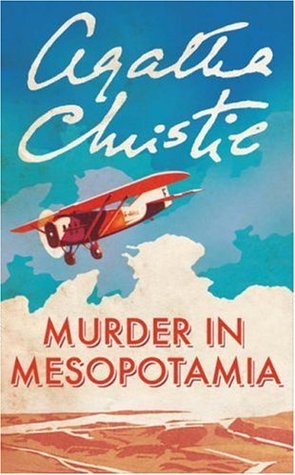
 This is the second book I’ve read for the 1936 Club (hosted by Karen and Simon) and an obvious one for me as I’m also taking part in Read Christie 2021 this year. The monthly prompt for Read Christie is ‘a story set before WWII’, which makes Murder in Mesopotamia, published in 1936, the perfect choice!
Murder in Mesopotamia is a Poirot mystery and one of several to feature a first person narrator – usually Captain Hastings, but in this case Nurse Amy Leatheran. At the beginning of the novel she agrees to travel to the site of an archaeological dig near Hassanieh in Iraq to nurse the wife of the expedition leader, Dr Leidner. Louise Leidner is being blamed by some of the other archaeologists for causing tension on this year’s dig, but when Nurse Leatheran arrives at the site what she finds is a nervous, frightened woman who claims to be receiving threatening letters from a former husband. A few days later, Louise is found dead in her bedroom, having been hit on the head by a blunt object. It seems impossible that a stranger could have entered the site without being seen, therefore the murderer must be someone on the dig…but who?
When I first began to read, I couldn’t help making comparisons with They Came to Baghdad, one of my favourite Christie novels, which features lots of colourful descriptions of Iraq. The sense of place in this one isn’t quite as strong – and in fact, we see very little of Iraq beyond the confines of the dig site – but there’s still plenty of atmosphere. The descriptions we do get of the dig and the various roles of the members of the expedition are fascinating and feel authentic, which is to be expected as Christie herself was married to an archaeologist, Max Mallowan, and often accompanied him on digs. Not only could she draw on her own personal knowledge and experience in the writing of this novel, she also apparently based some of the characters on people she knew.
Nurse Leatheran is a very opinionated narrator who doesn’t hold back on her views of ‘Foreigners’ (including Poirot), but apart from that I quite enjoyed her narration. We get to know the other participants in the dig through her eyes and, because she is an outsider, meeting all of these people for the first time, we can never be completely sure whether or not she is giving us an accurate impression of them. Poirot himself appears halfway through the novel, conveniently passing through Hassanieh after working on a case in Syria – and we are told that a week later, after solving this mystery, he will go on to investigate the Murder on the Orient Express.
As usual, I didn’t manage to solve the mystery myself. I came up with a few theories, but none of them were correct, which isn’t surprising as the final solution is so far-fetched I don’t think I would ever have thought of it! The method by which the murder is carried out seems unlikely, if not impossible, but the motive relies on us accepting something which I found impossible to believe. Still, this was an entertaining read and another great 1936 book.


 She Reads Novels