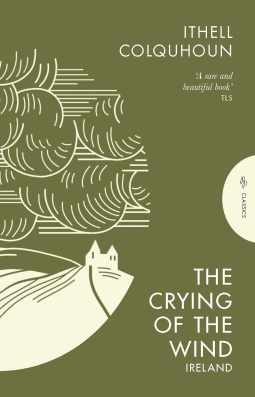
The Crying of the Wind: Ireland by Ithell Colquhoun

Ithell Colquhoun was a completely new name for me when I spotted this book on NetGalley recently, but I know now that she was a prominent British surrealist painter in the 1930-40s, as well as an occultist, poet and author of both fiction and non-fiction. The Crying of the Wind, originally published in 1955, describes her travels around Ireland and her impressions of the people she meets and places she visits. It’s the first of three travel books she wrote, with a book on Cornwall following in 1957 and then one on Egypt which has never been published.

Colquhoun bases herself near the village of Lucan on the River Liffey, to the west of Dublin. In each chapter, she sets out on a walk or an excursion by car to visit different parts of Ireland, including Glendalough, Connemara and Cashel. The structure seems a bit haphazard, with no real order or pattern to the places she visits, and the book definitely has the feel of a personal journal rather than something you could use to plan out your own travels. It’s an interesting book, though, and I did enjoy reading it. The descriptive writing is beautiful at times, as you would expect from a book written by a painter; here she describes the approach to Connemara’s Twelve Bens mountain range:

Across miles of mulberrydark bogland we drove towards them, the tawny of king ferns lining the ditches that bordered the road. Air of a wonderful transparency arched above us, blue washed with white gold. I did not regret our slow pace, enforced by the pot-holes in the road, since I could watch the mountains from gradually shifting angles.

Although Colquhoun includes some anecdotes about her encounters with Irish people, the way they live and the conversations she has with them, the main focus of her writing is on the beauty of the natural environment and on places of historical interest such as old churches, holy wells and remains of ancient forts and towers. She often laments the rate of progress and its effect on the natural world; when walking in the countryside, she is very aware of the noise of traffic on busy roads nearby and the sights of new housing developments and factory chimneys altering the landscape forever.

With her interest in the occult, Colquhoun spends a lot of time discussing the myths, legends and folklore of each place she visits. She believes in ghosts, spirits and supernatural beings and accepts their existence in a very matter-of-fact way.

Their forms vary; a friend described one she had seen on some downs in Dorsetshire as being ‘the size of a haystack, opaque but fluid at the edges, moving very quickly’; another is sometimes seen like a tower racing over wide sands on the north coast of Cornwall. I have myself seen in Cornwall one like a massive pillar of unknown substance, with filaments stretched from the top seemingly to hold it to the ground like the guy-ropes of a tent.

The Crying of the Wind is an unusual travel book, then, and also a fascinating one. I’ll look forward to reading her Cornwall book, The Living Stones, which is also available in a new edition from Pushkin Press.

Thanks to Pushkin Press Classics for providing a copy of this book for review via NetGalley.
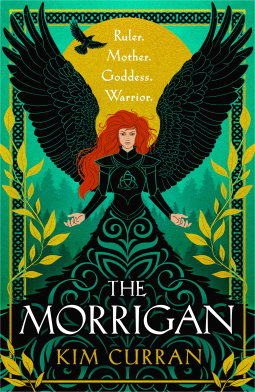
The Morrigan by Kim Curran – #ReadingIrelandMonth25

Trying to tell my story is like trying to hold the smoke of a forest fire in your hands or force an ocean into a cup. I resist. I re-form. How could they succeed when even I didn’t know who I was from one moment to another?

There have been so many Greek mythology retellings recently, it came as a nice surprise to see that this new novel by Kim Curran takes as its subject not another Greek goddess, but an Irish one. In Irish mythology, the Morrigan is known as the goddess of war and fate, a fierce, shapeshifting figure who leads warriors into battle and can foretell whether they will live or die. She is sometimes known as Badb, sometimes as Macha and sometimes as Nemain and often believed to be all three. In The Morrigan, Kim Curran sets out to tell her story.

The novel begins with the Tuatha Dé Danann, the supernatural race to which the Morrigan belongs, returning to Ireland having spent many generations ‘in the north of the world learning arts and magic’. Soon after their arrival, they defeat the Fir Bolg in battle to reclaim Ireland for themselves, only to be defeated in turn by the invading Milesians, who drive them underground. Rather than stay beneath the earth with her own people, the Morrigan goes out into the world where she discovers that even the power of a goddess is limited in a land ruled by men.

The Morrigan is beautifully written and as a debut novel, I thought it was very impressive. Having very little knowledge of Irish mythology, I found it fascinating and particularly enjoyed the first section about the Tuatha Dé Danann, where the writing style, together with the shapeshifting, magical beings and epic battles, makes it feel like a high fantasy novel. The later stages of the book are based on the Ulster Cycle – with the Morrigan crossing paths with Medb, Queen of Connacht; Conchobar, King of Ulaid; and the legendary warrior Cúchulainn – and feel slightly more grounded in reality, but less captivating for me personally. I did love the way Curran incorporates all of the Morrigan’s three parts into the novel, moving seamlessly from Badb to Macha to Nemain, showing how her personality and actions change as she takes on each persona, while at the same time retaining memories of her previous lives and experiences.

However, there was so much happening in this book that I started to feel overwhelmed. There seemed to be no real direction to the plot and it felt like a string of short stories and separate episodes rather than one cohesive narrative. I think there was easily enough material here for a trilogy, rather than trying to pack everything into a single book. Maybe readers more familiar with Irish myth and legend would have found it all easier to follow than I did, but as a newcomer it was just too much for me to process all at once.

I would still highly recommend this book to anyone interested in sampling some Irish mythology – or anyone with existing knowledge who wants to see how Kim Curran approaches the subject. It has certainly left me wanting to look into some of the stories and characters in more depth and wishing more authors would move away from Greek mythology to explore other parts of the world!

Thanks to Michael Joseph for providing a copy of this book for review via NetGalley.
As this book is set in ancient Ireland and the author Kim Curran was born in Dublin, I am contributing this review to #ReadingIrelandMonth25 hosted by Cathy of 746 Books.

The Ballad of Lord Edward and Citizen Small by Neil Jordan

March is Reading Ireland Month, hosted by Cathy at 746 Books, so I looked at my unread books by Irish authors and decided on this one, The Ballad of Lord Edward and Citizen Small. Neil Jordan is better known as a film director (his directing credits include Interview with the Vampire and The Company of Wolves) but has also written several novels and short story collections. This is the first of his books that I’ve read.

The Lord Edward of the title is a real person – Lord Edward Fitzgerald, an 18th century Irish aristocrat and revolutionary. His life has been well documented but little is known about his relationship with his servant, Tony Small. At the beginning of the novel, Fitzgerald is fighting for the British Army in the American Revolution when he is wounded at the Battle of Eutaw Springs in September 1781. Small, an escaped slave, rescues him from the battlefield and saves his life, and in return Fitzgerald frees him from slavery. Small then chooses to remain in Fitzgerald’s service when he leaves America and travels first to London, then home to Dublin, and later to France.

As time goes by, Small becomes Fitzgerald’s constant companion and close friend, but never loses sight of the fact that he is a servant and their racial and class differences mean that society will never consider him the equal of his lord. While Fitzgerald enters into a romantic liaison with Elizabeth Sheridan, wife of the famous playwright Richard Sheridan, before becoming involved in revolutionary politics and working towards an independent Irish republic, Small gets to know the other servants in the grand houses they reside in and takes steps to learn about his own heritage.

This could have been a great novel – it covers a period of Irish history not written about very often and seeing things through the eyes of a former slave provides an interesting perspective – but I didn’t like the writing style at all. I have no idea why it seems to have become the fashion for authors to ignore conventional punctuation, in this case speech marks. I found it very difficult to tell where the dialogue began and ended or who was speaking to whom and I had to keep going back to read the same sections more than once before I could follow what was being said. Punctuation was invented to help the reader; choosing not to use it just makes things unnecessarily confusing.

I do appreciate having had the opportunity to learn about the life of Lord Edward Fitzgerald and the significance of Tony Small and there were some parts of the book that I enjoyed. It was interesting to see other well known historical figures such as Richard Sheridan and Thomas Paine making appearances in the story and I loved the way Jordan showed Small developing a passion for theatre and literature (obviously two passions of Jordan’s own). However, the book felt uneven, with too much time spent on some episodes and not enough on others – the last few months of Fitzgerald’s life seemed particularly rushed.

I had mixed feelings about this one, then, and I’m not sure whether I would read anything else by Neil Jordan, but I’m pleased I managed to fit in a Reading Ireland book this month, as well as the Welsh ones I’ve read for Reading Wales!

Book 14/50 for the Historical Fiction Reading Challenge 2024

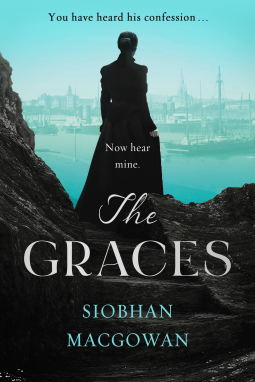
The Graces by Siobhan MacGowan

I found Siobhan MacGowan’s first novel, The Trial of Lotta Rae, a very powerful, emotional read and I was hoping for something similar from her new book, The Graces. I’m pleased to say that I thought this one was even better.

The novel opens on an August evening in 1918, as a group of pilgrims make their way to the bell tower of Mount St Kilian Abbey in Dublin. As Brother Thomas and Father Sheridan watch the candlelit procession weaving through the trees below the abbey, they remember the woman to whom the pilgrims are paying homage – Rosaleen Moore, known as The Rose, who died just three years earlier. On her deathbed, Rosaleen revealed a terrible secret to Father Sheridan, something which has left him so disturbed he decides to discuss it with Brother Thomas tonight.

In a series of long flashbacks, Rosaleen’s story unfolds, beginning with her childhood in rural County Clare, where she first discovers that, like her grandmother, she has been ‘touched by the Graces’ and is blessed – or cursed – with the sight. When her gift gets her into trouble in the village, she is sent away to live with an aunt in Dublin. Here she finds herself befriended by a group of spiritualists and healers who encourage her to use her special talents to help others. However, Rosaleen will learn that meddling in things she doesn’t fully understand is not a good idea and could have disastrous results.

The Graces is a fascinating, moving story, exploring the clashes between superstition and science and the consequences of thinking we know best. It reminded me of Hannah Kent’s The Good People and Emma Donoghue’s The Wonder, which have similar themes and are also set in Ireland, but although it’s bleak at times, the book is also very gripping and leaves you with a lot to think about after reaching the final page. Rosaleen herself is not always an easy character to like – her arrogance leads her to make poor decisions and I was disappointed in the role she plays in a love triangle with two different men, Lorcan and Rian – but I could still have sympathy with her situation because the whole thing is so desperately sad.

Away from the central plot, the political developments in early 20th century Ireland also form an important part of the story. Rosaleen is in Dublin during the time of the Easter Rising, the formation of the Cumann na mBan (an Irish republican women’s paramilitary group) and the move towards independence. Through her relationship with Lorcan, who is involved in all of these things, Rosaleen is exposed to new ideas and new ways of thinking, but she doesn’t fully embrace them herself and feels caught in the middle between two extreme views.

Having enjoyed both of Siobhan MacGowan’s novels (although I always feel that ‘enjoyed’ isn’t quite the right word to use with this sort of book), I’m already hoping for a third!

Thanks to Welbeck Fiction for providing a copy of this book for review via NetGalley.

This is book 5/20 of my 20 Books of Summer 2023

This is book 27/50 for the 2023 Historical Fiction Reading Challenge.

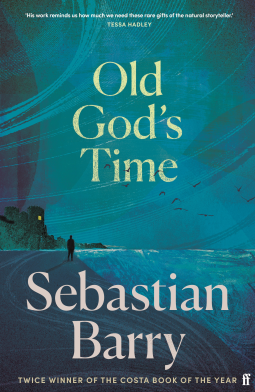
Old God’s Time by Sebastian Barry – #ReadingIrelandMonth23

Sebastian Barry is one of my favourite Irish authors; he writes beautifully and I’ve loved some of his previous books – in fact, the only one I’ve read that I didn’t like much was Days Without End, mainly because the subject (army life in the American West during the Indian Wars) didn’t really appeal to me. His new novel, Old God’s Time, has a very different setting – Ireland in the 1990s – and I hoped it would be another good one.

Old God’s Time is the story of Tom Kettle, a recently retired police detective who lives in the annex of a castle in Dalkey, a coastal resort to the southeast of Dublin. The castle overlooks the Irish Sea and Tom is finding some contentment in the quietness and solitude of his retirement…until, one day, two younger policeman arrive at his door. They are reopening an historic case Tom worked on in the 1960s and they want to hear his thoughts on it.

Forced to confront moments from his past that he would have preferred to forget, Tom begins to remember. He remembers his beloved wife June and his two children Joseph and Winnie, all now dead, in separate tragic incidents. He remembers his career as a detective and his time in the army. And he remembers that terrible, disturbing thirty-year-old case, linked to one of the darkest episodes in Ireland’s recent history.

When I first read the blurb for this book, it sounded like a crime novel, but being familiar with Sebastian Barry’s work, I knew it would probably be something quite different! In fact, the crime element is pushed into the background until much later in the book, and instead we spend time inside Tom’s head, watching him go about his daily business while memories fleet in and out of his mind, almost at random. The memories don’t come to him chronologically, but in a haphazard, disordered way and sometimes it is unclear whether he is even remembering things accurately. This doesn’t make for easy reading and I spent the first half of the novel feeling very confused. ‘Stream-of-consciousness’ writing is not my favourite style at the best of times and although it does usually work for me in Barry’s novels, I wasn’t won over until the second half of the book. From that point, I was gripped.

The story that does eventually unfold in Old God’s Time is very sad and very grim. It’s a subject that is painful and difficult to read about, but it’s one that needs to be discussed and not ignored. My heart broke for Tom, June and the other characters, but at the same time it’s not a completely miserable book and the beautiful descriptions of the Irish landscape provide a bit of respite from the sadness of the story. I didn’t like this book as much as The Secret Scripture or On Canaan’s Side, but it’s a powerful novel and one I’m pleased I read.

Thanks to Faber & Faber for providing a copy of this book for review via NetGalley.
I’m counting this towards Reading Ireland Month 2023, hosted by Cathy at 746 Books.

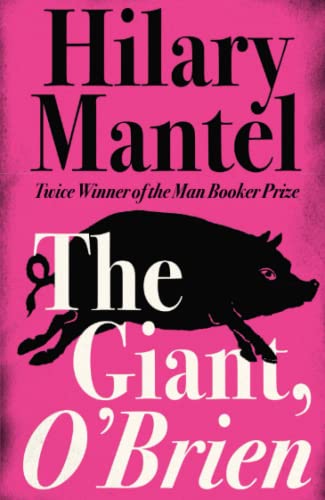
The Giant, O’Brien by Hilary Mantel

Having finished Hilary Mantel’s Thomas Cromwell trilogy last year, I knew I wanted to read more of her books. A Place of Greater Safety, her novel about the French Revolution, has always sounded appealing to me but the length is off-putting, so I decided to try a shorter one first.

The Giant, O’Brien, published in 1998, is based on the true story of the 18th century Irish giant, Charles Byrne. Also known as Charles O’Brien and claiming descent from the High Kings, but usually referred to by Mantel as simply ‘the Giant’, Byrne and his friends leave Ireland in 1782, fleeing ‘cyclical deprivation, linguistic oppression and cultural decline.’ The Giant has previously been able to make a living by entertaining his neighbours with stories and songs but, sensing that things are changing, he knows he needs to find a new way to earn money. The solution seems obvious, so after arriving in London with his entourage, the Giant appoints the unscrupulous Joe Vance as his agent and agrees to exhibit himself as a freak, to be stared at, pointed at, poked and prodded, in return for money.

The story of another man unfolds in parallel with the Giant’s. His name is John Hunter, a Scottish surgeon and anatomist – like Charles Byrne, a real historical figure. Mantel describes Hunter’s early years in Long Calderwood and how he came to be in London, first as an assistant to his brother William, another famous anatomist, and then on his own, conducting autopsies in the name of scientific research. Before the Anatomy Act of 1832, it was very difficult to obtain bodies for medical study in the UK, a problem which led to body snatching and the illegal digging up of graves. In one fascinating, if slightly gruesome scene, Hunter lectures a group of newly recruited body snatchers on the best ways to get hold of fresh corpses without being detected. Naturally, the bodies of most interest to Hunter are those that are unusual in some way – so when he hears news of the Giant currently being exhibited in London, he decides to make him an offer, despite the fact that the Giant is not yet dead.

Mantel portrays the Giant as a gentle, intelligent man with a natural gift for telling stories and a seemingly endless knowledge of myth, folklore and fairy tales. This, as much as his height, makes him stand out from his friends. While the others succumb to London’s temptations – alcohol, women and gambling – the Giant saves his money in the hope of one day rebuilding Mulroney’s tavern, now a ruin but once the place where ‘Courts of Poetry’ were held and he was taught the art of storytelling. John Hunter, in contrast, is much less likeable; if the Giant represents tradition and a way of life that is about to be lost forever, Hunter represents progress and advancement and is portrayed as clever, ambitious and lacking in empathy.

In her author’s note at the end of the book, Mantel explains which parts of the story are based on fact and which are purely fictional. There’s more factual information available on John Hunter than there is on the life of Charles Byrne, but what we do know about Byrne is that he suffered from gigantism caused by pituitary tumours, his height was 7ft 7 (2.31m) and his skeleton has been on display in the Hunterian Museum at the Royal College of Surgeons for over two centuries, despite his own wishes to be buried at sea. The museum has been closed since 2017 for renovations and the future of Charles Byrne’s remains is the subject of an ethical debate.

I found both the Giant and John Hunter interesting to read about, particularly as I previously knew nothing at all about either of them, but I thought the book seemed slightly disjointed because of the way it kept switching between the two narratives. Until they began to converge very near the end, the two storylines felt completely separate and unconnected; I suppose Mantel’s aim was to show the contrast between the main characters and the different paths they followed through life, but I felt it didn’t flow very well as a novel. I also didn’t find the eighteenth century London setting as immersive as the Tudor world she creates in the Wolf Hall books. Still, there are some fascinating ideas in this novel and the Giant O’Brien himself is a character I won’t forget in a hurry!

This is book 1/50 read for the 2023 Historical Fiction Reading Challenge.

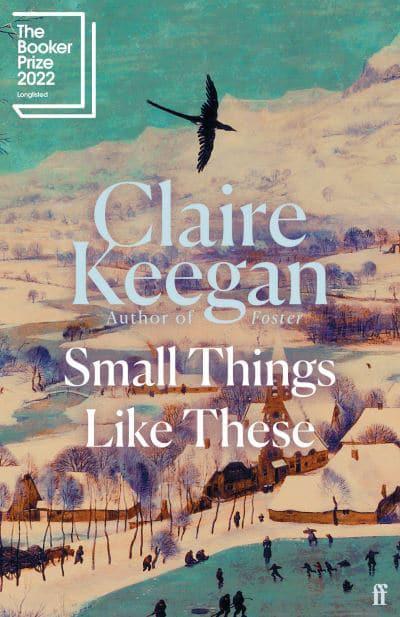
Small Things Like These by Claire Keegan – #NovNov22

I hadn’t really considered reading this book until my post on the HWA Crown Awards for Historical Fiction, when several of you commented that you had read and loved it. Around the same time, it was shortlisted for the Booker Prize and again I saw a lot of praise for it, so when I saw how short it was (128 pages in the edition pictured here) I thought I would give it a try for this year’s Novellas in November.

Small Things Like These is set in a small town in Ireland during the winter of 1985. The weather has turned cold and frosty and Bill Furlong, coal and timber merchant, finds his deliveries very much in demand, with customers desperate to heat their homes. Seeing how his friends and neighbours are struggling, Bill knows how lucky he is to have his own business and to be happily married with five lovely children.

Just before Christmas, Bill delivers coal to the local convent and discovers a girl locked in the coal shed, worrying about her hungry baby. Bill is left greatly disturbed by this encounter, particularly as he himself was the child of a single mother and if it hadn’t been for the kindness of his mother’s employer who helped to care for them both, they might also have been sent to a convent. His wife, Eileen, advises him not to get involved, but Bill continues to feel uneasy about the girls working in the convent laundry and the way the nuns are treating them. He knows he will eventually have to make a decision – but what will it be?

This is a quiet but powerful story, with the details of daily life in a small Irish community beautifully described. It didn’t feel like the 1980s to me, though – if I hadn’t known I would have thought it was set at least a few decades earlier. Maybe that was intentional, as some stories really are timeless. Considering how short the book is, Bill’s character is fully developed and his emotional dilemma is portrayed in depth.

Before reading this book, I had never read anything about the Magdalene Laundries, which were run by convents and were really homes for unmarried mothers and ‘fallen women’. There were allegations of women being beaten, punished and treated as slaves and although the last of these laundries closed in 1996, the Irish government didn’t issue an apology until 2013. Through Bill Furlong’s story Keegan explores the question of complicity and whether by staying silent when we know something is wrong we can be held partly responsible. This aspect of the book reminds me of A History of Loneliness by John Boyne, which looks at another scandal within the Catholic Church.

Not for the first time, though, I’ve come to the end of a hugely popular book feeling that although I liked it and found a lot to admire, I didn’t manage to love it the way everyone else did. In this case I think I just wanted a little bit more. It ended quite abruptly just as I was getting really interested in it and I would have liked to have known what happened to the characters next. I’m sure other readers will have thought it was the perfect length and ended in exactly the right place! Still, I’m looking forward to reading more by Claire Keegan and will think about reading Foster for next year’s Novellas in November.