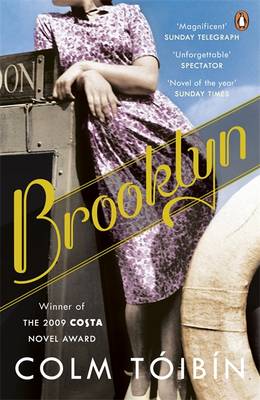
Brooklyn by Colm Tóibín

Brooklyn tells the story of Eilis Lacey, a young woman who lives in a small town in Ireland with her mother and sister. It’s the 1950s, only a few years after the end of World War II and it’s not easy to find a good job in a town like Enniscorthy. When Eilis is offered the chance to work and study in New York she leaves her family behind and prepares to start a new life in Brooklyn. After a traumatic journey across the Atlantic, we see how she settles into her new home and job, struggles with homesickness and makes new friends. But it’s during a trip home to Ireland that Eilis is faced with making the biggest decision of her life…

Brooklyn is a warm, gentle story with an old-fashioned charm. It’s not the most original book I’ve ever read and it’s not the most exciting or dramatic, but when I picked it up and started reading, I found it was just what I was in the mood for. Tóibín tells his story using simple language and a controlled, understated writing style and it was actually quite refreshing to read a book with such clear, direct prose and such a straightforward plot. The book was published in 2009 (and made the Booker Prize long list that year) but if I hadn’t been aware of that I could almost have believed it was written in Eilis’s own era because it does somehow have a very 1950s feel.

Eilis herself is a pleasant, likeable person. Looking at other reviews, many people have complained that she is too passive, allowing other people to run her life for her. I could accept her passivity as part of her quiet, innocent personality, though I agree that it didn’t make her a particularly strong or memorable character. I thought some of the minor characters were more interesting to read about – such as Georgina, the woman who befriends Eilis on her nightmare ocean crossing, or Miss Kelly, who runs the local shop in Enniscorthy where Eilis used to work. We stay with Eilis’s perspective throughout the whole book which means we only get to see the other characters when they are interacting with her directly, but something Tóibín does very successfully is to explore the relationships between Eilis and the important people in her life.

The book does touch on some of the social issues of the time – we learn a little bit about Ireland’s economy, the Holocaust is briefly mentioned, and we get a glimpse of racism in 1950s New York when Eilis starts serving black customers at Bartocci’s department store. But although those issues and others are there in the background they don’t form a major part of the plot. Instead, the focus of Brooklyn is very much on Eilis and the things that affect her personally: her new job at Bartocci’s, studying bookkeeping at evening classes, making new friends and visiting her boyfriend. The reader is immersed completely in the small details of Eilis’s daily life, something which could easily have become very boring, but in Tóibín’s hands is fascinating and compelling.

I haven’t personally had the experience of living in another country and I’m not sure how I would feel about it, but there were still parts of Eilis’ story that resonated with me and that I could identify with. I loved Brooklyn – and I was happy with the way the book ended too!
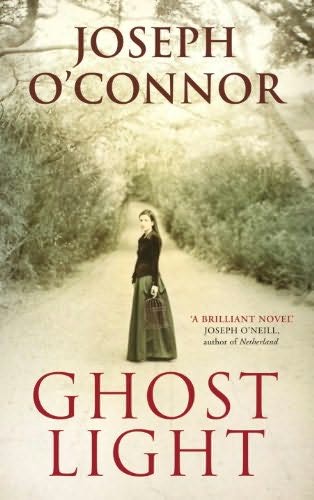
Ghost Light by Joseph O’Connor

Ghost Light tells the story of Molly Allgood, a real-life Irish actress who performed under the stage name Maire O’Neill and was engaged to the playwright John Millington Synge at the time of his death from cancer in 1909. Molly was fourteen years younger than Synge, she was a Catholic whereas he was a Protestant, and she came from a much poorer background. It seemed that almost everyone disapproved of their relationship including their parents, families and friends.

We first meet Molly in 1952, many years after Synge’s death. She’s living in poverty in London, dependent on alcohol, alone and desperate. We follow her over the course of a day as she prepares to take part in a play which is being broadcast on BBC radio and this story is interspersed with Molly’s memories of Synge and flashbacks to the early twentieth century.

As you’ve probably guessed, Ghost Light is not a happy book at all. Molly’s story is very sad, moving and poignant. The novel is written mostly in the second person, as well as following a stream of consciousness style, which made the book a bit harder to read than it needed to be, but Joseph O’Connor’s writing is undeniably beautiful and I did get used to the second person perspective after a while. There was also a chapter written in the style of a scene from one of Synge’s plays which I thought was a nice addition.

O’Connor states in his author’s note that although Molly and Synge were real people, this is a fictional story and most of the events described in the novel never actually happened. However, even if O’Connor’s Molly and Synge don’t bear much resemblance to their real-life models, they both felt completely realistic to me. Although I didn’t find Molly very likeable, I did love her narrative voice, which was bitter one minute and amusing the next, and this helped me warm to her character.

I won this book in last October’s Readathon and would like to thank Jessica of Park Benches and Bookends for providing a copy. I wish I’d had a chance to read it sooner, but my timing was actually perfect because I was in Dublin for a few days just last week and discovered some displays on Synge and Molly Allgood in the Dublin Writers Museum which I probably wouldn’t have appreciated if I hadn’t read Ghost Light!

The Secret Scripture by Sebastian Barry

It’s 2011, the start of a new reading year, but I still have a few reviews to post of books that I read in December 2010.  This is the first, and I’ll be posting another two later in the week before I start to discuss my 2011 reading.

The Secret Scripture tells the story of Roseanne McNulty, who has spent most of her adult life in Roscommon Regional Mental Hospital. She’s now almost one hundred years old and has decided to devote her final days to recording her life story in a secret journal. Meanwhile, the hospital is about to be closed down and Dr Grene has begun the slow process of reassessing his patients to see if they can return to the community. There’s something about Roseanne that intrigues him and he becomes determined to find out why she is there and how she came to be admitted to a mental institution.

The story is told in the form of two alternating narratives: the first is Roseanne’s Testimony of Herself in which she relates anecdotes and memories from her childhood in Sligo, Ireland, building up a picture of the events that led to her admission to the mental hospital. Roseanne is a captivating narrator with a strong, memorable voice and her story is absolutely heartbreaking; it seemed her whole life was just one tragedy after another. The second narrative is from Dr Grene’s Commonplace Book, the doctor’s account of his investigations into Roseanne’s past, as well as the details of his own troubled marriage and strained relationships. Although Dr Grene’s voice was not as strong as Roseanne’s, I still found his sections of the story interesting.

I don’t want to say too much about the plot because I think this is one of those books that will have more impact if you go into it knowing as little as possible. What I do want to tell you about is Sebastian Barry’s writing style. His style is quite unusual, very poetic in places, and it took me a few chapters to get used to it. But as the book went on, I became more and more impressed by the quality of the writing. There are so many great lines, such as when Dr Grene describes his relationship with his wife:

Now we are two foreign countries and we simply have our embassies in the same house. Relations are friendly but strictly diplomatic.

Or when Roseanne describes how her mother’s beauty has faded:

She was like a painting with its varnish darkening, obscuring the beauty of the work.

It really was beautifully written and the plot started to take second place to the gorgeous prose.

The author assumes you have some previous knowledge of 20th century Irish history. There are a lot of references to the Free State, the Irregulars, the IRA, Eamonn de Valera, the Royal Irish Constabulary and the Irish civil war, for example. I only have a basic knowledge of Irish history and although I could still follow what was happening, I think I might have got more out of the novel if I’d had a deeper understanding of the historical and political context. I also knew nothing at all about the bombing of Belfast during World War II, described here by one of the characters:

I ran like a demon along the ways, screaming I do not doubt, and saying wild prayers for the people of Belfast, and soon there were hundreds in the streets, all doing the same as me, people in their nightdresses and people naked as babes, running and screaming, and at the edge of the city we just kept going, and the waves of planes had come in behind us, all the while without mercy letting go the bombs, and an hour later or maybe more, I cannot say, I was perched on the edge of a huge dark mountain, and looked back, and Belfast was a huge lake of fire, burning, burning, the flames leaping like red creatures, tigers and such, high high into the sky…

This is just one example of Barry’s vivid imagery; I could have included a lot more.

The only thing that disappointed me about this book was a plot development towards the end that just felt too contrived and unrealistic. If it wasn’t for that one negative point, The Secret Scripture would definitely have been one of my favourite books of 2010.

Highly recommended

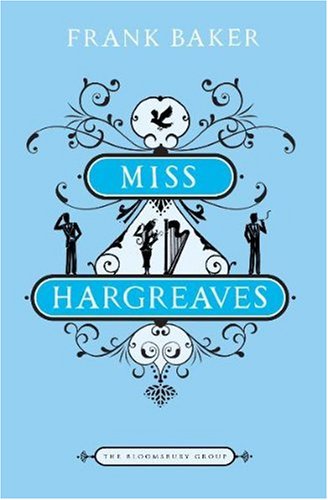
Review: Miss Hargreaves by Frank Baker

When I started to notice these Bloomsbury Group books appearing on other blogs, I knew I wouldn’t be able to resist reading them too. Not just because the covers are so pretty, but also because the stories all sound so intriguing! Miss Hargreaves (pronounced Hargrayves as we are told in the author’s note) was the one that appealed to me the most and the one I’d heard the most about – and it was the right choice because I loved it. It’s a charming tale about the power of imagination and how it can lead to an unusual and unlikely friendship.

“Henry,” I moaned, “she is exactly as I imagined.”
Limping slowly along the platform and chatting amiably to the porter, came – well, Miss Hargreaves. Quite obviously it couldn’t possibly be anyone else.

Norman Huntley has always allowed his imagination to run away with him. On a trip to Ireland with his friend Henry, they amuse themselves by inventing an imaginary eighty-three-year-old woman called Constance Hargreaves. They make Miss Hargreaves a poet and a musician; they give her a dog called Sarah and a cockatoo named Dr Pepusch – and Norman writes her a letter inviting her to stay at his home in Cornford, Buckinghamshire.

Never expecting her to accept his invitation (how could she – she doesn’t exist!) Norman is stunned when a little old lady arrives at the train station accompanied by a dog, a cockatoo, a harp – and even her own bath. It seems that Norman’s creation has come to life – and with even Henry convinced it’s all a practical joke, how will he explain Miss Hargreaves to his parents, his sister and his girlfriend Marjorie?

As the story continues, it gets more and more bizarre. I can safely say this is one of the most original and unusual books I’ve read for a long time! Miss Hargreaves is an unforgettable character – endearing and eccentric, yet ever so slightly sinister – and Norman is torn between a fatherly pride in his creation and frustration at the way she’s taking over his life. Somewhere in the middle of the novel, a gradual shift of power from Norman to Miss Hargreaves takes place, resulting in an almost Frankenstein-like situation where the creator begins to lose control of his creation. And yet Miss Hargreaves seems to be aware that there’s something different about her and that some kind of invisible bond exists between herself and Norman.

I was expecting the story to be funny and entertaining – and it is. However, there are also some very moving and poignant scenes, making the book a perfect mixture of dark and light.

There was only one aspect of this book that I could maybe have done without and that was the music. With Norman Huntley’s church organ, Cornelius Huntley’s violin and Miss Hargreaves’ harp, the musical elements of the book became a bit too much for me. However, I’m sure other readers will enjoy the organ playing scenes and they certainly add to the quirkiness and originality of the book.

Recommended

Pages: 317/The Bloomsbury Group/Year: 2009 (originally published 1940)/Source: My own copy