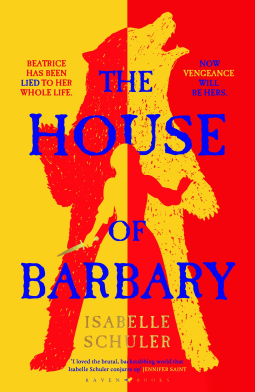
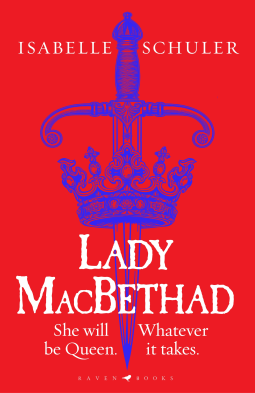
 A few years ago I read Isabelle Schuler’s debut novel, Lady MacBethad, which is set in 11th century Scotland and imagines the early life of Gruoch, the ‘real’ Lady Macbeth. Her second book, The House of Barbary, is set in a very different time and place – 17th century Switzerland – and this time it’s inspired by the Bluebeard fairy tale.
Our heroine is Beatrice Barbary, the only child of Jakob Barbary, one of the two mayors of Bern. Beatrice has never known her mother, who died when she was a baby, and has had an unusual upbringing, with her father encouraging her interest in natural science, keeping her away from other children and, now that she’s a young woman, preventing her from marrying. As a result, the people of Bern think she is strange and she has no friends her own age. When Jakob is killed, brutally murdered in his own home, Beatrice is determined to find out who is responsible and why, but as she begins to investigate she becomes aware of just how vulnerable and alone she is. The only person who may be able to help is Johann Schorr, an artist who lived with the Barbary family during Beatrice’s childhood, working on a portrait of Jakob; the problem is, for some reason, Beatrice has no memory of him at all.
Beatrice’s narrative alternates with Johann’s story, which is set more than a decade earlier during his time in the Barbary household. As a Catholic in a largely Protestant city, Johann is grateful for the support and patronage of Jakob Barbary and begins to consider him a friend. However, their friendship is tested when Johann makes a gruesome discovery in Jakob’s cellar and he must decide whether he can continue working for the man or whether he should get as far away as possible, even if it means sacrificing his career and leaving Beatrice, an innocent young child, in danger.
If you’re familiar with the Bluebeard folktale, you can probably guess what’s hidden in the cellar – and if you’re not, I won’t spoil things by telling you. It’s only a loose retelling of Bluebeard anyway and whether or not you know other versions of the story should make no difference to your enjoyment of this one. And did I enjoy it? Yes, I did, for the most part – but I felt that some of the developments in the second half of the book let it down. Beatrice, who has set out to investigate and avenge her father’s death, ends up doing things that I found disproportionate and difficult to justify, so that I lost most of the sympathy I’d had for her earlier on. The ending was not what I’d expected or hoped for either.
I’ve never been to Bern and loved the descriptions of the city, as it was in the 1650s, with its cobbled streets, sandstone arcades and famous bear pits. I’ve read very few books set in Switzerland and even less about 17th century Switzerland, so everything was new to me; it was interesting to read about the political system in place at that time, with Bern having two mayors at once – they would alternate each year, one ‘acting’ and one ‘sitting’ – and four powerful officials known as Venners, who would each oversee one district of the city. This political system is important to the story, with Beatrice’s father being one of the two mayors and all four Venners being part of his inner circle.
Schuler’s historical note at the end of the book was fascinating; I discovered that, although Beatrice is a fictional character, she’s based on the real life German entomologist and naturalist Maria Sibylla Merian, a woman I previously knew nothing about. It’s always good to learn something new!
I think the only other Bluebeard retellings I’ve read are two short stories: Angela Carter’s The Bloody Chamber and Nalo Hopkinson’s The Glass Bottle Trick. If you can recommend anything else, please let me know.
Thanks to Raven Books for providing a copy of this book for review via NetGalley.

 She Reads Novels