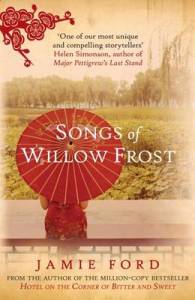
 William Eng has spent the last five years of his life in the care of the nuns at Seattle’s Sacred Heart Orphanage. It’s 1934 and living conditions at the orphanage are very poor, particularly for William who is Chinese-American and considered inferior to most of the other children. But William is not at all sure that he is actually an orphan – although he has never known his father, the last time he saw his mother she was being carried out of their apartment by a doctor, promising that she’d be coming back soon.
On William’s twelfth birthday he and the other boys are taken to see a film as a special treat and William becomes convinced that one of the actresses he sees on the screen, Willow Frost, is his mother. With the help of his best friend, a blind girl called Charlotte, he sets out to find Willow Frost in the hope that she can answer the question that has been troubling him for five years – what can lead a mother to abandon her child?
Having loved Jamie Ford’s previous novel, Hotel on the Corner of Bitter and Sweet, I was looking forward to reading this one. If anything, this book was even more ‘bitter and sweet’ than the first! At times it was so sad that I wasn’t sure if I could bear to continue reading, but even while my heart was breaking for William and his mother it was obvious that they loved each other and that gave me a glimmer of hope. I wanted them to find the happiness they deserved and that was what kept me turning the pages.
Although we begin in 1934 with William in search of Willow Frost, at least half of the novel is actually set several years earlier in 1921 and follows the story of the young Willow – or Liu Song as she was originally known. It was the 1921 section of the story that I found particularly upsetting to read; being Chinese, a woman and unmarried, life is not easy for Liu Song and it seems that every bad thing that could possibly happen to her does happen. While her stepfather, Uncle Leo, is the villain of the book, I was equally furious with the attitude of a social worker who supposedly had William’s best interests at heart but was clearly only concerned with punishing his mother for what she claimed was immoral behaviour.
Despite the overwhelming sadness, I enjoyed Songs of Willow Frost. There are some great descriptions of Seattle in the 1920s and 1930s and we are given some fascinating insights into the city’s Chinese community and the lives of people struggling to survive during the Depression. I didn’t find this book quite as satisfying as Hotel on the Corner of Bitter and Sweet and there were one or two aspects of the plot that didn’t resolve the way I would have liked them to but overall I thought this was a wonderfully poignant and moving story.
Thanks to Lovereading for the review copy
 She Reads Novels