Monstrous Tales: Haunting Encounters with Britain’s Mythical Beasts

This is a great new collection of short stories inspired by British folklore. I was drawn to it because it included several authors whose work I’ve previously enjoyed, but I was pleased to find that the stories by authors who were new to me were just as strong. The book has also given me the opportunity to learn about lots of creatures from British myth that I’d never come across before; only one or two of them were familiar to me.

I’ll start with the three stories by authors I hadn’t tried before. I particularly enjoyed Jenn Ashworth’s Old Trash, set in the Pendle area of Lancashire where a mother has taken her troubled teenage daughter camping for the weekend, hoping to keep her away from the bad influence of an older boyfriend. Ashworth does a wonderful job of creating a creepy atmosphere as darkness falls over the hills and Rachael and Mae listen to tales of the gytrash, a huge black dog thought to be an omen of death. Abir Mukherjee’s The Doctor’s Wife is another highlight, following a doctor and his wife who move to a small village in the Highlands of Scotland. Once there, the doctor becomes obsessed with the fate of his predecessor and a mysterious woman dressed in red. This story combines a British setting with elements of Hindu mythology, which is fascinating and adds some diversity to the book.

Sunyi Dean’s Eynhallow Free didn’t work for me quite as well as the others, which I think is due to the story being written in second person (addressing the reader directly as ‘you’, putting us in the position of the protagonist, a style I never really get on with). I did love the Orkney setting, though; it’s a very eerie story, incorporating figures from Orkney folklore such as the Goodman of Thorodale and the Finfolk. There’s one more story also set in Scotland: These Things Happen by Dan Jones. I’ve read some of Jones’ history books, but this is my first experience of his fiction. I disliked the main character which put me off the story a little bit, but I was fascinated by the descriptions of the Cat Sith, the large black cat of Scottish mythology that walks around on its hind legs.

Welsh folklore is represented by the Fad Felen, or yellow plague, which appears in Rosie Andrews’ story, The Yellow Death. The story is set at the end of the First World War and the Fad Felen can be seen as a metaphor for the yellow of mustard gas. This is one of only two stories in the book with historical settings. The other is Rebecca Netley’s Mr Mischief, in which ten-year-old Bessie moves to a big house on the Yorkshire moors with her Uncle Kit who has a job as gamekeeper. Here she learns about a mysterious being known only as Mr Mischief and the lengths the superstitious locals go to in order to keep him happy.

I think my favourite story in the book was probably Boneless by Janice Hallett, about a writer investigating reports of a giant slug in Derbyshire. Written in Hallett’s usual style incorporating emails, articles, texts etc, it explores issues such as climate and habitat change and how animals are forced to adapt and evolve. The ending is great – I hadn’t expected the story to go in that direction at all. I also liked The Beast of Bodmin by Jane Johnson, which is set, like a lot of Johnson’s work, in Cornwall. Gina moves into a cottage on the edge of Bodmin Moor, hoping to make a new start in life, and almost immediately her black cat, Roxy, goes missing.

The collection is completed by Stuart Turton’s Deaths in the Family. It follows the story of Ben and his family, who gather together for Christmas every year, barricading themselves indoors while an army of grotesque and murderous Redcaps amasses outside. I wasn’t sure what to make of this story as it was so strange and felt different in tone from the others in the book, but it was certainly entertaining!

Nine stories in this collection, then, and although I inevitably enjoyed some more than others, there wasn’t a single bad one here. I’m looking forward to exploring more of Ashworth, Mukherjee and Dean’s work now, so if you can recommend anything please let me know.

Thanks to Raven Books for providing a copy of this book for review via NetGalley.

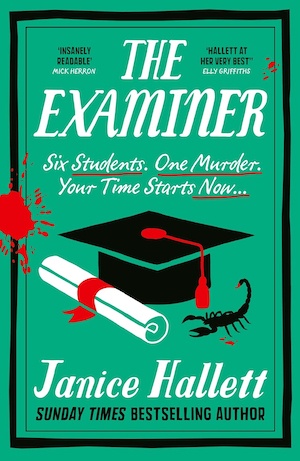
The Examiner by Janice Hallett

It’s September 2023 and six students are preparing to start Royal Hastings University’s new Multimedia Art course. The course is led by Gela Nathaniel who has personally selected her students from different backgrounds to ensure a range of skills and artistic knowledge. There’s Jem Badhuri, an ambitious and enthusiastic young woman who works mainly in sculpture and sound; Alyson Lang, already an experienced and talented artist; Jonathan Danners, whose family own an art gallery; Cameron Wesley, a marketing executive trying to juggle the course with his job; Ludya Parak, a graphic designer and single mother; and finally, Patrick Bright, a man in his fifties who runs an art supplies shop.

Almost as soon as the course gets under way there are hints that something is wrong. Some of the students seem to be hiding secrets and tensions quickly develop between them. Then, five of the group go on an overnight trip to Somerset to visit a museum and it’s not clear whether all five have returned again. Is the missing student still alive or have they been murdered and the others are covering it up? As the course comes to an end, Ben Sketcher, an external examiner responsible for giving an independent assessment of the course and the students’ grades, is given access to all the communications between Gela and her class and must decide whether a crime has been committed.

The Examiner is written entirely in the form of emails, WhatsApp messages and transcripts of chats from the Royal Hastings University messaging app, Doodle. This makes it easy for Hallett to conceal the truth from the reader because each character only reveals what they want the others to know and they aren’t necessarily always being honest. Clues do eventually begin to emerge but the full picture doesn’t become clear until Ben has read every message and every email. Readers of Hallett’s The Appeal or The Mysterious Case of the Alperton Angels will already be familiar with the epistolary format she uses and to be honest I think it’s something you either love and connect with immediately or you don’t. If you didn’t enjoy her other books this one probably won’t change your mind. Personally, I find them unusual and imaginative – and very gripping, as the short length of the emails and chats makes it difficult to stop reading!

The Multimedia Art course is a year long and during that time the students are given various assignments and projects to complete. Their responses to these are provided in the book and although I know very little about multimedia art I enjoyed reading them as they give a deeper insight into each character. I was particularly intrigued by Jem’s work with soundscapes and binaural audio and Patrick’s experiments with resin. Gela’s notes as she examines and grades each project are also interesting as they give us clues about how she views each student and her relationship with them. Why does she show such favouritism to the overqualified Alyson, for example? Why does she make so many allowances for Cameron, who barely attends the course and makes very little effort when he does?

When I eventually discovered what was going on behind the scenes of Gela’s Multimedia Art course I felt slightly let down because it seemed so far-fetched and not what I had expected. Still, the fun was in getting there and watching the dynamics play out between the six students along the way. Although The Twyford Code and The Alperton Angels are still my favourite Hallett novels, I did love this one as well; it’s maybe not the best place to start with her books, but I think existing Hallett fans will enjoy it as much as I did.

I’m counting this as my third book for this year’s RIP challenge.

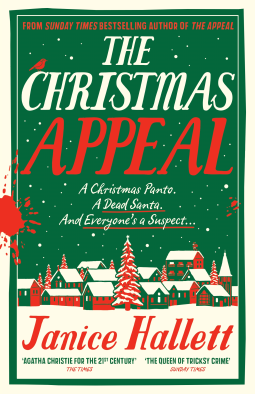
The Christmas Appeal by Janice Hallett – #NovNov23

In this new novella, published just in time for Christmas, Janice Hallett returns to the world of her earlier novel, The Appeal. Once again, newly qualified lawyers Femi and Charlotte are sent a folder of documents and are challenged by their former mentor, the now retired Roderick Tanner, to read through them all and solve the mystery they contain. And once again, the mystery unfolds in the town of Lower Lockwood where the amateur theatrical group known as The Fairway Players are preparing to stage another play, with the aim of raising money for the church roof appeal. This time, it’s that great British tradition, the Christmas pantomime! This year’s choice is Jack and the Beanstalk and rehearsals are about to begin.

Sarah-Jane MacDonald, the fundraising expert from The Appeal, and her husband Kevin have now been elected as co-chairs of The Fairway Players, a move that not everybody is happy with – particularly not Celia Halliday, who believes that she should be the one running the group. Celia is determined to do whatever it takes to prevent Jack and the Beanstalk from being a success, but it seems that the pantomime is already destined to be a disaster and anything that can go wrong will go wrong. What has happened to the young couple who auditioned for parts and have never been seen or heard from since? Is it true that the giant beanstalk Sarah-Jane wants to use as a prop is made of deadly asbestos? Is it really a good idea to use a script written in the 1970s? And whose is the dead body that appears on the night of the performance?

Like The Appeal, this book is written entirely in the form of emails, texts, WhatsApp messages and other types of media. If you’ve read the first book you’ll already be familiar with many of the characters which will make things easier to follow, but if not I don’t think it will be too much of a problem as this one should also work as a standalone. The format of the book allows the different personalities of the characters to shine through very strongly, from bossy Sarah-Jane to snobbish Celia, so you should be able to get to know them quickly.

I found this a more light-hearted book than The Appeal, with lots of humorous misunderstandings and funny moments (I particularly loved Kevin attempting to buy ‘sweets’ to hand out to the children on performance night and accidentally purchasing something completely different instead). I felt that Hallett was trying to make this an entertaining festive read rather than a more serious crime novel, which does mean that the actual mystery is quite weak. The solution relies heavily on information that is only revealed by Tanner at the end of the book and I think it would be almost impossible to solve otherwise. As Tanner already knows all the answers, he doesn’t really need Charlotte and Femi’s assistance and there’s a sense that he has set them this task simply as a problem-solving exercise and to see what they will do with what they’ve learned.

Despite the mystery not being very strong, I enjoyed this book for the characters, the humour and the insights into staging a Christmas pantomime. Hallett’s next novel, The Examiner, out next year, seems to be unrelated to this one, but I wonder whether she’ll return to the Fairway Players in the future for another book.

Thanks to Viper for providing a copy of this book for review via NetGalley.

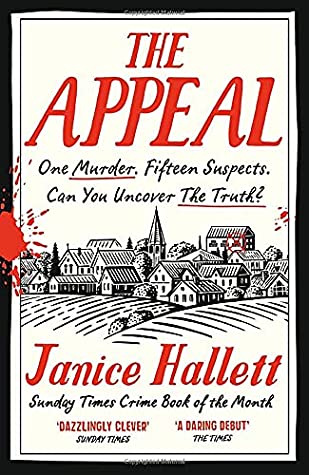
The Appeal by Janice Hallett

I loved Janice Hallett’s most recent novels, The Twyford Code and The Mysterious Case of the Alperton Angels, so I was looking forward to going back and reading her first book, The Appeal. I know Hallett’s style is not one that works for all readers (to be honest, I’m very surprised that it works for me), but if you enjoyed either of those other two novels, I can almost guarantee that you’ll enjoy this one as well.

The Appeal begins in the small English town of Lower Lockwood where the members of an amateur dramatics society, The Fairway Players, are preparing for their upcoming production of All My Sons by Arthur Miller. The Players are led by Martin Hayward and his wife Helen, a couple who also own the local golf club and are highly respected within the community, as well as members of several other prominent Lockwood families. On the fringes of the group and desperate to be accepted into the Haywards’ social circle is Isabel Beck, a young nurse who convinces her new friends Sam and Kel Greenwood to join the Players.

Before the group even begin rehearsals, disaster strikes: Martin and Helen’s two-year-old granddaughter, Poppy, has developed a rare form of brain cancer which is unlikely to be cured with conventional chemotherapy. Poppy’s parents have placed all their hopes in a new experimental treatment which is not yet available in the UK. Determined to obtain this very expensive new drug from America, the Haywards and their friends launch a fundraising appeal, ‘A Cure for Poppy’. At first, everything seems to be going well, but when one of the Fairway Players is found murdered, questions are raised not just regarding the killer but the appeal itself. Does the doctor responsible for obtaining the new treatment really have Poppy’s best interests at heart? Why did Sam leave her last nursing position in Africa so suddenly? And who is the mystery donor who promised a large sum of money then changed his mind?

Roderick Tanner QC has set his two law students, Femi and Charlotte, the task of looking through the documents associated with the Lockwood case. Someone has already been sentenced for the murder, but Tanner believes they are innocent and he wants the students to confirm his opinion as he prepares to appeal the decision. The novel is presented entirely in the form of emails sent to and from the various characters involved in the case, as well as several WhatsApp discussions between Femi and Charlotte as they try to make sense of the evidence. As I’ve said, this is probably something you’ll either love or hate, but for me it’s very effective – I find that the short length of each email makes the book very immersive and compelling as it’s easy to think ‘I’ll just read one more!’ It also allows a lot of misdirection as every character could be considered an unreliable narrator; we can never be sure who they really are or how they really feel because all we see is the way they choose to present themselves in an email or on social media. Some suspension of disbelief is required, though, as most people aren’t sending constant emails to each other all day long!

The weakest aspect of The Appeal for me was actually the murder mystery. The murder doesn’t take place until late in the novel and then we learn that Tanner has been withholding information from us, which makes it very difficult to solve the mystery for ourselves. I also wasn’t sure why he wanted help from Charlotte and Femi, as he already seemed to know everything anyway. Apart from that, I enjoyed following the progress of the Poppy campaign and correctly guessed some of the twists in that storyline! There’s a large cast of characters to get to know, but I found that most of them had their own very distinctive personalities – from needy, eager to please Isabel to practical, no-nonsense professional fundraiser Sarah-Jane – so I had no problem keeping track of them all.

Of the three Janice Hallett books I’ve read, this is my least favourite, but it still kept me entertained from beginning to end. I’m looking forward to reading her new novella, The Christmas Appeal, coming in October!

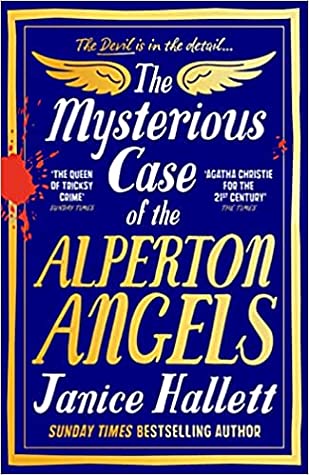
The Mysterious Case of the Alperton Angels by Janice Hallett

Imagine you find a box of documents that make up the research material for a true crime book. After reading them, you see that the book will shed new light on the eighteen-year-old case of the Alperton Angels – but what will you do next? Destroy the documents? Or hand them over to the police? This is the premise of Janice Hallett’s new novel, The Mysterious Case of the Alperton Angels. It’s fascinating, but Hallett has a style all of her own which can take a while to get used to. I knew what to expect as I loved her previous novel, The Twyford Code – one of my favourite books of 2022 – and I think I enjoyed this one even more.

The case of the Alperton Angels involved a cult led by a man who called himself the Angel Gabriel, two vulnerable teenagers and a baby they believed to be the Antichrist. When true crime writer Amanda Bailey is commissioned to write a book for a new series re-assessing historic crimes, she decides to write about the Alperton Angels from the perspective of the baby, who is now about to turn eighteen. The only problem is, she has no idea where the baby is – or even who they are. Even worse, she discovers that one of her rivals, Oliver Menzies, is working on the same book from the same angle. Who will find the baby first and uncover the truth behind the Alperton Angels?

The whole novel is presented as Amanda’s collection of research material: emails, letters, WhatsApp messages, and even excerpts from books and film scripts. Where she has met and interviewed people involved in the case, these conversations are transcribed by her assistant Ellie, who adds her own amusing observations and asides. This modern, multimedia style of storytelling is not something that would usually sound appealing to me, but in Janice Hallett’s hands I love it. And actually, when I think about it, it’s really just an updated form of the classic epistolary novels I’ve always enjoyed, so there’s no reason why I shouldn’t like it!

Despite the fragmentary style, I could still get a feel for the personalities of the main characters – Amanda persistent and tenacious, Oliver gullible and easily led, and Ellie witty and down to earth – but there’s also a sense that there’s a lot we’re not being told. How much can you trust what someone says in an email or in an interview where they know they’re being recorded? Similarly, the facts behind the case of the Alperton Angels are unravelled very slowly, one little piece of information at a time, and with many of the suspects and witnesses following their own agenda, we don’t even know if what we are reading is true or will be proved false later in the book. Things do eventually start to come together and make sense – and if you continue to the end, you’ll be rewarded with some great twists!

I found The Mysterious Case of the Alperton Angels completely gripping and difficult to put down, particularly as there are no traditional chapter breaks so no logical places to stop. Now I’m looking forward to reading Janice Hallett’s first novel, The Appeal.

Thanks to Viper for providing a copy of this book for review via NetGalley.

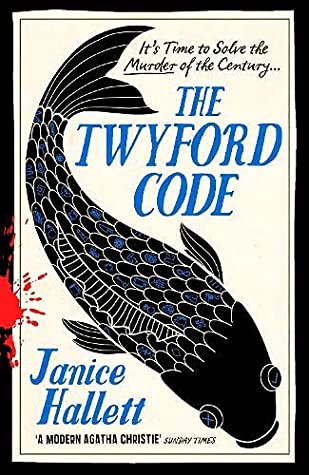
The Twyford Code by Janice Hallett

Stolen gold, Chinese jewels, nuclear weaponry, oil, Nazi treasure, a secret portal to a parallel utopian society, an underground bunker full of priceless artworks, an airtight library of valuable books, evidence of alien visitation, a cure for cancer, a time machine, a device to contact the spirit world, a map of the human genome from fifty years before modern science discovered it. You name it, someone, somewhere, at some time, has suspected Edith Twyford hid clues to it in her books.

It’s always a nice feeling when you start to read a book and can tell after just a few pages that it’s going to be one of your books of the year. It’s a particularly nice feeling when that happens in January! The Twyford Code is one of those books; I loved it and before I’d even finished I was adding Janice Hallett’s previous novel The Appeal to my TBR.

The Twyford Code is such an unusual book it’s been difficult for me to decide how much I can say about it without spoiling the fun for other readers. I’m probably not going to do it justice here, but this is the best I can do!

In 1983, Steven Smith finds a book by children’s author Edith Twyford on a bus in London. Unable to read the book himself, he takes it to school and gives it to his Remedial English teacher, Miss Isles, completely unaware of what he is setting in motion – because Miss Isles believes that this book, and the rest of Twyford’s Super Six series, contains a secret code that will lead to a hidden treasure. Then, on a school trip to Bournemouth, Miss Isles disappears without trace, an incident which will haunt Steve for the rest of his life.

In 2019, Steve has just been released from prison after serving an eleven-year sentence. He now has no memory of what happened to Miss Isles on that long-ago day, but he is convinced that her disappearance had something to do with the Twyford Code. Now that he is free, Steve decides that the time has come to uncover the truth about Miss Isles, Edith Twyford and the code.

Using an old iPhone given to him by his estranged son, Steve records the details of his investigations in audio form and most of the novel is presented as a series of transcripts of these audio files. The voice recognition software used to transcribe the recordings often ‘mishears’ words or spells them phonetically, which makes for a challenging but entertaining reading experience! It’s probably something you’ll either love or hate, but my advice is to try to stick with it as it does become less distracting after a while and the format really is an important part of the story.

This was the perfect book for me in many ways. I have always enjoyed puzzles and word games and there are plenty of those incorporated into The Twyford Code in various forms. I also read a lot of Enid Blyton as a child and Edith Twyford is clearly supposed to be a fictional version of Blyton (her Super Six books are obviously the equivalent of Blyton’s Famous Five and we are told that, like Blyton, Twyford’s books are now seen as outdated, racist and sexist, and have been edited to make them suitable for a modern audience). But I think what I actually enjoyed most about this novel was Steven Smith’s personal story – the details of his troubled, impoverished childhood in the 1980s, how he drifted into a life of crime, and how he sets out to solve the code and find out what happened to Miss Isles.

I loved this book and on reaching the end, I wanted to go back to the beginning and read it all again to look for all the clues I’d missed the first time. I didn’t do that, because I have so many other books waiting to be read, but it was very tempting and I’m sure I’ll be picking up The Appeal before much longer!