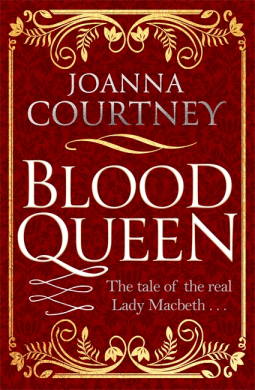
 The fictional story of Macbeth, complete with witches, ghosts and prophecies, is well known thanks to Shakespeare’s play, but how many of us know the story of the real historical figure – King of Alba (Scotland) from 1040 until 1057 – on whom the play was based? I have read one version, Dorothy Dunnett’s wonderful King Hereafter, but it’s always interesting to see how different authors approach the same subject so when I came across Blood Queen, Joanna Courtney’s recent novel about ‘the real Lady Macbeth’, I decided to give it a try.
I remember reading one of Courtney’s previous books, The Chosen Queen, several years ago and my impression at that time was that she was a good storyteller but spoiled things by replacing the names of her historical characters with modern equivalents. She does the same in this book and again I found it annoying and unnecessary. She explains in her author’s note that some of the historical names sound unnatural to ‘the modern ear’, so Gruoch and Suthen become Cora and Sibyll, Lulach becomes Lachlan and Gillacomghain becomes Gillespie. I don’t really understand that decision at all; it’s a story set in the 11th century and readers will understand that, so why not just leave the names as they are?
Anyway, we first meet the sixteen-year-old Cora MacDuff on the eve of her wedding to Macbeth, son of the Mormaer of Moray. Cora fled to Moray several months earlier following an attack on her home in Fife by the men of King Malcolm, her father’s cousin. She swears to ‘make of myself a sword to avenge the wrong done to my father by his own blood’ and she is driven by this desire for the rest of her life. Cora believes that if she marries Macbeth, part of the royal bloodline of Aed, their heir would be able to challenge King Malcolm, or at least his son, Prince Duncan. Before the wedding can take place, however, Cora is abducted during a raid and forced into marriage with another man – Macbeth’s rival, Gillespie, who also believes he has a claim to the throne.
Cora’s story alternates with the story of Sibyll, the Danish-born wife of Prince Duncan. Sibyll, sister of Ward (or Siward), the Earl of Northumbria, is also no stranger to violence, having lost both parents when their small fishing community in Denmark was attacked by the Wend tribe. Her marriage to Duncan, which takes place early in the novel, means that their son, if they have one, will be king one day…but not if Cora’s son gets to the throne first.
In this novel, Joanna Courtney has chosen to focus on the parallel lives of Cora and Sibyll, showing how, although circumstances make them rivals, both women have the same hopes and ambitions, both just wanting the best for their children. A lot of care seems to have gone into the writing of the book; there are maps of Alba, descriptions of the system of alternate inheritance used in Alba at that time, genealogy charts showing the royal lines of Aed and Constantin, and a very extensive set of notes at the end. This is why I was surprised to come across a description in the third chapter of Gillespie as a ‘wide, cumbersome young man with a belly that already hung ponderously over his kilt’. Kilts in the 11th century? I don’t think so, though I’m happy to be corrected.
Blood Queen is the first book in a Shakespeare-inspired trilogy; the second, Fire Queen, is about Ophelia from Hamlet and the third, the upcoming Iron Queen, will be about Cordelia from King Lear. After trying two Joanna Courtney books I probably won’t read any more, but I have to admit that I know absolutely nothing about the inspiration for Ophelia or Cordelia and would have been interested to find out more.
Thanks to Piatkus for providing a copy of this book for review via NetGalley.

 She Reads Novels