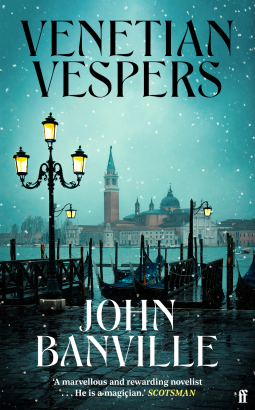
 So far my experience of John Banville’s writing has been limited to Prague Nights, one of his mystery novels published under the pseudonym Benjamin Black. I’ve been meaning to try more of his books and when I saw this one, I was immediately drawn to it by the title and the beautiful cover (I love a Venetian setting).
Venetian Vespers is set at the turn of the 20th century and begins with writer Evelyn Dolman and his wife Laura on their way to Venice for a belated honeymoon – the reason for the delay is that Laura’s father died just after their marriage. Evelyn had been expecting Laura to inherit her father’s fortune, but due to some sort of conflict that Evelyn doesn’t fully understand, his father-in-law left everything to his other daughter instead. This is disappointing for Evelyn – but then, their whole marriage has been a disappointment so far and isn’t showing any signs of improving.
On their first night in Venice, Evelyn meets Frederick FitzHerbert, a man who claims to have been at school with him, although Evelyn can’t remember him at all. He doesn’t like to admit this, though, so falls into conversation with Freddie and is introduced to his beautiful sister, Francesca. Returning drunk to the palazzo near St Mark’s Square where he and Laura are staying, Evelyn behaves so badly towards his wife that when he wakes up in the morning she has disappeared. Despite feeling ashamed of himself, he makes no real attempt to find Laura, too distracted by thoughts of Francesca. But are Francesca and her brother really who they say they are and what do they want with Evelyn?
It’s obvious to the reader from early on that the FitzHerberts are con artists of some sort, but what we don’t know is what they’re hoping to achieve or why they’ve picked Evelyn as their target. We also don’t know what has happened to Laura, so there’s plenty of tension and mystery. However, the whole novel is narrated by Evelyn from a point in the future, which means there’s lots of foreshadowing and comments like “looking back, I can see” and “If I’d known then what I know now” and I found this a bit annoying. Also, all the foreshadowing and hinting meant I spent most of the book waiting for something dramatic to happen and when it eventually did, very late in the book, I felt slightly let down.
The book is beautifully written, though! Banville uses language appropriate to the period, with every word and phrase carefully chosen so that you could almost imagine it was written in an earlier time. It’s also extremely atmospheric. I love Venice but have only been there in the summer, in hot, sunny weather; Evelyn is there in the winter and the Venice he describes is a gloomy, sinister, forbidding place – “that place of glancing lights, distorting reflections, looming shadows”. It’s the perfect backdrop for the unpleasant, unlikeable characters (even our narrator is an awful person).
Although I couldn’t quite manage to love this book, I enjoyed it more than the other one I read by Banville and was captivated by the haunting portrayal of Venice and the tense, unsettling atmosphere. An ideal read for cold, dark evenings.
Thanks to Faber & Faber for providing a copy of this book for review via NetGalley.
 She Reads Novels