Air by John Boyne – #NovNov25

This is the fourth book in John Boyne’s Elements quartet. Having enjoyed Water, Earth and Fire, I’ve been very much looking forward to Air and the short length made it an obvious choice to read during Novellas in November (hosted by Cathy of 746 Books and Rebecca of Bookish Beck). Although each book has a different narrator and can be read as a standalone, there are links between all four, sometimes obvious and sometimes more subtle. It’s not essential to read them in order, but I would save this one until last if possible as it ties together some of the loose ends and provides closure for the characters. I’ve avoided spoilers for the first three books in the rest of my review, so don’t worry if you haven’t started the series yet!

Air tells the story of Aaron Umber and his fourteen-year-old son, Emmett, and a large part of the book is set onboard a plane (hence the title). The Umbers also have a family member who is a pilot – Boyne always works the relevant element into the story in multiple ways. At the start of the novella, Aaron and Emmett are at Sydney Airport, preparing to board a flight that will take them from their home in Australia across the world to Ireland, where Aaron hopes to reconnect with his ex-wife – and Emmett’s mother. The only problem is, he hasn’t told her that they’re coming.

As it’s such a long flight from Australia to Ireland (with a change in Dubai), Aaron has plenty of time to think and reflect on the circumstances that have brought him to this point. He looks back on his first encounters with the woman who would become his wife, the problems they experienced during their marriage and the reasons it ultimately ended in divorce. He also confronts his memories of the abuse he suffered as a teenager and his knowledge of the similar ordeals his wife went through before they met. Emmett has grown up unaware of any of this, but he’s beginning to ask questions and Aaron wonders if now could be the right time to tell him the truth.

Like the other books in the quartet, Air is a dark and sometimes disturbing read – although not as much so as the previous books as this one is concerned with moving on from trauma rather than describing the traumatic events themselves. Also, while the previous three narrators were morally ambiguous at best, completely evil at worst, Aaron is much easier to like and have sympathy for. I loved his relationship with his son, Emmett; it felt so real and believable and also very moving, though not in an overly sentimental way.

I have deliberately not revealed the name of Aaron’s ex-wife because she appears in one of the other books and I don’t want to spoil the surprise for anyone wanting to read the series through from the beginning. Other characters also appear again or are referred to, mainly those from Water and Fire. Earth feels less well integrated into the series as a whole, which is slightly disappointing as the other three books tie together so perfectly.

All four novellas are now available in one volume, published under the title Elements, but can still be bought separately as well.

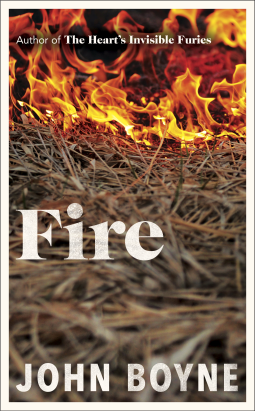
Fire by John Boyne – #NovNov24

This is the third book in John Boyne’s Elements quartet and it’s the darkest and most powerful so far. Each book can be read as a standalone story, but if you’ve read the previous two – Water and Earth – you’ll see some links between the characters and plots. I would still recommend reading them in order if possible, although it’s not essential.

Fire, like the other books, is novella-length – in this case 163 pages – but as usual, Boyne manages to pack a huge amount into those pages, more than you would often find in a much longer novel. Our narrator this time is Freya Petrus, a renowned surgeon who works with burns and skin grafts. She’s only in her thirties but has already established herself as one of the best in her field. What Freya gets up to in her private life, however, is much less admirable…in fact, it’s horrible. To understand what has made her the person she is – both the good side and the bad – we have to go back to Freya’s childhood and witness the traumatic experiences that shaped her future.

It’s difficult to really discuss the issues a book like this raises without spoiling things, so I’ll just say that what Freya experiences as a child leaves her badly damaged and, in her mind, justifies the harm she does to other people as an adult. I did have some sympathy for the young Freya, but that was surpassed by the loathing I felt for the older Freya. John Boyne is never afraid to tackle unpleasant and controversial subjects in his books, but the things Freya does are particularly shocking and I found it a very uncomfortable book to read. It’s also fascinating and completely gripping, so I do recommend it as long as you’re prepared!

As with the themes of water and earth in the previous two books, the element of fire plays a part in this one in several different ways: not only does Freya work with victims of fire, it could be said that she’s also playing with fire in her personal life. Other important themes running through the story include the question of nature versus nurture and which has the biggest role in forming our character, the level of responsibility each of us has to do what we know is right, and the different expectations society has of men and women. It’s a book that leaves you with a lot to think about after reaching the final page.

Although each book in this quartet does work on its own, a minor character from each one becomes the main protagonist of the next. It seems that Aaron, who works with Freya at the hospital, is going to be the star of the final book, Air. It will be published in May 2025 and I’m looking forward to seeing how Boyne brings the series to an end.

Thanks to Doubleday for providing a copy of this book for review via NetGalley.

I’m counting this book towards Novellas in November, hosted by Cathy of 746 Books and Rebecca of Bookish Beck

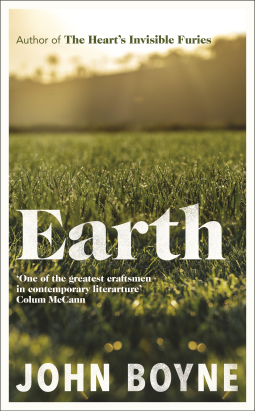
Earth by John Boyne

Earth is the second in John Boyne’s new quartet of novellas named after the four elements. I enjoyed the first book, Water, so I was looking forward to this one and it didn’t disappoint. Although the two books (and presumably Fire and Air as well) are loosely linked, they are completely separate stories and you don’t need to read them in order. If you have already read Water, you may remember Evan Keogh, the teenage boy we last saw leaving his home on a small Irish island in search of a new life in England. Earth is Evan’s story.

Evan has had a talent for football from an early age, but his true passion is for painting and on his arrival in London he hopes to pursue a career as an artist. After a series of rejections he is forced to accept that he’s unlikely to achieve his dream and with his money running out he reluctantly decides that he will have to use his football skills after all. The book begins with Evan, now twenty-two and a famous footballer, preparing to stand trial for sexual assault. Robbie, his friend and teammate, is accused of rape and Evan has been charged as an accessory for filming the incident on his phone.

For such a short book (under 200 pages), Boyne manages to create a multi-layered story covering a range of important – and often uncomfortable – topics. Much of Evan’s story is told in flashbacks as he remembers his childhood, his strained relationship with his father and his growing awareness of his sexuality (Evan is gay, which can make life difficult both in his small Irish community and in the world of professional football). When he arrives in London he is taken advantage of by an older man who pushes him into work as a male escort, which has disastrous results for Evan. This is what leads to Evan’s decision to become a footballer, despite his dislike of the sport – and again I thought it was interesting to see how Boyne explores the idea of someone achieving huge success in a profession that they don’t enjoy and don’t respect, as well as the various ways in which young men cope with suddenly attaining a level of fame that they’re not really prepared for.

The trial is also a main focus of the book and I found it increasingly frustrating and infuriating to see how the victim was treated in court. I hoped Evan would do the right thing and not just try to protect his friend, but Boyne keeps us doubting him throughout the novel and I’m not going to tell you whether I got the outcome I wanted. Obviously there have been many real life cases of women making allegations of sexual assault against famous people and the courtroom scenes are all the more disturbing because you can easily imagine them happening.

Like ‘water’ in the previous book, Boyne works the element of earth into the story in several different ways, from the soil of Evan’s island home to the ground beneath his feet that is so important to his sport. Of the two, I think I preferred Water but both are powerful books and I’m now looking forward to Fire, coming in November of this year.

Thanks to Doubleday for providing a copy of this book for review via NetGalley.

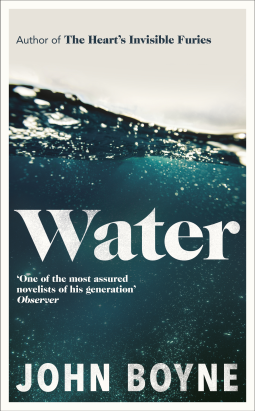
Water by John Boyne – #NovNov23

Water is the first in a planned quartet of novellas named after the four elements and linked by some shared characters and themes. I’ve enjoyed many of John Boyne’s longer novels so I was intrigued to see what he could do with a shorter format.

We begin with Vanessa Carvin arriving on an island off the coast of Ireland where she has rented a cottage in the hope of escaping from her past and starting a new life for herself. The first thing she does when she gets there is cut her hair and change her name to Willow, before settling into a quiet existence, going for walks, attending church and trying not to attract too much attention to herself.

The whole book is narrated by Willow and she reveals her secrets to the reader slowly, when she is ready to do so, but we know from the start that something has gone badly wrong with her marriage to Brendan Carvin, Director of the National Swimming Federation. Where is he now? What happened to their eldest daughter, Emma? Why is Willow estranged from her younger daughter, Rebecca, who refuses to answer her texts and keeps blocking Willow’s number? It takes a while for the truth to emerge but, once it does, it gives Boyne the opportunity to return to the themes he has explored in other books such as A History of Loneliness and All the Broken Places (Father Odran Yates, protagonist of the former, is even referred to once or twice as a friend of Brendan’s, strengthening the tie between the two books). These themes include the questions of whether we can be considered complicit in another person’s crimes just by choosing to look the other way when our instincts tells us something is wrong and whether there is always more we could and should have done.

Water is the title of the book, but that element is also worked into the novel in a variety of different ways. Not only is Willow’s husband a swimming coach, but the sea has a role to play in the fate of one of the other characters and Willow’s own name refers to a tree that grows by water. And of course, the island itself is surrounded by water, both physically and metaphorically separating Willow from her old life in Dublin. For such a short book (176 pages in the hardback edition) it’s a very powerful one. It deals with some difficult and uncomfortable topics but, as I’ve come to expect from Boyne, there are also some humorous moments to lighten the mood. I can’t wait to see how he tackles the other three elements; I’m already looking forward to the second book in the series, Earth, which is due in May 2024.

Thanks to Doubleday for providing a copy of this book for review via NetGalley.

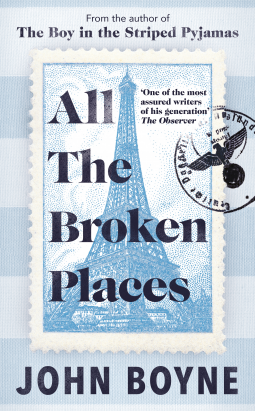
All the Broken Places by John Boyne

I love John Boyne’s books and couldn’t wait to read his new one, All the Broken Places. It’s a sequel to his 2006 children’s novel The Boy in the Striped Pyjamas, but this time it’s aimed at adults. Although I haven’t read the first book, I have seen the film and that helped me understand the background of the characters and the references to things that had happened in the past. If you’re not familiar with The Boy in the Striped Pyjamas, though, I don’t think it would matter too much as this book does work on its own.

All the Broken Places begins in the present day, 2022, and is narrated by ninety-one-year-old Gretel Fernsby. Gretel has lived in the same luxury apartment building in London since the 1960s; most of the other residents have also been there for a long time, so when a new family move into the flat below, Gretel is curious to meet her new neighbours. However, she is alarmed to discover that the family includes a nine-year-old boy, Henry, who brings back memories of her own brother at the same age – memories Gretel has spent her whole life trying to suppress.

As she gets to know Henry and his parents, Gretel quickly becomes aware that something is not right. She wants to help, but is afraid of making the situation worse. At the same time, she is forced to confront her own past when, as the young daughter of a Nazi commandant of a Polish concentration camp, she and her mother fled to France at the end of the war and tried to build new lives for themselves under new identities. Gretel has lived with the shame and guilt ever since, but now it seems she might have an opportunity to redeem herself.

As the story of Gretel’s life unfolds, we are taken on a journey from Poland to France, Australia and then England. Chapters set in the past alternate with chapters set in the present as Gretel battles with her conscience again to try to do the right thing for Henry. There are not many books with protagonists in their nineties and I admired her for the courage, resilience and wisdom she displays in old age, despite what she may have done or not done when she was younger.

I really enjoyed this book, although at times it’s an uncomfortable read and often a moving one. John Boyne has shown previously that he’s not afraid to tackle controversial subjects in his novels and I’m sure this is another one that will divide opinion. Some readers will take the view that anyone with any connection to the atrocities of the Holocaust deserves no pity; others will have sympathy for a twelve-year-old girl who, although she was at least partly aware of what was happening, lacked the strength, will and opportunity to do anything about it and has regretted it ever since. This is a theme Boyne has explored several times before, particularly in A History of Loneliness (a novel about the child abuse scandal within the Catholic church and probably my favourite of his books) – whether by turning a blind eye to the actions of others we are as much to blame as they are and whether it’s our responsibility to speak out if we know something is wrong.

This is a fascinating novel; it’s published today and I look forward to hearing what other people think of it.

Thanks to Doubleday for providing a copy of this book for review via NetGalley.

This is book 49/50 read for the Historical Fiction Reading Challenge 2022.

The Echo Chamber by John Boyne

This is not my usual sort of read at all, but because I’ve enjoyed so many of John Boyne’s other books (my favourites are A History of Loneliness and This House is Haunted), I’m happy to read anything he writes.

The Echo Chamber is the story of the Cleverleys, an obnoxious and unpleasant celebrity family trying to fit into a world ruled by social media, where more and more of our lives are played out online rather than in ‘real life’. George Cleverley is a famous BBC television presenter who thinks of himself as a national treasure; when he gets himself into trouble for unintentionally misgendering someone, things go from bad to worse as he tries to make amends and ends up offending everyone else along the way. His wife Beverley (yes, Beverley Cleverley) is a bestselling romance novelist whose books are actually the work of ghostwriters. Beverley has been having an affair with a much younger man, her dance partner on Strictly Come Dancing, who has gone home to Ukraine leaving her in charge of his beloved pet tortoise.

The Cleverleys have three children: Nelson (the only one of the family I felt any sympathy for), a teacher who is being bullied at work and has a collection of uniforms he wears to give himself confidence; Elizabeth, a Twitter-addicted ‘influencer’, obsessed with getting likes and increasing her followers; and the youngest, seventeen-year-old Achilles, who has come up with a scheme for blackmailing older men and cheating them out of their money.

This book is hilarious. I don’t always find books funny that are supposed to be, but this one made me laugh. It satirises everything and everyone: the press, the conflict between ‘woke’ and ‘anti-woke’, prejudice and intolerance in all of their forms, supporters and opponents of cancel culture, those who like to document every single moment of their lives on Instagram, the hypocrisy of people who hide behind fake names to post hurtful tweets while using the hashtag #BeKind. All of these things are explored through the lives of the Cleverleys who, for various reasons, get themselves into all sorts of ridiculous and farcical situations. I did sometimes wonder whether John Boyne was writing from personal experience and it does seem that it was written as a response to abuse he received himself on Twitter following the publication of one of his previous books – something I wasn’t aware of, probably because I don’t spend enough time on Twitter!

Beneath the humour, there are some important messages here and this book can be seen as a warning against society’s current obsessions with technology, social media and our online presence. Would we all be happier if we cancelled our accounts, switched off our computers and put away our phones? That’s not likely to happen, but it’s something to think about.

Thanks to Doubleday for providing a copy of this book for review via NetGalley.

This is book 7/20 of my 20 Books of Summer 2021

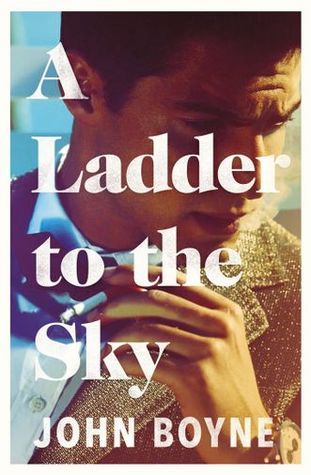
A Ladder to the Sky by John Boyne

‘You’re right, of course,’ he said finally. ‘I’m not very good at thinking up plots, that’s the problem. I feel like all the stories in the universe have already been told.’

‘But that’s just not true,’ I insisted. ‘There’s an infinite supply for anyone with an imagination’.

This month is Reading Ireland Month. I wasn’t sure whether I’d have time to join in, but then I remembered I had A Ladder to the Sky on the TBR pile and, of course, John Boyne is an Irish author. I have read and enjoyed several of his books and this – his most recent, published in 2018 – sounded as though it would be another good one.

John Boyne’s books are always imaginative and always a little bit different to anything else I’ve read and this one is no exception. It tells the story of Maurice Swift, an aspiring novelist whose ambition knows no bounds and who is prepared to do whatever it takes to climb the ‘ladder to the sky’. The first section of the book, however, is written from the perspective of Erich Ackermann, a successful author who is touring Europe to promote his latest novel. Erich, a gay man in his sixties, has almost given up on the idea of finding love, but when he meets Maurice at a hotel in West Berlin in 1988, he feels an instant attraction to the young man and offers him a job as his assistant. Soon he finds himself confiding in Maurice, telling him all the secrets of his past and his youth growing up in Nazi Germany. But can Maurice be trusted – and what might he do with the information he has been given?

While I was reading this opening section, I was beginning to feel confused. It wasn’t really what I’d expected from the blurb – it seemed as though Erich Ackermann was the protagonist of the novel rather than Maurice and instead of reading a story about an ambitious young author I was reading one about Nazis and the fate of a family of Jews during the war. Eventually, though, I understood the point of all this and saw where the plot was heading. As one of the characters in the novel remarks, sometimes you need to give a book at least one hundred pages before making up your mind (“Yes, perhaps you’ll be bored at the start, but what if it gets better and suddenly everything that went before falls into place”) and that was certainly the case here. The book became more and more enjoyable the more I read, and by the time I reached the end I could appreciate the clever structure and the way in which Maurice’s true nature was revealed.

I won’t go into too many details about the things Maurice does as he tries to climb the ladder of ambition, but I can tell you that he is not a pleasant person at all. He is ruthless, cruel, completely without morals and doesn’t seem to care how much he hurts and betrays people. As an author, he suffers from a problem which will be familiar to many aspiring writers – he knows he can write, but he doesn’t know what to write about. Unable to think of any stories of his own, he decides to steal other people’s. But these are not just simple cases of plagiarism; the methods Maurice uses to obtain these stories and pass them off as his own are much worse than anyone could imagine.

Although the novel is quite dark at times (the section narrated by Maurice’s wife, Edith, is particularly disturbing) there’s also some humour, especially when Boyne is having fun satirising the literary world and various author stereotypes – for example, we meet Henry Etta James who writes an award-winning novel called I Am Dissatisfied with My Boyfriend, My Body and My Career and Garrett Colby whose books all feature talking animals, including one about an ‘unrequited love affair between a man and a raccoon’. At one point Maurice also picks up a book by Maude Avery, the fictitious author from Boyne’s previous novel, The Heart’s Invisible Furies, which I thought was a nice touch. Real authors find their way into the novel too, such as Gore Vidal, whom Maurice visits at his villa on the Amalfi Coast.

I ended up loving this book; in fact, with the exception of The Thief of Time, I’ve enjoyed everything I’ve read by John Boyne so far. I still have four of his earlier adult novels to read: The Congress of Rough Riders, Next of Kin, Mutiny on the Bounty and The House of Special Purpose. If anyone has read one or more of those, I’d love to know which you’d recommend I read next.