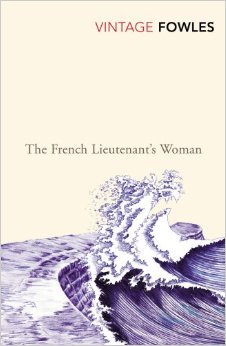
 I feel I’ve been making a lot of progress with my Classics Club list recently. I have just finished two books from the list – one by Thomas Mann and another by Robert Louis Stevenson – but before I tell you about either of those, I wanted to post my thoughts on a book I read almost a month ago. It has taken me a while to motivate myself to write about The French Lieutenant’s Woman because I wasn’t quite sure what I wanted to say. I didn’t dislike it but I certainly didn’t enjoy it as much as I hoped I would or as I feel I should have done.
The story is set in the 1860s in the English coastal town of Lyme Regis (which Jane Austen readers will know as the place where Louisa Musgrove fell down the steps in Persuasion). Sarah Woodruff, the ‘woman’ of the title, spends her days standing alone on The Cobb, the town’s harbour wall, staring out to sea. Nicknamed ‘Tragedy’ by the people of Lyme, Sarah is considered to be a disgraced woman following a brief relationship with a French naval officer who abandoned her and married another woman on his return to France.
Charles Smithson, who is staying in the town with his fiancée Ernestina Freeman, encounters Sarah while out walking one day and is intrigued when he is told about her background. The more he learns about Sarah, the more fascinated he becomes, but as he is still engaged to Ernestina, he will soon be faced with making some important decisions.
The French Lieutenant’s Woman is an unusual novel and I can definitely understand its appeal. Published in 1969 but set in 1867, there are times when it feels almost like an authentic Victorian novel and others when the author intrudes into the story to make an observation from a very contemporary perspective. In John Fowles’ own words:
“You are not trying to write something one of the Victorian novelists forgot to write; but perhaps something one of them failed to write. And: Remember the etymology of the word. A novel is something new. It must have relevance to the writer’s now – so don’t ever pretend you live in 1867; or make sure the reader knows it’s a pretence.”
This novel, then, is a mixture of old and new. It’s a book about the Victorian period – the culture, the science and literature, the conventions of society – as well as a book set in the Victorian period. The author (or the narrator – it’s difficult to distinguish between the two) plays an important role in the story, giving us his opinions of the characters and their actions, and even appearing as a character himself later in the novel. And this, I think, is probably why I had a problem with the book. It doesn’t bother me at all when a Victorian author stops to talk directly to the reader – Anthony Trollope in particular uses that technique a lot and it always seems very natural to me – but when a modern author does it, I don’t think it ever feels quite the same.
In addition to the narrative style, Fowles also incorporates other experimental or postmodern elements. The most intriguing of these, I thought, was his use of alternate endings. He gives us three to choose from: one traditional ‘happy ending’, another which offers some hope, and a third which isn’t very happy at all. By the time I had reached this stage of the novel, I had accepted that I wasn’t going to be drawn into the story emotionally and had no real preference as to how the story should end, so I found it interesting to read all of the endings and think about which might have been the most likely.
I don’t want to sound too negative about this book. I loved the early chapters, particularly the memorable opening scenes where we see for the first time the lonely figure of Sarah gazing out to sea, and I also enjoyed the subplot involving Charles’ servant, Sam, and Mary, Ernestina’s aunt’s maid. I’m sure The French Lieutenant’s Woman must be a fascinating book to study at university or to discuss with a group, but when I’m reading for pleasure I prefer a novel that I can lose myself in, rather than one like this where I am constantly being pulled out of the story. Despite this, I did like John Fowles’ writing and would be happy to try more of his books, but maybe someone who has read them can let me know if they are all like this one?
 She Reads Novels