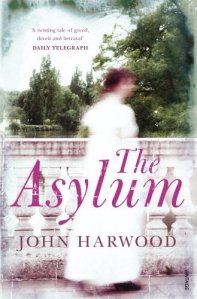
 Imagine waking up one day to find yourself in an asylum, with no memory of how you came to be there. You know your own name – Georgina Ferrars – but the doctor tells you that you had admitted yourself as a voluntary patient the day before under the name Lucy Ashton. The clothes and belongings you’ve brought with you, marked with the initials LA, seem to confirm this, but you’re sure that’s not who you are. Sending a telegram to your uncle, a London bookseller, you wait for him to prove your identity, but when the reply comes it isn’t what you’d hoped for at all. Apparently Georgina Ferrars is safe and well at home…which means you must be an imposter.
This is the nightmare scenario in which a lonely young woman finds herself in this atmospheric gothic tale of betrayal and deceit, secrets, insanity and identity. To describe the plot in any more detail would risk giving too much away, so I won’t try – I think it’s best if you begin this novel knowing no more than I’ve already told you above as part of the fun is in wondering what’s going on and coming up with theories of your own. And I certainly came up with plenty of theories…and had to keep changing and revising them as new clues and revelations came to light!
As I read The Asylum I felt as confused and bewildered as our narrator did. Was she really Georgina Ferrars, as she claimed to be? I thought so at first – I liked her and wanted to believe her – and I was convinced she must be the victim of a conspiracy. But who exactly was involved in the conspiracy? The doctor? The uncle? The fake Georgina? After a while, though, I began to have doubts. Was the narrator herself the fake after all? I couldn’t believe she was telling lies, so did that mean she was deluded or just suffering from a total loss of memory? There were so many questions to ask and so many possible answers.
The story is set in the 1880s and written in the style of a Victorian sensation novel. Like Wilkie Collins’ The Woman in White and other books of that era, parts of the story are told in the form of journal entries and letters. These help to fill in some gaps in our knowledge so that we can start to understand what is happening to Georgina. There were other aspects of the novel that reminded me of Fingersmith by Sarah Waters and one of the letter writers finds herself in a situation similar to the heroine of Samuel Richardson’s Clarissa, but there were enough original ideas here to make this an intriguing and absorbing story in its own right.
Most of the action takes place within the confines of Tregannon House (the private asylum on Bodmin Moor, Cornwall, in which Georgina becomes trapped) and the atmosphere Harwood creates is wonderfully claustrophobic and eerie. I really sympathised with Georgina’s situation and shared her terror and bewilderment. My only criticism of the book is that the ending – in particular the way in which one of the villains of the story is eventually dealt with – felt a bit too melodramatic in comparison to the rest of the book.
This is the third John Harwood novel I’ve read and while I think the first, The Ghost Writer, is still my favourite, I enjoyed this one more than the second, The Séance. They’re all great, though, and if you like this sort of book you can’t go wrong with any of them!


 She Reads Novels