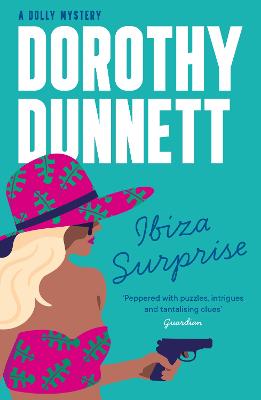
Ibiza Surprise by Dorothy Dunnett

Today (25th August) marks the centenary of one of my favourite authors, Dorothy Dunnett, and to celebrate I decided to read her 1970 mystery novel Ibiza Surprise, which has recently been released in a new edition by Farrago Books. Although Dunnett is better known for her historical novels (The Lymond Chronicles, the House of Niccolò series and King Hereafter, all of which I highly recommend), she also wrote seven of these contemporary mysteries featuring the portrait painter Johnson Johnson and his yacht, Dolly. The original title of this one was Dolly and the Cookie Bird and in the US, Murder in the Round.

Each book in the series is set in a different part of the world and narrated by a different young female protagonist. The narrator this time is Sarah Cassells, the twenty-year-old daughter of Lord Forsey of Pinner, who has been training as a cook since leaving school. Despite her father’s title, he is not a rich man and Sarah is earning a living by providing catering for private parties. When she hears that Lord Forsey has been found dead in an Ibiza boatyard, apparently having committed suicide, she refuses to accept that her father has killed himself. Suspecting murder, she sets off for Ibiza, where she hopes to uncover the truth.

Staying with the wealthy family of a school friend, Sarah finds herself doing the catering while also investigating her father’s death – and at the same time, looking out for a potential future husband. This last task could be easier than expected, as within hours of landing she becomes surrounded by eligible men. However, it appears that at least one of these men may not be all he seems – but which of them can and cannot be trusted?

From a mystery perspective I enjoyed this book more than the previous two – Tropical Issue and Rum Affair – because I found the plot easier to follow. I didn’t solve it all myself, though, and had to wait until the end for everything to be revealed. Sarah is not a character I could particularly like or identify with, but Dunnett perfectly captures her personality through her narrative style: an intelligent but frivolous young woman interested in men, parties, clothes and having a good time. Ibiza, of course, is an ideal place for Sarah to indulge her interest in those things, although I expect it was not quite the same there in 1970 as it is today! Away from the social whirl, there are also some lovely descriptions of the scenery, as well as some insights into the cultural side of life on the island.

We still don’t know a lot about the curiously named Johnson Johnson, apart from the fact that he’s a secret agent of some sort. He is on the peripherals of this particular mystery, although there’s obviously a lot going on behind the scenes that we don’t see. In this series, Dunnett employs the same literary device as in her other books, allowing us to see her heroes only (or mainly) through the eyes of other characters, which leaves a lot open to misinterpretation.

I will get to the other four Johnson mysteries eventually, beginning with the next one, Operation Nassau, which has also just been reissued. Meanwhile, if you think Dunnett’s historical novels could be more to your taste, here’s a post I put together for my Historical Musings series a few years ago on Reading Dorothy Dunnett – and just for fun on what would have been her 100th birthday, some Lines from Lymond!
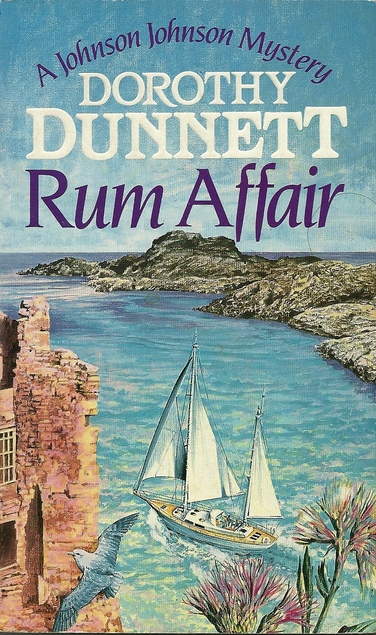
Rum Affair by Dorothy Dunnett – #1968Club

I am, after all, the only really photogenic coloratura soprano alive. My only problem, just about then, was in staying alive.

It’s been a while since I read my first of Dorothy Dunnett’s Johnson Johnson mysteries and this week’s 1968 Club (hosted by Simon and Karen) seemed the perfect opportunity to read another one. Rum Affair – originally titled Dolly and the Singing Bird and then The Photogenic Soprano – was the first in the series to be published (in 1968 obviously), although Tropical Issue, the other one I’ve read, was the first chronologically.

Dunnett is better known for her historical novels, some of which have recently been reissued, but the seven books in her mystery series have contemporary settings. They are each narrated by a different young woman and all feature the portrait painter Johnson Johnson and his yacht Dolly.

Rum Affair opens with Tina Rossi, a Polish-Italian opera singer, arriving in Scotland where she is due to give two performances at the Edinburgh Festival. During a break in her schedule, she has arranged to meet her lover, Kenneth Holmes, at his friend’s Rose Street flat. However, there’s no sign of Kenneth – just a card with the three handwritten words, “Darling, I’m sorry”. Searching for clues to explain his absence, Tina opens a wardrobe door to reveal the body of a man, a stranger, who has been shot in the chest. When the police unexpectedly arrive, making enquiries about a robbery in the neighbourhood, she quickly makes the decision to conceal what has happened – to try to save her own reputation, she tells us, and Kenneth’s.

Instinct is a marvellous thing, I dare say; but I prefer to use my good sense. You, perhaps, with a strange man lying dead at your feet would have welcomed the police with an exhibition of nervous relief. I, on the other hand, kept my head.

On the same night, Tina’s path crosses for the first time with that of Johnson, who is staying nearby. Tina is immediately intrigued by Johnson, a mysterious man who wears bifocals and introduces himself as “thirty-eight. Painter. London. On holiday.” When Johnson invites her to join him on a yacht race to the Isle of Rum, she is quick to accept. Rum is where Kenneth is currently based, working on a highly sensitive project for his employers, although she doesn’t admit this to Johnson. However, it seems that Johnson has a reason of his own for wanting Tina to sail with him on board Dolly – and it’s not just so that he can paint her portrait!

I won’t go into any more detail regarding the plot because I wouldn’t like to inadvertently give too much away and spoil the mystery – and I don’t want to say much more about Tina Rossi either as I’m finding that part of the fun of reading the Johnson novels is in getting to know the woman who is narrating the story. What I will say is that Tina is very different from Rita Geddes of Tropical Issue and that their narrative voices reflect their different personalities and backgrounds (while I liked Rita immediately, I never connected with Tina at all, but I suppose you can’t like every character in every book). As for Johnson himself, even though I have now read two books in this series, he is still very much an enigma to me. Of course, we only see him through the eyes of the narrators so we only know what they choose to tell us and are reliant on their observations and interpretations of his character, which may not always be correct or true.

I also found the setting interesting; the race in which Johnson and Tina are participating takes them around the west coast of Scotland, visiting several islands of the Inner Hebrides, of which Rum is one.

In the summer night, the Inner Hebrides lay all about us, black on the indigo sea. Above us, the uninterrupted sky stretched, a light, dense ultramarine, its ghostly clouds and small, sharp white stars suspended over the bright winking lights, near and far, of a constellation of lighthouses, and the grey, dimly voyaging waves here below.

I particularly enjoyed the scenes set at Fingal’s Cave on the island of Staffa!

Although I don’t think these books come close to the brilliance of Dunnett’s Lymond or Niccolò series, or King Hereafter, they are still quite enjoyable in a different way. I am looking forward to reading the rest and meeting the other five narrators.

Tropical Issue by Dorothy Dunnett

Tropical Issue Having read all of Dorothy Dunnett’s six-volume Lymond Chronicles, eight-volume House of Niccolò series and her standalone novel, King Hereafter, I suppose it was only a matter of time before I picked up one of her Johnson Johnson mystery novels. I wasn’t entirely sure that I was starting with the right book, as Tropical Issue (originally titled Dolly and the Bird of Paradise – Dolly being the name of Johnson’s yacht and the ‘bird’ being the female narrator of the story) was actually the sixth to be published. I had discovered, though, that it is also the first chronologically, so it seemed like a good place to start.

Our narrator is Rita Geddes, a Scottish make-up artist with a punk hairstyle (the book was published in 1983 and I should point out here that unlike the rest of Dunnett’s books, these were contemporary novels rather than historical ones). Rita’s latest client is the journalist and celebrity Natalie Sheridan and at the beginning of the novel Rita is in London preparing Natalie for a photo shoot with the photographer, Ferdy Braithwaite. Ferdy has borrowed his friend Johnson Johnson’s studio flat to use for the session and in this way, Rita meets Johnson for the first time. Not that she learns much about Johnson during this first meeting, other than that he is recuperating after being seriously injured in a plane crash – and that he is a portrait painter, has black hair and wears bifocal glasses.

Joining Natalie for another job on the island of Madeira, Rita learns that the life of her friend and fellow make-up artist Kim-Jim Curtis could be in danger. And when Johnson and his yacht, Dolly, also arrive in Madeira, a mystery unfolds which is complex, surprising and takes the reader through a range of exotic locations from the banana plantations of Barbados to the volcanic craters of St Lucia. As with all good mystery novels, you’ll need to pay attention as things which may seem irrelevant at first turn out to be important later in the book.

I liked the character of Rita from the beginning. She has a very distinctive narrative voice, with her strong personality coming across in every sentence – how can you not love a character who thinks, when disturbed by an intruder in the night, “I rather wished I was wearing something handier than a quilt, but if all else failed, I could smother the guy if I caught him”? As for Johnson, it was difficult not to want to make comparisons with Dunnett’s other heroes, Lymond, Nicholas and Thorfinn, but really, while they do all share some characteristics, there are also some big differences between them. However, I do think there were a lot of similarities in the way Dunnett introduces his character to us – viewing him only through the eyes of other people (in this case Rita), with his true thoughts and motives often being obscured and misinterpreted.

While I love all of Dorothy Dunnett’s other books, I can’t really say that I loved this one – but I did enjoy it. It took me a while to really get into the story, but after a few chapters I was won over by a wild and wonderful sledge race to rival the ostrich ride in Niccolò Rising. It made a nice change, in a way, to be able to read a Dunnett novel without becoming too emotionally involved in the lives of the characters! I don’t feel the same compulsion to immediately read the rest of the series as I did with Lymond and Niccolo, but it’s good to know that there are still another six books to look forward to.