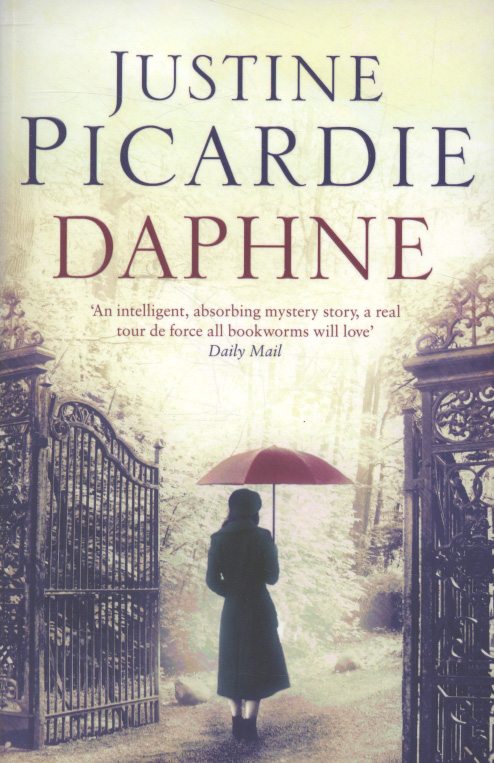
 Justine Picardie’s novel Daphne features one of my favourite authors, Daphne du Maurier, as the main character. We first meet Daphne in 1957, an eventful time in her life. Having discovered that her husband has been having an affair, she throws herself into her current project: a biography of Branwell Brontë. Daphne is convinced that Branwell has been unfairly treated by literary historians. She believes that he may have been capable of writing a novel to rival Wuthering Heights or Jane Eyre and that he may even have been the author of some of the works attributed to his more famous sisters. As part of the research for her new biography Daphne begins corresponding with Alex Symington, a Brontë scholar who shares her views on Branwell. But Symington has some secrets in his past. Can he be trusted?
Another thread of the novel takes place in the present day and is narrated by a student who is busy writing her PhD thesis on Daphne and the Brontes. The story of the shy, naïve student and her difficult relationship with her older husband, Paul, is clearly supposed to mirror the story of Maxim de Winter and his young wife in du Maurier’s Rebecca. Paul even has a glamorous ex-wife, reminiscent of Rebecca herself.
Whenever I read a novel with multiple time frames I usually find that I’m more interested in the historical parts than in the modern day sections, but with Daphne I thought all three strands of the story were equally interesting. The chapters which deal with the characters of Daphne and Symington seemed to be well-researched and were very informative. We learn a lot about Daphne’s relationship with her father, the actor Gerald du Maurier. We are also shown how Daphne was feeling the pressures of being a famous author, how she felt haunted by the ghost of Rebecca and could only truly relax when she was at Menabilly, her Cornwall home. And Picardie explores the link between Daphne and the Llewelyn Davies brothers, particularly Peter, who was the inspiration for J.M. Barrie’s Peter Pan.
I should warn you that if you haven’t read any of Daphne du Maurier’s novels yet you may come across some spoilers, particularly for Rebecca, so you might want to read that one first. I would highly recommend reading Rebecca anyway – it’s a fantastic novel and one that I’ve read and loved several times. I thought Daphne lacked the magic of du Maurier’s own novels and I don’t feel the desire to read it again and again as I have with Rebecca, but it was still an enjoyable book. If you’re interested in du Maurier, the Brontes or literary mysteries with a gothic feel, I’d suggest giving Daphne a try.
 She Reads Novels