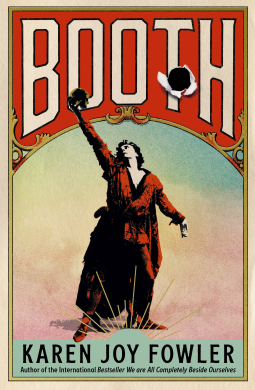
 This fascinating new novel by Karen Joy Fowler tells the story, in fictional form, of the Booths, the 19th century theatrical family who produced two of America’s most acclaimed actors, as well as one infamous killer – John Wilkes Booth, the man who assassinated Abraham Lincoln.
Although John Wilkes is, unfortunately, the best known Booth and probably the reason many readers will be drawn to this novel – to find out more about his background and what drove him to commit such a terrible crime – this is not just his story. In fact, he plays no bigger a part in it than several of the other Booths. For much of the first half of the book, the focus is on his father, the Shakespearean actor Junius Brutus Booth, who will have an important influence on the lives of each of his children – despite the fact that they rarely see him, as he spends so much time away on tour while the family stay at home on their farm near Baltimore.
Junius Brutus is a talented and successful stage actor, but as the years go by his alcoholism and eccentric behaviour make him increasingly unreliable, damaging his reputation and his financial situation. Still, he remains the centre of his children’s lives, and when three of his sons – Junius Jr (or June), Edwin and John Wilkes – follow in his footsteps and become actors themselves, they face a lifelong battle to avoid comparisons with him and with each other. It is Edwin who emerges from his father’s shadow to become one of the leading actors of his time and it is from Edwin’s perspective that we see part of the story unfold.
There are also two Booth daughters who survive to adulthood, Rosalie and Asia – and these are the other characters whose perspectives we see throughout the novel. Rosalie is the eldest and her viewpoint is particularly important early in the novel as she has experiences and memories that her younger siblings do not. As Rosalie grows into a sensitive woman who remains unmarried and close to her mother, she becomes known to the family as ‘poor Rosalie’, a sad and slightly tragic figure. Her younger sister Asia, a stronger personality who will become an author later in life, also offers some interesting insights into the dynamics of the Booth family; she has good relationships with both Edwin and John and feels caught in the middle as tensions begin to grow between the two brothers.
The murder of Abraham Lincoln doesn’t take place until near the end of the novel and there’s not much time left after that to explore the impact this terrible event has on the rest of the Booth family. Neither are we given any real answers as to what went wrong with John Wilkes Booth and what led him to carry out the assassination. It’s hard to say why, coming from a family who were loyal to the Union and largely anti-slavery, it is only John who ends up supporting the Confederacy and opposing abolition. All we can do is make our own assessment based on the information we are given, through the eyes of his siblings, about his childhood, his relationships, his education and his political views.
The novel has clearly been thoroughly researched (although in her author’s note, Karen Joy Fowler explains that as there’s very little information available on Rosalie Booth, it was necessary to use her imagination to fill in the gaps where Rosalie’s character is concerned). However, the book is incredibly detailed and this does slow the plot down a lot, particularly in the middle. We are also given some biographical information on Abraham Lincoln himself and on the events that lead to the Civil War and his presidency. These sections are interspersed with the Rosalie, Edwin and Asia chapters and are presented as non-fiction, which I didn’t really like as I felt it disrupted the flow of the story.
Despite the negative points I’ve just mentioned, I loved this novel. Even the use of present tense and heavy foreshadowing didn’t put me off. I enjoyed learning about a group of historical figures I’d previously known almost nothing about – I particularly liked the parts about the colourful theatrical careers of Edwin and Junius Brutus – and every time I picked the book up I looked forward to finding out what would happen to the family next. I haven’t read anything else by Karen Joy Fowler, not even We Are All Completely Beside Ourselves, but having enjoyed this book so much I’ll consider reading some of her others now.
Thanks to Serpent’s Tail for providing a copy of this book for review via NetGalley.
 This is book 13/50 read for the Historical Fiction Reading Challenge 2022.
 She Reads Novels