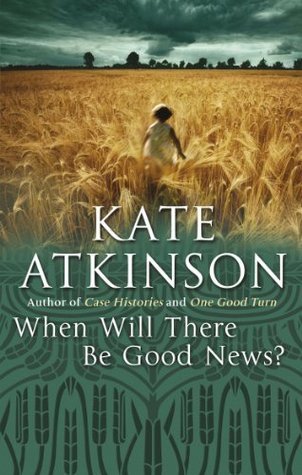
When Will There Be Good News? by Kate Atkinson

When Will There Be Good News It seems that everyone is talking about Kate Atkinson’s new novel, A God in Ruins, at the moment – and that’s definitely a book I would like to read soon, as I loved Life After Life – but I’m also still working through her Jackson Brodie series, of which this book, When Will There Be Good News?, is the third.

The story opens with a tragedy: the murder of a mother and two of her three children as they walk home through the countryside on a beautiful summer’s day. Six-year-old Joanna, who witnesses the brutal attack, is the sole survivor. Thirty years later, Joanna is living in Edinburgh where she is now a doctor with a successful practice and mother of a beloved baby son. She has managed to put the horrors of her childhood behind her and build a new life for herself, but how will she react when she hears that the man who murdered her family is about to be released from prison?

Another character with a troubled past is sixteen-year-old Reggie (short for Regina) Chase, Joanna’s ‘mother’s help’. Reggie is alone in the world apart from her criminal brother, Billy, and the only bright spots in her life are her friendship with Joanna and her love of ancient literature (she has left school but is continuing to study Greek and Latin in private sessions with an eccentric retired teacher, Ms MacDonald). When Joanna and her baby disappear, Reggie is sure something terrible must have happened and she can’t understand why nobody else seems to be worried.

Like the previous two books in this series (Case Histories and One Good Turn), the plot is built around coincidences, chance encounters and interlinking storylines. This is how our old friend Jackson Brodie is brought into the story; accidentally boarding a train heading north towards Edinburgh instead of south to London, he finds himself caught up in a rail disaster which brings him into contact not only with Reggie but also with Detective Chief Inspector Louise Monroe, one of his love interests from One Good Turn. It was nice to meet Jackson and Louise again, but the real star of this book is Reggie, possibly my favourite character to appear in the series so far.

I find Kate Atkinson’s books very quick, addictive reads – despite enjoying them so much that I don’t really want to reach the end, I just can’t seem to read them slowly! As I’ve mentioned before, her books are not conventional crime novels. Crimes are committed and investigated, but the focus tends to be on the impact the crimes have on the characters, and the events and relationships that arise as a result. Each time I’ve finished a Jackson Brodie novel I’ve found that it’s not the plot I remember, but the characters. They are so well developed and so human, with hopes and dreams, likes and dislikes, doubts and worries that any reader will be able to identify with.

This is probably the darkest book of the series so far, with so many tragedies, disasters and accidents that I could certainly understand why it was given the title When Will There Be Good News? The book is not without some humour and lighter moments, though, so don’t let that put you off reading it! I now have only one more Jackson Brodie novel to read (Started Early, Took My Dog), but I may be tempted to read A God in Ruins first – or is there another Kate Atkinson book you think I really need to read without delay?
One Good Turn by Kate Atkinson

One Good Turn After reading Case Histories, the first of Kate Atkinson’s Jackson Brodie novels just before New Year, I was desperate to continue with the series. Luckily, I saw a copy of the second book, One Good Turn (subtitled A Jolly Murder Mystery), on the shelf on my next visit to the library so I didn’t have too long to wait!

Following the events of Case Histories, Jackson Brodie has given up his private investigating, taken his inheritance and is leading a quiet life in the French countryside. At the beginning of One Good Turn, he is visiting Scotland for the Edinburgh Fringe Festival where his girlfriend, Julia, is acting in a new play. On Tuesday, as he waits to enter a comedy venue, Jackson witnesses a road rage incident in which one man attacks another with a baseball bat. Jackson doesn’t want to get involved but it seems that he may have no choice.

Another bystander is crime writer Martin Canning, who intervenes by throwing his laptop at the assailant – and then begins to wish he hadn’t when he is asked to accompany the victim to hospital and stay with him overnight. They say that one good turn deserves another, but Martin’s good turn leads to a chain of bizarre incidents that could almost have come straight out of the pages of one of his own Nina Riley crime novels.

Over the next four days, a complex plot unfolds involving a fraudulent businessman, a mysterious cleaning company, a knife-wielding Russian girl, two teenage shoplifters, an unwelcome guest and an aggressive dog. Jackson can’t help being drawn into the investigations, but as the mystery deepens he finds that he has become both a victim and a suspect.

I had enjoyed Case Histories but I thought this one was even better. It was good to meet Jackson again and to see how his relationship with Julia has developed, but I also think it’s good that Jackson is only one of a large cast of eccentric, colourful characters, each of whom becomes caught up in the whirlwind of events. Atkinson puts so much detail and so much humour into her characterisation that each one feels like a real person – we can laugh at them and with them, but we can understand them and have sympathy for them as well.

In this book, we get to know Gloria Hatter, the bored and disillusioned wife of an unscrupulous businessman in trouble for fraud; police detective Louise Monroe, who is trying to investigate the case while struggling to cope with the behaviour of her teenage son; and my favourite, Martin the crime novelist, a shy, reclusive man still haunted by memories of a disastrous trip to Russia several years earlier. Martin’s Nina Riley mysteries sounded so much fun I kept wishing they really existed!

The one criticism I had of Case Histories – the fact that it dealt with three separate storylines that never really came together – was not a problem with this book, as it’s more of a conventional crime novel in that respect. Characters and events that seemed unrelated at the beginning do eventually begin to overlap and things start to fall into place (comparisons are made throughout the novel to a set of Russian dolls, with one fitting inside the other). I loved the ending too; there was a surprise on the final page that left me questioning everything I’d read about one of the characters!

Now I’m looking forward to reading the third book in the series, When Will There Be Good News?

Case Histories by Kate Atkinson

Case Histories My first introduction to Kate Atkinson’s work was Life After Life, which I read in 2013 and loved. I’ve been wanting to read more of her books and knowing that a lot of people speak very highly of her Jackson Brodie novels, I decided to start with the first one in the series, Case Histories.

In Case Histories, private detective Jackson Brodie is investigating three old cases that have remained unresolved for years:

Case History No. 1 – During the summer heatwave of 1970, three-year-old Olivia Land is sleeping in a tent in the garden with her older sister, Amelia. When Amelia wakes up, she finds that Olivia has disappeared without trace.

Case History No. 2 – In 1994, eighteen-year-old Laura Wyre is murdered on her first day working in her father’s office. Her killer has still not been found and no motive for the attack has ever been discovered.

Case History No. 3 – In 1979, Michelle Fletcher is living on an isolated farm with her new husband and baby daughter. Depressed, lonely and finding it hard to cope, an argument with her husband ends in a brutal murder.

The connection between these three stories is Jackson Brodie, who is contacted by family members hoping to have the cases reopened or looked at again. Amelia and Julia Land want to find out what happened to their little sister, Olivia, and whether she could still be alive; Laura’s father, Theo, wants to know who killed his beloved daughter and why; and Shirley Morrison is searching for her sister Michelle’s daughter, with whom she lost contact after the incident which tore their family apart. But Jackson has problems of his own and as he begins to investigate these three very different crimes, he is reminded of a tragedy in his own past and another ‘lost girl’ who disappeared from his life decades earlier.

I loved Case Histories. I know describing a book as unputdownable is a cliché, but it was true in this case – it really is the sort of book where once you start reading, you don’t want to stop until you reach the end. It’s a crime novel I would recommend even to readers who are not really interested in crime fiction because, while the three mysteries are quite interesting, the real strength of the book is in the characterisation. The story is not so much about the crimes themselves as about the effect they had on the people involved and how they have tried (and often failed) to move on from what has happened.

I liked Jackson and am looking forward to meeting him again in the rest of the series, but my favourites in this book were Amelia and Theo. Amelia, who is approaching middle age feeling friendless and unwanted, has invented an imaginary boyfriend to brighten up her non-existent social life, and Theo, for whom his daughter was the centre of his universe, is neglecting his health while he devotes his life to finding her killer, drawing up colour-coded charts of her friends and teachers and making yearly pilgrimages to the scene of her death. Their lives are sad, lonely and tragic, yet Atkinson injects just enough humour into their stories to turn them into characters who are amusing but not ridiculous, flawed but sympathetic.

I also thought the structure of the book was interesting, because the timeline is not entirely linear. We see events from one perspective in one chapter, then in the next chapter we go back several hours, days or weeks to see those same events from another character’s perspective, filling in gaps and adding to our knowledge of what is going on. Two of the case histories – Olivia’s disappearance and Laura’s murder – worked very well alongside each other, but the third one, involving Michelle and her sister, felt disconnected from the others and didn’t work quite as well. I think I had expected all three cases to be much more closely linked than they actually were and I was disappointed that they weren’t.

At the end of the book, after Jackson is sure he’s solved the crimes, there are still more twists to come. We are given enough information throughout the story so that we can guess at what may have happened and work out some parts of the mystery, but the final pieces of the puzzle are withheld from us until the very end.

That’s two Kate Atkinson books read and two enjoyed; now I can’t wait to read the second book in the Jackson Brodie series, One Good Turn.

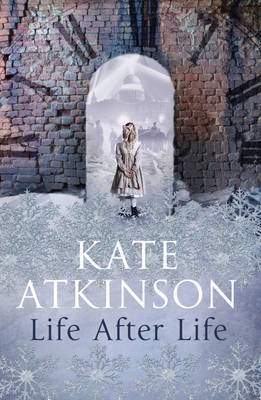
Life After Life by Kate Atkinson

Life After Life Do you ever look back on your life and wish you had done something differently? Do you sometimes regret the decisions you’ve made and wonder what would have happened if you’d chosen another path through life? I’m sure we would all answer ‘yes’ to those questions, but unfortunately most of us only have one chance to get things right. But Ursula Todd is not like the rest of us. If things don’t work out the first time, she does have the chance to go back and try again…and again…and again.

Ursula is born one snowy night in February 1910 with the umbilical cord around her neck. Darkness falls and she dies before the doctor has time to arrive. We turn the page and it’s that same night in February 1910 again. This time the doctor is present and she survives, but this is only the beginning of Ursula’s journey through life. Every time she reaches a turning point, she must be sure to make the right decision – otherwise darkness will soon fall once more and Ursula must return to the night of her birth in 1910 and have another attempt.

As we follow Ursula again and again through some of the major events of the twentieth century – including both the First and Second World Wars (there are some very atmospheric scenes set in London during the Blitz) – she slowly grows in wisdom and learns from her previous mistakes, even without being fully aware of what is happening to her or why. Gradually she develops a sort of intuition or déjà vu that allows her to draw on her past experiences, and this is used to particularly good effect in an early sequence of chapters in which she has several attempts at preventing the maid, Bridget, from going to London and catching Spanish flu.

Apart from Ursula herself, the characters who are almost always there throughout every version of the story are the members of the Todd family – Ursula’s brothers Maurice, Teddy and Jimmy, sister Pamela and parents Hugh and Sylvie – and the servants, Mrs Glover and Bridget. Izzie, Ursula’s wild and irresponsible aunt, also plays a significant role in many of the storylines. Other characters come and go; people who are an important part of Ursula’s life in one existence barely appear at all in another and it’s fascinating to see how something as simple as a chance encounter in the street (and the way she reacts to it) could completely alter the course of her future. Sometimes Ursula is unable to change the outcome of a particular event no matter what choices she makes; on other occasions even a small action has huge consequences.

Life After Life is a very clever, complex novel; I was so impressed by it! With such an unusual and complicated plot it could have been a disaster, but it wasn’t; I thought everything worked perfectly and although I found it confusing at first, after the first few chapters I knew I was going to love the book. It’s actually much less repetitive than you might think and fortunately we don’t have to go right through the entire story from the beginning each time Ursula is reborn! I sometimes felt a bit distanced from Ursula, maybe because in each of her lives she makes different choices, has different ambitions and motives, so is not exactly the same person she was in a previous existence – but that didn’t stop me liking her and hoping things would work out better for her the next time darkness fell and she went back to that snowy February night yet again.

This is the first Kate Atkinson book I’ve read and having enjoyed it so much I will be looking out for her other books now. I understand that her earlier novels are very different to this one but I would still like to read them and would welcome any recommendations.