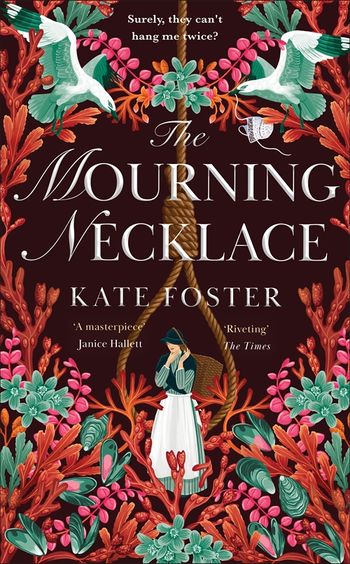
 Some people become famous for their remarkable lives and others for their remarkable deaths. Maggie Dickson is one of the latter – although technically, it wasn’t really a death at all! Known as ‘Half-Hangit Maggie’, Maggie Dickson was sentenced to death in 1724 and hanged in Edinburgh’s Grassmarket. As her family gather in a nearby tavern, they are shocked to look up and see Maggie herself standing at the door. Other than a rope burn around her neck, she seems unharmed by her ordeal and determined to make the most of the second chance she’s been given. But while everyone has questions for her – how did she survive and how did it feel to be so close to death? – there’s only one question that matters now to Maggie: will they try to hang her again?
Maggie Dickson was a real person and the story of her survival is a true one, still remembered three hundred years later; Maggie Dickson’s Pub in Edinburgh is named after her and she is often featured in Edinburgh walking tours. In The Mourning Necklace, Kate Foster builds a fictional story around this amazing woman and her near-death experience, using her imagination to fill in the gaps around the historical facts.
The year before she receives her death sentence, Maggie is living with her parents and younger sister, Joan, in Fisherrow, a small fishing community in Musselburgh, Scotland. The Dickson family have made their living from fish for generations, but Maggie doesn’t see a future for herself as a fishwife and wants something different out of life. Her marriage to Patrick Spencer, a perfume trader, seems to offer the opportunities she’s looking for, but when things don’t go according to plan, she takes control of her own fate and sets out alone for London. However, she gets no further than Kelso in the Scottish Borders before she is forced to make a series of decisions that will lead her back to Edinburgh and the gallows.
I enjoyed Kate Foster’s last novel, The King’s Witches, but I thought this one was much better and I connected with Maggie Dickson in a way that I didn’t with the women in the other book. There’s also a strong cast of supporting characters, including Joan, whose actions as a sister disappoint Maggie over and over again; Mrs Rose, who betrays Maggie for reasons of her own but at the same time is one of the few people to offer her friendship; and the wicked Dr McTavish, one of the book’s villains. All of these people have key parts to play in Maggie’s story, which is divided into three sections: the events leading up to her arrest, the hanging itself, and the path her life follows after she escapes death.
Maggie’s crime is something that will surprise a lot of modern readers as, although she unknowingly broke the laws of the time, today we wouldn’t really consider her to have committed a crime at all (at least not if Kate Foster’s interpretation is close to the truth). At first I assumed that as the death sentence was usually given as ‘hanged by the neck until dead’, it would be decided that Maggie had not served the sentence and would be hanged again. However, it wasn’t as straightforward as that because it seems that the sentence at that time was simply ‘hanged by the neck’ and the additional words were added later to avoid ambiguity in cases like hers.
This is a fascinating novel, with some great descriptions of 18th century Musselburgh, Edinburgh and Kelso. We also learn a little bit about the tea smuggling which was widespread down the east coast of Scotland and England due to high taxes on imported tea. I loved it and must find time to go back and read Kate Foster’s first book, The Maiden.
Thanks to Pan Macmillan/Mantle for providing a copy of this book for review via NetGalley.


 She Reads Novels