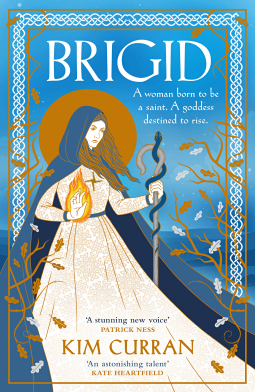
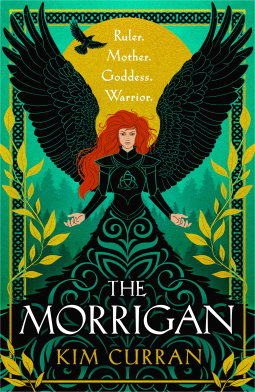
 I enjoyed Kim Curran’s previous book, The Morrigan, which told the story of the Irish goddess of war and fate, one of the supernatural race known as the Tuatha Dé Danann. Her new novel, Brigid, takes as its subject another figure from Ireland’s distant past: Saint Brigid of Kildare, a semi-mythical woman who may or may not have existed. The current thinking seems to be that she was a real person, an abbess who founded the abbey of Kildare, but has been given many of the attributes of the Celtic goddess, Brigid, who shares her name. Curran’s approach is to include both Brigids in the novel, with the goddess guiding and watching over her human namesake.
The human Brigid, born in the 5th century, is the daughter of an Irish chieftain and one of his slaves, whom he sells to a druid when she becomes pregnant. Brigid grows up in slavery in the druid’s household before being returned to her father, who attempts to arrange a marriage for her. When she gives away her father’s best sword to a beggar, the king hears about her kindness and grants Brigid her freedom. Determined not to be forced into marriage or to live a life controlled by men, Brigid sets off alone on a journey to find her mother. Along the way she makes several new friends, including Lommán the leper and Darlughdach the bard, with whom she later founds a small sanctuary for women, which expands over time into the large and powerful abbey of Kildare.
I had no prior knowledge of Brigid’s life before beginning this book, but it seems that Curran has incorporated many of the key events and characters traditionally associated with Brigid’s story. One of these characters is St Patrick, with whom Brigid clashes several times throughout the book. She resents Patrick because he has all the advantages of being a man in a male-dominated society and because his approach to converting people to Christianity is more forceful than hers. Brigid is happy to allow people to continue celebrating pagan gods and festivals alongside the new Christian religion rather than expecting an immediate conversion.
For a while, it seemed that the message of the book was “all men bad, all women good”, which is something that tends to annoy me because I think there are better, fairer ways to promote feminism. However, it turned out to be slightly more nuanced than that, as eventually some of Brigid’s own friends and followers become frustrated by her hatred of men and even Brigid herself has to accept that a life entirely without men is not possible and she’s going to have to learn to work with them whether she wants to or not. She can also be cruel, punishing people harshly for the smallest of things. As someone who would become a saint, I certainly didn’t find her very saintly in this depiction, but despite that she’s clearly someone who inspires love and loyalty from the women around her and that’s what makes her an interesting, if not always likeable, character to read about.
Whereas The Morrigan was a mythological retelling, with strong fantasy elements, this book is more grounded in reality. There’s still a small amount of magic, though, such as when Brigid performs her miracles – healing lepers, for example, or turning milk into butter. She’s assisted in this by the goddess Brigid, who occasionally appears to her in human form. However, I would describe this as much more of a historical fiction novel than a fantasy one, while The Morrigan was the other way round. They are both interesting books and it’s good to see an author tackling subjects that aren’t written about very often.
Thanks to Michael Joseph for providing a copy of this book for review via NetGalley.
 She Reads Novels