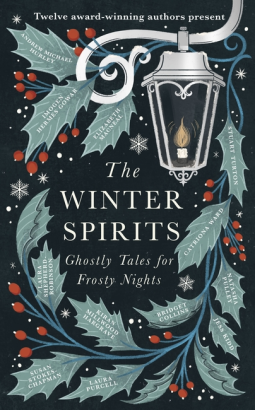
The Winter Spirits: Ghostly Tales for Frosty Nights

The Winter Spirits: Ghostly Tales for Frosty Nights is a collection of twelve new ghost stories written by popular authors of historical and Gothic fiction, all with a Christmas or Advent theme. It’s a follow-up to The Haunting Season, which I haven’t read but which includes eight of the same authors. This is the perfect time of year for ghost stories, so maybe I’ll look for the previous book next winter.

Back to The Winter Spirits and most of the stories are set in the 19th or early 20th centuries, giving them a traditional feel. More variety would have been nice – not just in the time periods, but also in the geographical settings, as the majority take place in Britain, with one or two in America or elsewhere in Europe – but otherwise I really enjoyed this collection. I’ve previously read full-length novels by most of the featured authors, but three of them were new to me: Andrew Michael Hurley, Catriona Ward and Susan Stokes-Chapman. I felt that Hurley’s The Old Play and Stokes-Chapman’s Widow’s Walk were two of the weaker stories, but looking at other reviews, some readers have singled them out as favourites, so I think it’s just a case of different stories appealing to different people! Ward’s contribution, Jenkin, was completely bizarre but added some diversity as it felt quite unlike any of the others.

The biggest surprise, for me, was Natasha Pulley’s The Salt Miracles; I really didn’t get on with her writing style in her novel The Bedlam Stacks, so I wasn’t expecting too much from this tale of disappearing pilgrims on a remote Scottish island (based on St Kilda). However, I ended up loving it – it’s such an unusual and chilling story! Inferno by Laura Shepherd-Robinson, one of my current favourite historical fiction authors, is another I particularly enjoyed – a wonderfully eerie story set in 18th century Italy, where a man is forced to confront his sins. Even better than both of these is Stuart Turton’s creepy and imaginative The Master of the House, in which a young boy who is being neglected by his father makes a deal with the devil. This one feels almost like a very dark fairytale and is one of the highlights of the book.

Of the twelve authors, Laura Purcell is probably the most well established as a writer of horror fiction and she doesn’t disappoint here with Carol of the Bells and Chains, in which a governess trying to deal with two unruly children tells them the story of the Krampus, with unintended consequences. Imogen Hermes Gowar’s A Double Thread, where a woman gets her comeuppance after badly treating her hardworking seamstress, is another I really enjoyed – it made me long for another novel by Gowar, as it’s been a few years since The Mermaid and Mrs Hancock!

The remaining stories are by Elizabeth Macneal, Bridget Collins, Jess Kidd and Kiran Millwood Hargrave. With a range of different styles and subjects, unless you just don’t like ghost stories I think this collection should contain something to please almost every reader.

Thanks to Sphere for providing a copy of this book for review via NetGalley.

The Dance Tree by Kiran Millwood Hargrave

Having enjoyed Kiran Millwood Hargrave’s previous book, The Mercies, I was looking forward to reading more of her work. This new novel, The Dance Tree, sounded very different, but equally intriguing. It’s set in 16th century Strasbourg during a plague of dancing – yes, dancing, which sounds harmless but, as the novel shows, is anything but.

The Dance Tree begins in 1518 and introduces us to Lisbet, a young pregnant woman, who lives with her husband and mother-in-law. Lisbet has already lost several babies and is determined to carry this one to full term; while her pregnancy advances she finds comfort in looking after the bees that provide the family’s livelihood and visiting the tree she has decorated in memory of her lost children. One day, Lisbet’s sister-in-law, Agnethe, comes home from the nunnery where she has been doing penance for the last seven years; Lisbet has no idea what the sin was that resulted in Agnethe being sent away, but she does know that her return has changed the dynamics within the household and that life will not be quite the same again.

Meanwhile, in the centre of Strasbourg, Frau Troffea walks into a market square, lifts up her hands and begins to dance. She is soon joined by more women…and more…and more, all of them dancing until the soles of their feet bleed. As the women continue to dance day after day – a desperate, frenzied dance that shows no sign of coming to an end – the authorities try to bring them under control, without success.

I knew nothing about the dancing plague before reading this book, so I found that aspect of the novel fascinating. Many theories have been put forward over the years to explain why the women danced, ranging from demonic possession or religious trance to ergot poisoning or mass hysteria. Even today, historians don’t know for sure what was behind the epidemic, but to help us understand some of the possible reasons, Kiran Millwood Hargrave provides back stories for some of the individual dancers. These stories are presented as brief chapters interspersed between Lisbet’s chapters, and although I thought they could have been better integrated into the novel as a whole, they were interesting to read.

I liked Lisbet and had a lot of sympathy for her situation, and also for her best friend, Ida, who is married to a controlling bully who belongs to the ‘Twenty One’, the group of men who rule the city. Agnethe is another intriguing character, although I found the reason for her seven-year penance too easy to guess. However, despite finding the characters interesting, I didn’t manage to form the deep emotional connection with any of them that I would have liked. I’m not sure why this should be, because Hargrave does write beautifully, except that I often find the use of present tense very distancing and I think that was the case here.

Although I didn’t love this book as much as I hoped, I would recommend Kiran Millwood Hargrave’s books to readers interested in historical fiction dealing with women’s lives in unusual settings and circumstances – in this book, the Strasbourg dancing plague, and in The Mercies, the witch trials on the Norwegian island of Vardø.

Thanks to Picador for providing a copy of this book for review via NetGalley.

This is book 22/50 read for the Historical Fiction Reading Challenge 2022.

The Mercies by Kiran Millwood Hargrave

I am always drawn to books with pretty covers like this one, even though I know that the story inside doesn’t always live up to the promise of the cover. This one, set in 17th century Norway, did sound fascinating, though, so I hoped that in this case it would be as good as it looked!

The novel opens in December 1617 in the remote island town of Vardø, in the far northeast of Norway. It is Christmas Eve but the men of the island have gone out to sea as usual in search of the fish on which their livelihood depends. Twenty-year-old Maren Magnusdatter watches from her window as she sits by the fire with her mother and sister-in-law mending torn sails. Suddenly there’s a flash of lightning and Maren and her mother run to the window…

And then maybe both of them are screaming but there is no sound save the sea and the sky and all the boat lights swallowed and the boats flashing and the boats spinning, the boats flying, turning, gone.

The effects of that Christmas Eve storm are disastrous both for Maren, who loses her father and brother, and for the town of Vardø as a whole. Where the male population of the town used to be fifty-three, now only thirteen remain – and those thirteen consist of babies, young boys and elderly men. Now the women of Vardø have two choices: abandon the island and start a new life somewhere else – or stay and do the work of the men themselves, so that their community can survive.

Meanwhile, far away in Bergen, a young woman called Ursa is marrying a man chosen for her by her father. The man’s name is Absalom Cornet and he has been summoned from Scotland to take up a position as Commissioner of Vardø. When they arrive in Vardø, Ursa is struck by the strength and independence of the women she meets there and the resilience they have shown in coping with such a terrible tragedy. Commissioner Cornet, though, views the women differently – and when Ursa discovers the true nature of the work her husband has carried out in Scotland and why he has been brought to Norway, she becomes afraid for her new friends.

The Mercies is based on real historical events – the 1617 storm which almost wiped out all the men of Vardø really happened, and so did some of the things that take place later in the novel. I loved the descriptions of the island and the portrayal of a small, superstitious society where outsiders and anyone deemed to be different – such as Maren’s sister-in-law, an indigenous Sámi woman – are regarded with suspicion. It was particularly interesting to see things from two such different perspectives: Maren, who has lived in Vardø all her life, and Ursa, to whom everything is strange and unfamiliar. However, despite the drama and tragedy of Maren’s storyline, she never really came to life for me and I couldn’t quite warm to her; I found Ursa more sympathetic as she struggled to fit into her new community and to come to terms with her knowledge of the sort of man she had married.

This is the first book I’ve read by Kiran Millwood Hargrave (she has previously written YA novels and this is her first one aimed at adults) and I thought her writing was beautiful at times, but I really wish authors would stop writing in present tense; I find it so distracting and distancing! Still, there’s a lot of atmosphere – I think books set in countries like Norway and Iceland do tend to have a certain atmosphere – but apart from those vivid opening scenes describing the storm and its aftermath, I felt that the rest of the story was one I’d read several times before. As soon as I found out who and what Absalom Cornet was, I could predict what was going to happen and I was right.

If you read The Mercies and enjoy it, I would recommend reading The Glass Woman by Caroline Lea too; I thought the two books had a very similar feel and if you like one you will probably like the other.

Thanks to Picador for providing a copy of this book for review via NetGalley.