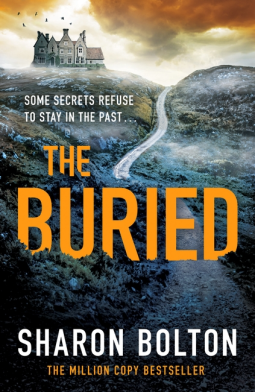
 Two new Sharon Bolton books in one year! I loved The Dark, the latest in Bolton’s Lacey Flint series, which was published in the spring – and now, with The Buried, she returns to her Florence Lovelady series. I’ve been waiting for this sequel since I read The Craftsman in 2018 and had almost given up hope of it ever appearing, but here it is at last. It was definitely worth the wait!
The Buried begins in the summer of 1999, with Florence Lovelady visiting Larry Glassbrook in prison. Florence, now a senior police officer with the London Met, was responsible for Larry’s conviction thirty years earlier for the murder of three teenagers in Sabden, Lancashire. Now the remains of four more children have been discovered and Florence is confused. Are these more of Larry’s victims or are the remains more recent, meaning that the real killer is still on the loose? Also, the bodies were found in the grounds of Black Moss Manor Children’s Home, which Florence had helped to close down in 1969 after finding evidence of neglect and cruelty. What does this mean and how can she discover the identity of the children?
Soon after Florence’s visit, Larry Glassbrook dies of cancer and preparations are made for his funeral. His daughter Cassie returns to Sabden after a long absence and immediately sets her sights on John Donnelly, whom she loved as a teenager and who is now a married man with children. Cassie herself has become a successful songwriter, but she has never quite managed to put the past behind her and still has questions about some of the things that happened in Sabden thirty years ago.
The first section of the book alternates between Florence and Cassie during the build up to Larry’s funeral and I have to admit, I felt very confused. I found that I’d forgotten most of The Craftsman and I kept coming across references to people and events I couldn’t remember at all. Who was Marigold? What was Florence’s involvement with Black Moss Manor? I had no memories of those things at all, but they were obviously important. Then I discovered that I wasn’t supposed to remember them as they didn’t actually form part of the plot of The Craftsman. I just needed to be patient because the second section of the novel takes us back to 1969 and my questions about Marigold and Black Moss Manor were answered. The shifting timelines with various parts of this book set both before and after the events of The Craftsman means it works as both a sequel and, in a way, a prequel.
The 1969 storyline (which forms the main part of the novel) is excellent – Sharon Bolton at her best. I was completely gripped by Florence’s investigations into the allegations of abuse at the children’s home and the obstacles she faces in trying to get anybody to take her concerns seriously. The 1960s setting allows Bolton to explore the sexism and misogyny Florence faces as she tries to do her work; the other police officers are exclusively male – local men from Sabden who resent Florence’s university education, southern accent and the fact that she is a woman doing what they consider a man’s job. Meanwhile, we get to know Sally Glassbrook, Cassie’s mother, who is struggling to cope after Larry’s arrest and imprisonment. As the family of a convicted murderer, Sally and her daughters are in a vulnerable position and find themselves having to fend off the unwanted attentions of Roy Greenwood, Larry’s former business partner.
Finally, I need to mention the supernatural elements! The way The Craftsman ended made me think these were going to be a major part of the second book, but things didn’t go quite as far in that direction as I’d expected and the crimes committed are all very human ones. We do see more of the coven of witches who are operating in Sabden (Pendle Hill, site of the famous 17th century witch trials, casts its shadow over the town), the influence of the mysterious and sinister group known as the Craftsmen, and Florence’s own seeming ability to communicate with the dead, but I didn’t think these elements dominated the story too much. However, they are there and won’t appeal to everyone. I would say these books are closer in tone to Bolton’s early standalones such as Sacrifice and Awakening than they are to the Lacey Flint novels or her other recent thrillers.
I loved this book once I managed to get back into the story, but I would definitely recommend reading The Craftsman first – or re-reading it if, like me, you read it several years ago and can’t remember the details.
Thanks to Orion for providing a copy of this book for review via NetGalley.
 She Reads Novels