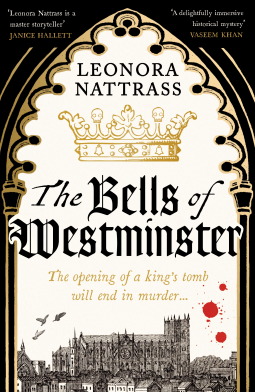
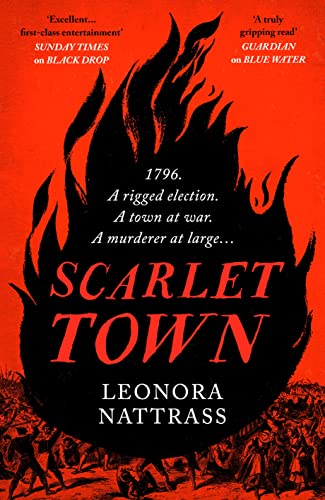
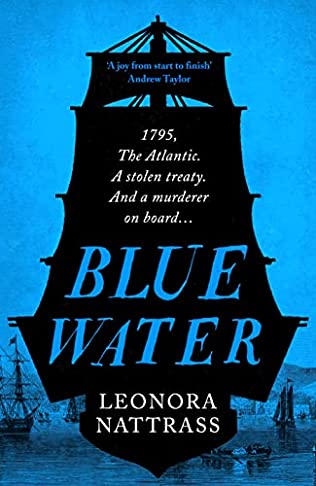
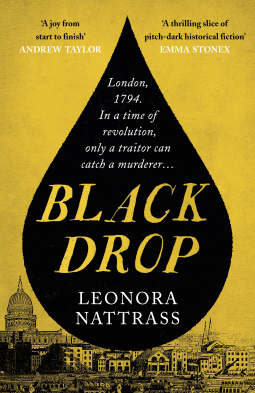
 I’ve enjoyed all three books in Leonora Nattrass’ Laurence Jago series (Black Drop, Blue Water and Scarlet Town) and was hoping for a fourth, but it seems she’s moved on to other things, at least temporarily. Like the Jago books, The Bells of Westminster is set in the 18th century but is a completely separate story with a new set of characters to get to know.
It’s 1774 and King George III has just given his permission for the Society of Antiquaries to open the tomb of Edward I, who rests in Westminster Abbey. The Society wants to discover whether Edward’s body was embalmed, according to his wishes, and whether he was buried with any valuable artifacts. However, the opening of the tomb sets in motion a series of bizarre events: first, a ghostly figure is seen wearing the dead king’s crown, then one of the Antiquaries is found dead and Edward’s body is stolen. Mr Bell, the Dean of Westminster, is given the job of investigating, but his daughter Susan knows he’s not capable of solving the mystery and it will be up to her to solve it for him.
The novel is narrated by Susan Bell who, at twenty-three, is already considered a spinster. Her father would like her to marry her cousin Lindley, an aspiring scientist who is staying with them at the Deanery, but Susan isn’t sure what she thinks of him – and anyway, she’s quite happy with the company of her talking parrot, Cuthbert. Susan’s narration takes the form of diary entries, through which we see the mystery unfold as well as gaining some insights into life within the confines of Westminster Abbey.
I’ll be honest and say that at first I didn’t think I was going to enjoy this book. I had trouble connecting with Susan’s narrative style, peppered with notes and asides, which seemed to be trying very hard to be clever and witty. It also took a long time for the story to really get started, but once the murder happened about a quarter of the way into the book, I became drawn in. Susan’s narration also grew on me after a while and I found I liked her much more than I thought I would at the beginning.
Nattrass explains in her author’s note which parts of the book are based on fact and which are invented. The opening of Edward I’s tomb in 1774 really happened, for example – although the body wasn’t stolen and a ghost didn’t really appear! The characters are also a mixture of real people and fictional ones (Susan Bell is one of the latter). One thing that’s completely real, of course, is the setting: with the whole book being set within Westminster Abbey and its grounds, there are lots of detailed descriptions of the chapels, arches and galleries as well as the various tombs and shrines.
 The eighteenth century was also a time of major scientific developments and Nattrass is able to explore some of these through Lindley’s interest in science. In particular, we see how a knowledge of science can work along with – and sometimes in conflict with – superstitions, religion or fear of the supernatural. This is a fascinating novel, then, and although I would still have preferred another Laurence Jago book, I did enjoy this one once I got past the slow, uncertain start!
Thanks to Viper for providing a copy of this book for review via NetGalley.

Book 47/50 for the Historical Fiction Reading Challenge 2024





 She Reads Novels