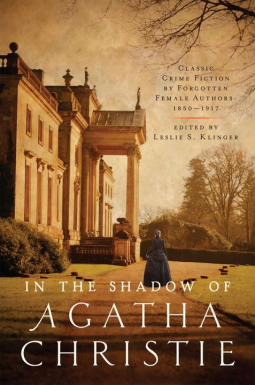
 Agatha Christie is an author most people have heard of, whether or not they’ve ever read any of her books. Ask someone to think of a female crime writer and she is probably the first name that will come to mind. Christie’s first novel, though, wasn’t published until 1920 – and she was by no means the first woman to write in the crime genre. This new collection of short stories, edited by Leslie S. Klinger, features some of the lesser known women crime writers who came before Agatha and could even have inspired her work.
The book is subtitled Classic Crime Fiction by Forgotten Female Writers: 1850-1917 and although I wouldn’t personally describe all of these authors as ‘forgotten’, there were certainly quite a few whose names were new to me. Of the sixteen stories included in the book, I had already read one of them – A Jury of Her Peers by Susan Glaspell (1917), which shows the different ways in which men and women evaluate the same situation and the different clues they pick up on – but it’s such a good story I was happy to read it again. Other names who may be familiar to many readers are Victorian novelist Elizabeth Gaskell and Scarlet Pimpernel author Baroness Orczy, although the stories included here – The Squire’s Story (1853) and The Regent’s Park Murder (1901) – didn’t particularly stand out to me.
As a fan of Victorian sensation novels, I was intrigued to come across stories by Ellen Wood and Mary Elizabeth Braddon, two authors whose work I’ve loved in the past. The Braddon one, The Winning Sequence (1896), is more of a ghost story than a mystery and I found it disappointingly weak, but Wood’s story, Mrs. Todhetley’s Earrings (1873), was very enjoyable. It is narrated by her young hero, Johnny Ludlow, who is apparently the subject of a whole series of short story collections, although I had never heard of him until now.
Others that I think deserve a special mention include The Statement of Jared Johnson (1899) by Geraldine Bonner, a murder mystery with a twist I’ve come across several times in crime stories recently but which I always find clever, The Ghost of Fountain Lane (1893) by C.L. Pirkis, in which a link emerges between two seemingly unconnected mysteries, and The Case of the Registered Letter by the Austrian author Augusta Groner. There’s also A Point in Morals (1899) by Ellen Glasgow, an unusual story which considers whether murder is always morally wrong, The Blood-Red Cross (1902) by L.T. Meade which features a sinister villain called Madame Sara, and Anna Katherine Green’s Missing: Page Thirteen (1915), an eerie tale of a house with a secret room.
The other authors represented in the book, whose work made less impression on me, are Catherine Crow, Mary Fortune, Harriet Prescott Spofford, Elizabeth Corbett and Carolyn Wells – whose The Adventure of the Clothes-Line (1915) is a parody of a Sherlock Holmes story which I think a lot of readers would enjoy even though I didn’t.
There’s nothing here, in my opinion, which resembles an Agatha Christie story in any way, so the title of this book could be slightly misleading if someone picked it up expecting a selection of Christie-style mysteries. I didn’t find any new authors here that I liked enough to want to explore further, but it was still interesting to read this collection and see how crime fiction has developed over the years.
Thanks to Pegasus Books for providing a copy of this book for review via NetGalley.
 She Reads Novels