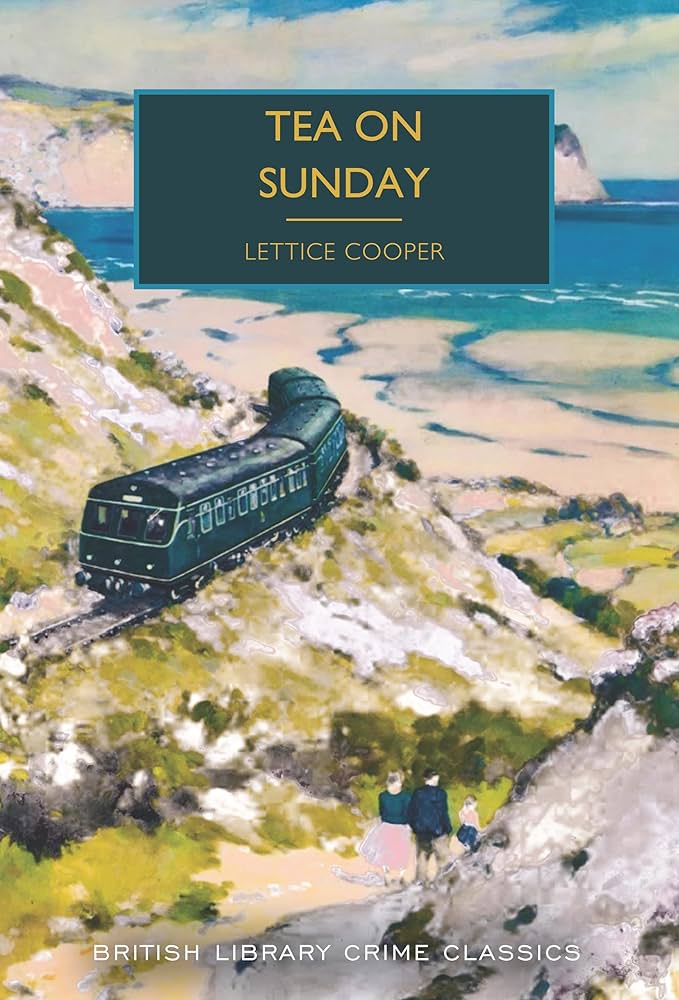
 Lettice Cooper is a new author for me. I’m aware that two of her books from the 1930s, National Provincial and The New House, have been published by Persephone, but I haven’t read either of them yet. Tea on Sunday, her only detective novel, sounded appealing, though; it was published in 1973, very late in her life, but has the feel of a Golden Age mystery and has recently been reissued as a British Library Crime Classic.
The plot is quite a simple one. On a snowy winter’s day, Alberta Mansbridge invites eight guests to a tea party at her home in London. The guests include her family doctor, her ‘man of business’, an old friend, the manager of her late father’s engineering company, her nephew Anthony and his wife, and two young men she has taken under her wing – an Italian and an ex-prisoner. As the group gather outside her door that Sunday afternoon, they become concerned when their knocking goes unanswered. Eventually the police are called and force open the door to find that Alberta has been strangled while sitting at her desk.
There’s no real mystery regarding how the murder took place. The doors and windows had been locked and there’s no sign of a burglary, so the police are satisfied that the killer must have been someone Alberta knew and let into the house – probably one of the eight guests who arrived early, committed the murder, then left again to return a few minutes later with the others. But which of the eight was it and why did they want Alberta dead?
Tea on Sunday is a slow paced novel where, once the murder is discovered, not much else actually happens. Most of the focus is on Detective Chief Inspector Corby interviewing the various suspects one by one and delving into Alberta’s personal history to see if the answer lies in her past in Yorkshire. Despite the lack of action, I still found the book surprisingly absorbing and that’s because of Cooper’s strong characterisation. Any of the eight could be the culprit as none of them have alibis and this means Corby has to learn as much as he can about each person and whether or not they have a motive.
Corby is a likeable detective and it’s a shame he only appears in this one book by Lettice Cooper as she could probably have built a whole series around him. Although a few of his comments about women are questionable, I could make allowances for the period in which the novel was written and in general he’s respectful towards the people he interviews and doesn’t judge until he’s heard all the facts. It would be easy, for example, for him to pin the blame on Barry Slater, the former prisoner Alberta met through her charitable work and who runs away as soon as the police are called to the scene, but he doesn’t do this and waits to form his own opinion.
Of the eight suspects, the characters who stand out the most, in my opinion, are Anthony Seldon and his wife, Lisa. As the dead woman’s nephew and the only direct family member invited to the tea party, Anthony naturally comes under suspicion, so a lot of time is spent on his background, painting a picture of a young man who disappointed his aunt by refusing to go into the family business and by marrying a woman she dislikes quite intensely. Another interesting character is Myra Heseltine, Alberta’s close friend who lodged with her until discovering that Alberta’s latest protégé, Marcello Bartolozzi, whom Myra distrusts, may be moving in as well.
It’s Alberta Mansbridge herself, however, whose character comes across most strongly. Despite being murdered so early in the book, she is brought to life through the words and memories of those who knew her: a woman proud of her family’s legacy, stubbornly resistant to change and progress, who interferes in other people’s business but at the same time is generous and giving. At first it’s difficult to see why so many people may have wanted her dead, but gradually motives emerge for almost all of the suspects.
The actual solution to the mystery is disappointingly simple and there are no clever twists along the way, like we would expect from Agatha Christie, for example. I felt let down by the ending, but it was still an enjoyable read up to that point and as the first book I’ve completed in 2025 it means my reading for the year is off to a good start.
 She Reads Novels