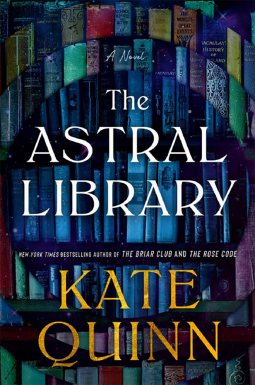
 Life has never been easy for Alix Watson. Passed around from one foster home to another, her childhood lacked love and security, and now that she’s an adult she’s living in poverty, juggling three part-time jobs in an attempt to make ends meet. But today has been the worst day of all: she’s lost one of her jobs – the highest paying one; her roommate has thrown her out of their shared apartment because his girlfriend is jealous; and she only has a few dollars left in the world, which she can’t even access because her card has been declined. Homeless and alone, Alix takes refuge in the reading room of Boston Public Library, the only place that has ever felt like home. Stumbling through an open door, she finds herself emerging into the Astral Library – a place where time stands still and where the desperate, the lonely and the abused can find sanctuary, literally, inside a book.
Many of us have probably wondered what it would be like to live in one of the fictional worlds described in our favourite books, but in the Astral Library people get the chance to really do exactly that. Alix just needs to decide which literary world to choose – Austen’s Regency? Dickens’ London? The possibilities are endless (as long as the book is in the public domain). Eventually Alix makes her decision, but before she can step inside her book and begin her new life, an urgent message arrives. Someone already within another book is in danger and it seems the future of the Astral Library itself could be under threat.
The Astral Library is a change of direction for Kate Quinn as she has previously only written historical novels, some of which I’ve read and enjoyed. I don’t read a lot of modern fantasy, but was curious to see how Quinn would handle such a completely different genre. First of all, I loved the concept of people being able to enter a book and make it their new home, interacting with the characters and watching the well known storylines play out. I was looking forward to seeing which book Alix would choose and what would happen to her once she’d entered it. However, the novel goes in a direction I wasn’t expecting and instead of Alix becoming immersed in one fictional setting, she jumps constantly from one to another as she and the Librarian are called on to rescue other library users. We only get brief glimpses of most of these books, which is a shame as a lot of them are books I’ve read and enjoyed – such as Jane Eyre, Dracula and The Three Musketeers – and it would have been nice to have spent longer exploring them!
There’s some interesting worldbuilding in terms of the Astral Library itself and the many rules that govern it – rules on who can and can’t enter, which books you can live inside and what you’re allowed to do once there, what to do about suitable clothing, the different privileges granted to the Librarian and her assistants, and much more. The Librarian is a great character; Alix finds her a bit unwelcoming at first, but gradually gains respect for her when she discovers what lengths the Librarian will go to in protecting those who have sought sanctuary in the library and how valiantly she’s been battling the bureaucracy of the Library Board who disagree with the way the library is being run. I was intrigued by the addition of two more characters, the Gallerist and the Programmer, but I won’t say any more about those!
I found The Astral Library mostly entertaining, although not quite what I’d wanted and expected it to be. Later in the book, though, it becomes clear that it’s a novel with a message – a message about the many threats facing libraries today. Libraries all over the world are at risk of closure, in need of more funding and increasingly focusing on offering other things rather than just books. Quinn also explores the topics of book banning and censorship. Towards the end of the book, it did seem that these messages were starting to dominate and become more important than the plot and the characters, but still, I enjoyed the book overall. I would prefer Kate Quinn to go back to writing historical fiction, which I think she does better, but it’s always interesting to see authors trying something different.
Thanks to HarperCollins for providing a copy of this book for review via NetGalley.
 She Reads Novels