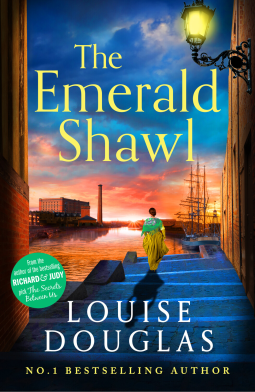
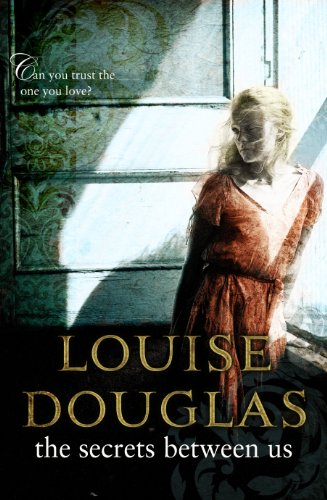
 I’d forgotten how much I love reading Louise Douglas! I’ve read four of her books and particularly enjoyed the du Maurier-inspired The Secrets Between Us, but then I seemed to lose track and missed all of her more recent ones. The Emerald Shawl, published this week, turned out to be the perfect choice for my return to her work.
The novel opens in Bristol in 1864, with journalist Nelly Brooks meeting a woman in a green shawl by the docks. Nelly’s ‘journalism’ amounts to writing a women’s column for the Courier, giving advice on cooking, cleaning and decorating, which is all her editor will allow her to do. She hasn’t given up on her dream of becoming a serious news reporter like her male colleagues, however, and when Eliza Morgan, the woman in the shawl, tells her of the murder of the wife and newborn child of an important man, Nelly is sure she’s found the story she’s been hoping for. When Eliza herself is found floating lifeless in the river the next day, Nelly doesn’t believe the verdict that it was an accidental drowning. She’s convinced that Eliza was murdered and that she is the only person who may be able to find out who killed her.
The mystery is the main focus of the book, but Nelly’s personal life is also interesting. Having become pregnant at the age of fifteen, she spent several years in an asylum, sent there by her parents who found it preferable to admitting that she’d had an illegitimate child. Nelly has had no contact with her daughter – or her parents – since the baby was removed from her after the birth, but she has now discovered that twelve-year-old Hannah is attending a school near Nelly’s place of work. As well as investigating Eliza’s death, Nelly also sets out to find a way to bring Hannah back into her life.
The characters in the book range from the very wealthy, such as the politician Sir Edward Fairfield and his wife, for whom Eliza Morgan worked as a seamstress, to the working class Skinners, who are drawn into the mystery when their daughter’s body is stolen from the morgue. Although both families live in Bristol, they may as well be in different worlds and Nelly has to navigate between the two.
I found it interesting to learn after finishing the book that Douglas based Nelly’s character on the American journalist Nellie Bly, who went undercover to report on conditions inside a mental institution. The fictional Nelly’s own experience of mental institutions allows Douglas to explore issues around mental health and how ‘insanity’ could be used as a convenient way of dealing with people seen as problematic. I also loved the Victorian Bristol setting, which made a nice change from the usual Victorian London settings! The building of the Clifton Suspension Bridge is completed during the course of the novel, an important event in Bristol’s history which helps set the story in a wider historical context.
I hope Louise Douglas will return to Nelly Brooks in a future book as I think there’s a lot of scope to do more with the character. If not, I still have plenty of her earlier novels to enjoy!
Thanks to Boldwood Books for providing a copy of this book for review via NetGalley.
 She Reads Novels