The Italian Girl by Lucinda Riley

The Italian Girl Rosanna Menici is only eleven years old when she first meets Roberto Rossini, the son of her parents’ best friends. Roberto is an opera singer at La Scala in Milan, a career which to Rosanna seems impossibly glamorous and out of reach. At a family party, Roberto hears her voice and recommends that she have singing lessons, but Rosanna tries not to get her hopes up. Her parents run a restaurant in the Piedigrotta district of Naples and although it is a successful business, they are not rich people and singing lessons are expensive. But when Rosanna’s brother, Luca, comes to the rescue and helps to pay for the lessons, it seems that her dream of becoming an opera star and marrying Roberto could eventually become a reality.

The Italian Girl is a lovely, romantic story spanning three decades and taking us from the streets of Naples and churches of Milan to a peaceful English village and some of the world’s greatest opera houses. It’s not a new novel – it was originally published as Aria in 1996 under the name Lucinda Edmonds – but has been revised and updated so that you wouldn’t guess it had been written so much earlier than the more recent Lucinda Riley books.

One way in which this book is different to the other novels by Lucinda Riley that I’ve read (The Girl on the Cliff, The Light Behind the Window and The Midnight Rose) is that the others have dual narratives, jumping between past and present, but this one, apart from a few letters written by an older Rosanna, follows one linear timeline. I like both types of book, but I do prefer to stay in one time period so I was happy with that aspect of The Italian Girl. Although this book isn’t really what you could call ‘historical’, being set in the fairly recent past, I think I would still have liked more period detail as the 1960s chapters didn’t feel any different from the 1970s or 1980s. On the other hand, this is a story driven more by the characters and their relationships rather than by the setting.

I initially found the young Rosanna a very endearing character. Things did seem to fall into place for her too easily, but I didn’t mind because I liked her and wanted her to succeed. Later in the book, though, I began to find her frustrating. I disagreed with a lot of her decisions, but I was hopeful that she would do the right thing in the end. As for Roberto, I had thought at first that he was going to be the sort of romantic hero I could fall in love with along with Rosanna…suffice it to say that this certainly didn’t happen, but I won’t spoil the story by explaining why not!

While the relationship between Rosanna and Roberto forms the main plot, there’s also a secondary romance between Luca and Rosanna’s friend, Abi. I liked both of these characters and found their story as interesting to follow as Rosanna’s and Roberto’s. I also enjoyed learning about the lifestyle of a professional opera singer and the amount of hard work and training it takes to reach the top. I’m not an opera fan and probably never will be, but this book made me want to listen to some of the arias Rosanna sings in the story.

The Italian Girl is a long book – almost 600 pages, which makes it quite a thick paperback – but after a slow start I was swept away by the story and it didn’t feel as long as it looked. It was the perfect book to read sitting outside in the summer sunshine we’ve had here this week!

I received a copy of The Italian Girl for review.

The Midnight Rose by Lucinda Riley

The Midnight Rose Anahita (Anni) Chavan’s whole family are gathering at her hill-top bungalow in Darjeeling to celebrate her one-hundredth birthday, but even surrounded by her children, grandchildren and great-grandchildren, there is still one person missing. This is Moh, her beloved son, whom she has not seen since he was a small child. Everyone believes him to be dead…everyone except Anni who is sure that he is still alive somewhere in the world. A year later Anni herself has died, but before her death she had written down her story and entrusted it to her favourite great-grandson, Ari Malik, in the hope that he would try to find out what happened to her missing son.

Anni’s story leads Ari to Astbury Hall in England, where filming is currently taking place for a new period drama set in the 1920s starring the beautiful young American actress, Rebecca Bradley. When Lord Astbury invites her to stay at the Hall for the duration of the filming as a safe haven away from the world’s press, Rebecca gratefully accepts, hoping that the peace and quiet will give her a chance to decide what to do about her equally famous actor boyfriend, Jack, who has just proposed to her.

Soon Rebecca is drawn into Ari’s search for the truth about Anahita’s past and as her tragic story unfolds, we are taken back to India in 1911, where as a young girl Anni becomes friendly with Princess Indira, the daughter of the Maharaja and Maharani of Cooch Behar. She and Indira are sent to school in England just before the beginning of the Great War, and while staying with family friends at Astbury Hall in Devon the relationship Anni forms with Donald Astbury changes her life forever.

This is the third Lucinda Riley novel I’ve read (the other two were The Girl on the Cliff and The Light Behind the Window – I still need to read Hothouse Flower) and it’s my favourite of the three. Although there were times when I found the plot easy to predict and a few coincidences that felt too implausible, there were enough unexpected twists to keep me in suspense wondering what was going to happen next. I particularly loved the parts of the book set in India during the British Raj and also the insights into what life was like for a young woman trying to find a place for herself in a new and unfamiliar country.

Sometimes when a book is set in multiple time periods, the different threads of the story can feel disjointed and unconnected, but that was not the case here. They came together perfectly, with the secrets of Astbury Hall being slowly revealed as Ari and Rebecca discover them. As usual, though, I found myself enjoying the historical sections of the book more than the contemporary ones. The modern day characters do have storylines of their own – Rebecca’s troubled relationship with her boyfriend and Ari’s struggle to find the right balance between his work and his personal life – but they didn’t interest me as much as Anni’s. I thought Lucinda Riley’s writing really came alive in the sections about Anni – the dialogue felt vibrant and the characters were strong and memorable, especially Anni herself, her best friend Indira, and Donald’s cruel and manipulative mother, Maud Astbury, the villain of the book.

The Midnight Rose is a long novel (650 pages – and it’s one of those books that is physically big and heavy too) but once I became swept up into the story I stopped thinking about the number of pages and concentrated on enjoying Anahita Chavan’s fascinating tale.

I received a copy of this book from Pan Macmillan for review

The Light Behind the Window by Lucinda Riley

The Light Behind the Window With 2012 coming rapidly to a close I’ve now had to accept that I’m not going to have time before the end of December to write about all of the books I’ve read this year. I still have three outstanding reviews to post from October, five from November, plus any more books that I finish in the final two weeks of this month. The good news is that I do have drafts nearly complete for most of those books, so it’s just a case of finding time to finish them. I’m going to try to post as many as possible this week and next, beginning with this one, The Light Behind the Window.

This is the third novel by Lucinda Riley. I haven’t read her first, Hothouse Flower (published as The Orchid House in America), but I enjoyed her second, The Girl on the Cliff and was looking forward to reading this one. I would describe Lucinda Riley’s books as similar to Kate Morton’s: a mixture of history, romance and suspense within a dual time-frame structure. The action in The Light Behind the Window is divided between England in the 1990s and France in the 1940s.

We begin in 1998, when we meet Emilie de la Martinieres whose mother has just died, leaving Emilie to inherit the family estate which includes a beautiful château and vineyard in the south of France. Alone in the world and not sure what to do with her inheritance, Emilie is grateful for the help of her new friend, Sebastian Carruthers, who she meets at a restaurant in the village. Sebastian is an Englishman with connections to the de la Martinieres’ château – he tells Emilie that his grandmother, Constance, had stayed there during the Second World War. After a very short time, Sebastian and Emilie marry and return to England where the Carruthers have a home in Yorkshire. Here at Blackmoor Hall, Emilie meets her new brother-in-law, Alex, who is not on good terms with Sebastian and lives in a separate wing of the house. Sebastian has nothing good to say about Alex, but as Emilie gets to know them both better she begins to wonder whether there’s more to the feud between the brothers than meets the eye.

The link between the two families – the Carruthers and the de la Martinieres – is explored further in the novel’s other storyline, which takes place in the 1940s and follows the adventures of Constance Carruthers who has been recruited by the SOE (the British Special Operations Executive) to carry out espionage in occupied France and assist the French Resistance. After she finishes her training, Constance travels to Paris on her first secret mission but things don’t go according to plan and instead of being met by her contact she ends up in the home of Edouard de la Martinieres – Emilie’s father. The past and present stories – Constance’s in the 1940s and Emilie’s in the 1990s are connected in many ways and during the course of the novel the two threads meet and become woven together. As it says on the front cover of the book, “Unlocking the past is the key to the future…”

I didn’t enjoy this one as much as The Girl on the Cliff, though it was still an entertaining read. I do like Lucinda Riley’s writing overall, but I couldn’t help thinking that the dialogue in this book felt very stilted and unnatural. I have to mention it because it was something that really grated on me, especially in the first half of the book, though by the time I was halfway through I had been swept away by the story and after that any problems with the writing were less noticeable.

Whenever I read a novel set in more than one time period I usually (though not always) find that I become more involved in one than the other. Being the lover of historical fiction that I am, it’s not surprising that it tends to be the historical storyline that I prefer and that was the case again with this book. The contemporary story felt too predictable at times and there were too many plot developments that I found hard to believe, but the wartime story was fascinating and exciting. I’ve never read anything about the SOE before and it was so interesting to learn about their work in France and what it involved.

Another aspect of the book I want to mention is that two of the main characters are Nazi officers; one of them is not much more than a stereotype and is one of the novel’s villains, but the other is portrayed more sympathetically, as someone who is not completely committed and having doubts about the Nazi regime. I thought this was an interesting perspective, but it would have been nice to have seen him actually do more to act on his concerns and I’m not sure I was really very comfortable with the way his story ended.

Despite having a few problems with The Light Behind the Window I’m looking forward to Lucinda Riley’s next book and will hopefully get around to reading Hothouse Flower at some point too!

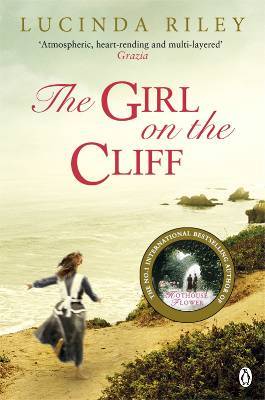
The Girl on the Cliff by Lucinda Riley

I read this book just after Christmas but it’s been one of those reviews that I’ve found difficult to write. Not because I didn’t enjoy the book, but because it was a complex story and hard to summarise or to write about without giving too much away.

The Girl on the Cliff begins in the present day and follows Grania Ryan, who has returned to her parents’ home in Ireland after having problems in her relationship with her boyfriend, Matt, in New York. One day Grania meets an eight-year-old girl, Aurora, standing on the edge of a cliff. As she gets to know the girl and her father better, Grania begins to discover how Aurora’s family, the Lisles, are connected with her own family, the Ryans.

Grania’s mother, Kathleen, is worried when she hears about her daughter’s new friends. Kathleen knows what problems the Lisles have caused for the Ryans in the past and is afraid of history repeating itself. As we go back in time, first to wartime London and then to one summer in 1970, we gradually learn the truth about the two families and why Kathleen has come to see the Lisles as enemies.

As we move through the generations, we meet lots of different characters but the most memorable is Aurora. In many ways Aurora seems much older than eight, though in others she still behaves like the child she is. Some short sections narrated by Aurora herself are interspersed with the main story, which I thought was very effective. There’s something almost otherworldly about her narration and at times I found myself wondering whether she was supposed to be a real child or some kind of ghost or fairy!

This is yet another of those novels with multiple time periods that I’ve been reading so many of recently, but this book is an example of how this structure can work very well – I found all the threads of the story equally interesting and cared about the characters in each one. So many things happen throughout the pages of this novel and I’ve only mentioned a few of them here – each time period contains its own set of surprises and secrets and I wouldn’t want to spoil anything for any future readers! I will say that the 1970s section was particularly moving and took the story in a direction I hadn’t expected at all. But whether I was reading about London in World War I or World War II, a farmhouse in rural Ireland or Grania and Matt’s fashionable loft apartment in New York, every time and location came to life.

The book wasn’t perfect – there were a few plot developments towards the end that I found difficult to believe and some parts of the story were too predictable – but there were plenty of surprising twists that I didn’t see coming and enough suspense to keep me turning the pages to see what would happen next. After enjoying this one so much, I’ll be looking out for Lucinda Riley’s next book and would also like to go back and read her previous one, Hothouse Flower.