 I’ve never read anything by Salman Rushdie before and have always felt slightly intimidated by him, but when I was looking for something to read for the A More Diverse Universe blog tour (hosted by Aarti of Booklust) I came across this title on Aarti’s list of suggestions and thought it sounded intriguing.
The Enchantress of Florence is a very imaginative mixture of history and fantasy, with a plot that is almost impossible to describe – though I’ll do my best! The story begins in 16th century India when a mysterious yellow-haired stranger calling himself the Mogor dell’Amore arrives by bullock-cart at the court of the Emperor Akbar in Sikri. Claiming to be related to Akbar, he begins to tell the Emperor the story of the lost Mughal princess, Qara Köz, or Lady Black Eyes, who is captured and after a series of adventures ends up in Florence where she falls in love with the soldier Antonino Argalia. Qara Köz is the enchantress of the title, believed to have powers of sorcery, as well as great beauty, and the entire city of Florence becomes captivated by her presence. In a separate, but connected, storyline we also learn of Argalia’s childhood, growing up in Florence with his friends Ago Vespucci and Il Machia (Niccolò Machiavelli). Will Akbar believe the stories he is told and what effect will they have on the Emperor and his court?
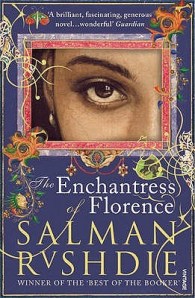 There are lots of themes and ideas in The Enchantress of Florence and I’m sure I didn’t fully understand all of them. However, one of the main themes, to me, seems to be the power and the magic of storytelling. The novel is made up of lots of separate interlocking stories, not just the three main ones I’ve mentioned above. One character will begin to tell a story and then a character within that story will begin to tell another story and so on, until you almost begin to forget who the original storyteller was and who the listeners are. These stories may or may not be true and all of them are rich in magical realism – we meet the emperor’s favourite wife Jodha, for example, who is imaginary but also seems to have a life of her own; a slave girl who has become a ‘Memory Palace’ (or a device to aid the memory); and an artist hiding inside one of his own paintings.
The fantasy elements and the abundance of princesses, emperors, giants and witches gives the book a fairy tale feel (I was reminded of The Arabian Nights) and there are beautiful, lavish descriptions of both Mughal India and Renaissance Florence, two settings which are very different but also surprisingly alike. I did enjoy this book, especially the sections set in India, and I thought it was beautifully written, but I did find it very complicated and difficult to follow and I think I would probably have needed to read it twice to be able to really appreciate it. People often talk about books having multiple layers, and that’s usually a good thing, but this one has so many layers I was a bit overwhelmed!
I won’t be immediately rushing out to buy the rest of Salman Rushdie’s books but I’m glad I chose to read this one – it was a challenge, but worth the effort, I think.

 She Reads Novels