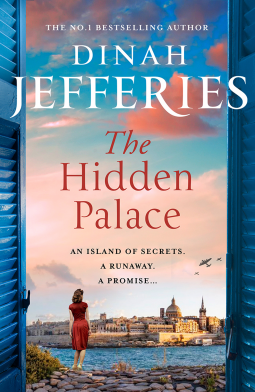
The Hidden Palace by Dinah Jefferies

This is the second book in Dinah Jefferies’ new World War II trilogy which began last year with Daughters of War. Although I think it’s always best to read a series in order if you can, I don’t think it would be a problem if you wanted to start with this book. People and events from the first book are alluded to, but are not essential to understanding the plot of this second novel.

Of the three Baudin sisters we met in Daughters of War, The Hidden Palace only focuses on one of them – the youngest sister, Florence, who has left occupied France for the safety of the English countryside. In England, Florence is reunited with her estranged mother, Claudette, who asks for her help in finding her sister Rosalie – Florence’s aunt – who ran away from home as a teenager and hasn’t been seen or heard from for years. Claudette believes that Rosalie may be in Malta, but with war still raging across Europe, no one is able to go there to look for her.

In an alternating storyline, we go back to the 1920s and follow Rosalie’s adventures when, after an argument with her father, she leaves home and finds work as a dancer in a nightclub in Malta. As the years go by, she builds a new life and identity for herself on the island, which makes Florence’s task much more difficult when, once the war is over, she is able to travel to Malta to begin her search. Accompanied by Jack, the Baudin sisters’ friend who worked for the British Special Operations Executive during the war, Florence is determined to find her aunt – but will her aunt want to be found?

I enjoyed The Hidden Palace overall, although I missed the other two sisters from the first book, Hélène and Élise, who stay behind in France and appear only briefly. Florence was not initially my favourite of the sisters so I wasn’t sure how I would feel about this book focusing mainly on her, but I did warm to her after a while – although I had mixed feelings about the development of her romance with Jack, knowing that he had originally been Hélène’s love interest. I also found the sections of the book set in England slightly lacking in atmosphere; you would hardly think the war was still taking place, as the lives of the characters seem largely unaffected and there’s no sense of any real hardship.

The chapters set in Malta were of much more interest to me, particularly as I have been to Malta and enjoyed revisiting, through Rosalie’s eyes, the vibrant streets of the capital Valletta and the peaceful stillness of Mdina, the ‘Silent City’. Malta was very badly hit during the war, due to its strategic importance as a base in the Mediterranean between Europe and North Africa, and it was the target of thousands of German and Italian air raids, making it one of the most heavily bombed places in the world. This is where Rosalie spends the war years, so as you can imagine, her story is a lot more dramatic than Florence’s in the Devon countryside! However, Rosalie also becomes caught up in a scandal involving human trafficking and I couldn’t see the point in this storyline as it didn’t seem to lead anywhere.

The novel has a satisfactory ending, but not everything is fully resolved, so I’m looking forward to finding out what happens in the final part of the trilogy. The third book, Night Train to Marrakech, is due next year.

Thanks to HarperCollins for providing a copy of this book for review via NetGalley.

This is book 51 read for the Historical Fiction Reading Challenge 2022.
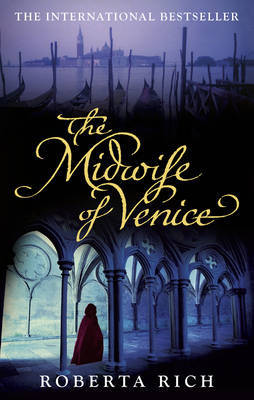
The Midwife of Venice by Roberta Rich

The Midwife of Venice is set in 1575 and is the story of Hannah Levi, a midwife who lives in the Jewish ghetto in Venice. Although Jews are forbidden to attend Christian women in childbirth, when the Conte di Padovani summons her to his wife one night Hannah agrees to go with him. The Conte promises that if she assists in the birth of his heir he’ll reward her with a large sum of money – money that Hannah desperately needs so that she can pay the ransom to free her husband Isaac, who has been captured and taken to Valletta, Malta as a slave of the Knights of St John. But when it proves to be a difficult birth and Hannah is forced to use her special ‘birthing spoons’ (a device similar to forceps) she finds herself threatened with accusations of witchcraft.

The plot moves back and forth between Hannah in Venice and Isaac in Malta, until the two alternating storylines begin to come together. Luckily, I found both Hannah’s and Isaac’s adventures equally interesting to read about, so I didn’t mind leaving one character behind for a while to find out what was happening to the other.

I loved the first few chapters of this book; the story’s various locations (the Jewish ghetto, Venice’s streets and canals, the island of Malta) were vividly described without being too detailed, and it was interesting to learn about the relationship between the Christians and Jews in 16th century Venice. But halfway through, the plot started to take some dramatic twists and turns which I can only describe as unbelievable and ridiculous. Hannah was a likeable enough character, but it seemed to me that everything worked out too easily for her (and for Isaac) – there were too many coincidences, too many last-minute escapes and the villains were too easily defeated. If you can suspend your disbelief it’s all very entertaining I suppose – with murder, kidnapping, blackmail, disguises, slavery and even the plague, it’s certainly never boring – but I think I would have preferred something slightly more serious!

One other little problem I had was with the number of Italian and Jewish terms that were dropped into the text, a lot of which were unfamiliar to me. There was a glossary at the end of the book which I didn’t discover until too late – it would have been helpful to have known about it before I began instead of when I was nearly finished.

Although I prefer historical fiction novels to have a bit more depth than this one, The Midwife of Venice was fun to read. The setting and subject matter were unusual and interesting, and the fast pace and cliffhanger chapter endings made it a quick read. Oh, and I love the cover too!

The Disorderly Knights by Dorothy Dunnett

The Disorderly Knights is the third of Dorothy Dunnett’s Lymond Chronicles. In this instalment, Francis Crawford of Lymond goes to Malta to help the Knights Hospitallers of St John protect the island from invasion. It soon becomes obvious that not only is Malta under threat from the Turks, but the Order of St John itself is in danger of being torn apart by feuding factions among the knights. And as the action moves first to Tripoli and then back home to Scotland Lymond himself becomes entangled in the schemes of a very clever and subtle enemy.

I loved the first two books in this series, The Game of Kings and Queens’ Play, but this one is my favourite so far. It’s been a long time since I’ve been so completely immersed in a book – I had to tear myself away from it to go to work or to sleep and still couldn’t stop thinking about the story or the characters even when I wasn’t reading.

As with the first two books I found I had to keep turning back to remind myself of what had happened in earlier sections and was constantly changing my mind about what I thought was going on. Although I knew who the villain was (even if most of the characters in the book didn’t) I wasn’t sure what his motives were, what he was hoping to achieve or how long ago he had started to put his plans into motion, so there was still plenty of mystery to keep me guessing throughout the story.

I have never read anything set in either Malta or Tripoli, but both locations were brought to life for me through the vivid descriptions we were given. After I’d finished the book I looked up some of the historical events covered in the story such as the Siege of Tripoli and I was so impressed at how cleverly Dorothy Dunnett had woven fact and fiction together. The same applies to some of the novel’s later events set in Scotland – the feud between the Scotts and the Kerrs, for example, and even the deaths of some of the characters.

This was such an emotional book too – there were various points in the story where my blood was boiling, my heart was pounding or I had tears in my eyes – yet I think the fact that it caused such strong emotions proves what a powerful book this was. And I appreciated the moments of humour that the author injected into what would otherwise have been a very dark story. The scene with the eight hundred sheep was one of my favourites!

I couldn’t put this book down throughout the last 100 pages and was so glad I had Pawn in Frankincense ready to pick up as soon as I finished! You can expect to see my thoughts on that one soon.