The Queen and the Countess by Anne O’Brien

I’ve been looking forward to reading Anne O’Brien’s new novel as it’s set in one of my favourite periods of history, the Wars of the Roses. O’Brien has written about this period before, from the perspectives of Anne Neville in Virgin Widow (which I haven’t read) and Cecily Neville in The Queen’s Rival, but this book is slightly different because it focuses on not just one woman but two: Margaret of Anjou, wife of Henry VI, and Anne Beauchamp, Countess of Warwick.

The two women take it in turns to narrate their story, alternating chapter by chapter throughout the book and beginning in 1458 with the Loveday Parade – a procession through London intended to promote peace between York and Lancaster, the two feuding branches of the royal House of Plantagenet. In the parade, Queen Margaret walks hand-in-hand with the powerful Duke of York, while Anne watches her husband, Richard, Earl of Warwick, walk with his rival nobleman, the Duke of Exeter. The peace is very short-lived, however, and the following year York and Lancaster are at war again.

As the mental health of the Lancastrian king, Henry VI, goes into decline and he gradually retreats from real life into a world of prayer, Margaret does her best to rule in his place, aiming to keep the throne safe for Prince Edward, their young son. When Margaret’s army is defeated in battle and Warwick helps to put the Yorkist heir, Edward IV, on the throne, it seems that her life is in ruins, but it’s not long before Warwick falls out of favour with the new king and comes to her ready to form a new alliance with Lancaster. Meanwhile, Anne stays loyal to her husband throughout all of this but, with no real influence over his decisions, she can only hope that he’s picked the right side this time…

I was intrigued by O’Brien’s decision to pair Margaret of Anjou’s story with the Countess of Warwick’s in this book. There are so many other interesting women from this period – Margaret Beaufort, the mother of Henry Tudor; Edward IV’s wife Elizabeth Woodville and her mother Jacquetta, to name a few – it seemed like a bit of an arbitrary choice to put these two together, but as I read on and saw the shape the novel was starting to take it did make sense. Margaret and Anne are at first on opposite sides of the conflict, then on the same side, but in the difficult position of never fully being able to trust each other, which is an interesting dynamic for O’Brien to explore. Although they are two very different women, there are some parallels between them which begin to emerge as the novel progresses.

This is an eventful and dramatic period of history, so there’s always something happening in the novel – a battle to be fought, a marriage to be negotiated, a plan for invasion to be put into place. Using two narrators rather than one gives O’Brien a wider scope instead of being limited to one character’s personal experiences. However, the two threads of the story come together now and then through a series of fictional letters sent between Margaret and Anne. I’ve no idea if they really corresponded or not (I don’t think there’s any evidence of it, and if they ever did, I doubt it would have been as often as depicted in the book) but it’s a nice touch and makes the lives of the two characters feel less separate and disconnected.

The narrative voices of the two women sound almost identical, so I had to pay attention to the section headings, otherwise it sometimes took me a few paragraphs to decide which of them was narrating. Margaret of Anjou never really seems to be portrayed in a very positive light and she’s not very likeable here either, but I could at least have some sympathy for her. She was in a very challenging situation, trying to hold onto the throne for Lancaster with a husband who didn’t understand what was going on and who was by now completely incapable of ruling. Anne is a much easier character to like, but then, she doesn’t have the difficult decisions to make that Margaret does. Things aren’t easy for Anne either, though, as her fate is determined by the actions of her husband, Warwick, and while she does involve herself in politics to a degree, she has very little say in the course her life will follow.

This is ultimately quite a sad story – anyone familiar with the Wars of the Roses will know what happens to Margaret, her husband and her son, and how Anne’s later life plays out (at one point she’s declared legally dead while still alive in order to settle an inheritance dispute) – but I enjoyed reading it. It was nice to see some links to O’Brien’s previous novel, A Court of Betrayal, whose heroine, Johane de Geneville, was an ancestor of Anne Beauchamp’s – something I wasn’t aware of until I started reading this book and Anne mentioned her great-great-grandmother! I’ll look forward to O’Brien’s next book, whatever it may be, but I should probably try to find time to go back and read the earlier ones that I’ve missed as well.

Thanks to Orion for providing a copy of this book for review via NetGalley.
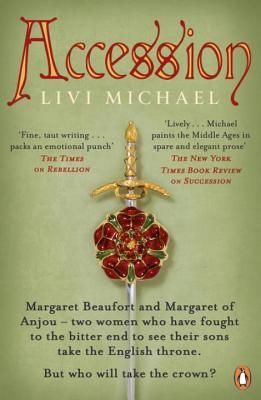
Accession by Livi Michael

accession Having followed the stories of Margaret Beaufort and Margaret of Anjou throughout the early stages of the Wars of the Roses in Livi Michael’s Succession and Rebellion, we come at last to the third book in the trilogy, Accession, which covers what is, in my opinion, the most interesting part of the period – Edward IV’s final years, the troubled reign of Richard III and Henry Tudor’s victory at the Battle of Bosworth.

The novel opens in 1471, shortly after the Battle of Tewkesbury which has secured the throne of England for the Yorkist king, Edward IV. Despite her best efforts, the Lancastrian queen, Margaret of Anjou, has had to admit failure: her armies have been defeated, her husband – the late King Henry VI – is dead, and her son, the Prince of Wales, on whom all her hopes rested, has been killed. Margaret, whose role in our story is almost over, is placed in the custody of Alice Chaucer, Duchess of Suffolk, where she will remain for the next few years.

For Margaret Beaufort, however, all is not lost. Although her son, Henry, the remaining Lancastrian heir, is still in exile in Britanny with his uncle, Jasper Tudor, Margaret is slowly preparing the ground for his return. The first stage in her plan is to marry again and the husband she has in mind – her fourth – is Thomas Stanley, a man who has become an expert at navigating through dangerous political waters and who has no qualms about changing sides between York and Lancaster whenever he believes the time is right to do so. Just the sort of man, she hopes, who has the power and the influence to help turn her dreams into reality.

I think Accession is probably my favourite of the three books in this trilogy. Although the writing feels a little bit dry on occasions – more like non-fiction than fiction – the story is still compelling, even for someone who has read about these historical figures and events many times before! As in the previous two books, Livi Michael incorporates excerpts from contemporary chronicles of the period to tell part of the story, which is a method I have found both unusual and very effective. The use of the chronicles helps to set these novels apart from others that I’ve read on the Wars of the Roses.

Another thing I appreciate about this trilogy is that Livi Michael has avoided making her characters into heroes or villains, instead giving each of them a mixture of good points and bad points – and that includes her two protagonists, neither of whom are very easy to like. Margaret Beaufort in particular is portrayed as ambitious, scheming and manipulative – but always with the best interests of her son at heart. Almost everyone in this novel appears to be out for what they can get…and yet there are little touches of humanity too: Margaret Beaufort feeling sorrow at the death of Queen Anne, for example, despite having secretly been working against Anne’s husband, Richard; or Henry Tudor recognising the sacrifices made for him over the years by his uncle Jasper.

As for Richard III, he is no more of a hero or a villain than any of the other characters in the novel. Whenever I read a book which covers Richard’s reign, I look forward to seeing how the author will choose to tackle the mystery of the Princes in the Tower, and I’m pleased to say that I was happy with the approach taken in Accession! It wasn’t quite what I’d expected, but I found it convincing and a little bit different from the theories given in other novels I’ve read.

I’ve enjoyed reading all three books in Livi Michael’s trilogy and will continue to read about this period of history as I never seem to get bored with it!

Thanks to Penguin for providing a copy of this book for review.

Rebellion by Livi Michael

rebellion This is the second in Livi Michael’s trilogy of novels telling the story of the Wars of the Roses from the perspectives of Margaret Beaufort and Margaret of Anjou. After reading the first book, Succession, a few months ago I was keen to continue with the trilogy; Rebellion picks up directly where Succession ended, but as long as you have some knowledge of the period, it’s not really essential to have read the previous novel before starting this one. I’m not going to go into the background to the Wars of the Roses here, though; if you’re not already familiar with it, I’ll refer you to my review of Succession so I don’t bore you by repeating myself!

Rebellion begins shortly after the Battle of Towton, often described as the bloodiest battle ever fought on English soil, which ended in disaster for the House of Lancaster and put a new Yorkist king on the throne – Edward IV. The defeated Henry VI and his wife, Margaret of Anjou, have fled to Scotland and from there Margaret travels to France to plead for help from the French king. Determined to win back the throne for Lancaster and secure the inheritance of her young son, Prince Edward, she eventually returns to England to lead an army into battle against York once again.

We also follow the story of another mother, Margaret Beaufort, whose only son, Henry Tudor, has been taken from her to be raised in the household of a guardian, William Herbert, at Raglan Castle in Wales. Margaret wants nothing more than to be reunited with Henry and can’t bear to think of him growing up in someone else’s care – but Henry is also a Lancastrian heir and it seems that there are people more powerful than Margaret who are making other plans for him.

Rebellion has a wide scope, encompassing most of the key events which occur from 1462-1471 and incorporating many important historical figures of the period from Edward IV and his wife, Elizabeth Woodville, to Margaret Beaufort’s husband (her third), Henry Stafford, and the family of the Earl of Warwick, known as the Kingmaker. We also have our first glimpses of Edward’s younger brother, Richard of Gloucester, who I’m sure we’ll be seeing much more of in the final novel. The characterisation is generally quite well done; my only problem was with the portrayal of Edward IV. I know he wasn’t perfect and, like his grandson Henry VIII, is said to have become fat and gluttonous as he approached middle age, but even so, I don’t think we really needed such graphic descriptions of his bodily functions!

As in the first novel, though, the main focus is on the lives of the two Margarets. I think both of these women are great subjects for historical fiction and both have interesting stories to be told; neither is particularly likeable, but their emotions, ambitions and thought processes are convincingly described. I could feel for Margaret of Anjou as she struggled to keep the Lancastrian hopes alive and I could sympathise with Margaret Beaufort as she suffered the pain of being separated from her beloved son.

I preferred this book to the first one, I think; I found it easier to get into, probably because the first few chapters concentrate on one character (Margaret of Anjou) so the narrative is more continuous at the beginning instead of jumping from one perspective to the next – although there’s plenty of that later in the book. The most notable thing about the previous book, Succession, was the use of medieval chronicles, from which quotes are given at the beginning or end of almost every chapter in such a way that they form a large part of the story. The author uses the same method again in this book, but the extracts seem to be used more sparingly than in the first one, so that they add an interesting angle to the novel without being too much of a distraction.

Rebellion, then, has its good points and its bad, but there’s no doubt that it’s set during a fascinating time in England’s history. Something that comes across strongly in this novel is the uncertainty of the period and the way in which fortunes can unexpectedly rise or fall and hopes and dreams can be destroyed in an instant:

“None of this is as we initially planned,” Warwick said, gazing intently at his son-in-law. “And none of it is set in stone.”

I’m looking forward now to reading Accession, the novel which will bring the trilogy to a close.

Thanks to the publisher, Penguin, for providing a review copy of this book.

Succession by Livi Michael

Succession With my interest in the Wars of the Roses, I remember hearing about this book, the first in a trilogy, when it was published a couple of years ago, but for one reason or another I never got round to reading it. Two years later, the third and final novel has just been published, and Penguin have kindly sent me the whole trilogy for review. I’ve now read the first book, Succession, and am sure I’ll be reading the other two very soon.

I know not everyone is familiar with the background to the Wars of the Roses, so I should start by explaining that they were a series of wars fought in the second half of the 15th century between two rival branches of the royal House of Plantagenet. With King Henry VI of England (a descendant of Edward III through the Lancastrian line) suffering from an unspecified mental illness, there were many who considered him unfit to rule, leaving the way open for another claimant to the throne – Richard, Duke of York, another of Edward III’s descendants. From 1455-1487 a number of battles were fought between supporters of Lancaster and supporters of York; Succession covers only the early part of this period.

There are interesting, colourful characters on both sides of this conflict, but if I had to choose, I would say that I’m a Yorkist. This novel, however, is written mainly from the Lancastrian perspective, concentrating on two young women who share the same name – Margaret. The first is Margaret of Anjou, wife of Henry VI, and the second is Margaret Beaufort, mother of the future Henry VII. We do meet plenty of other characters (so many that you may need to make use of the character list and family tree at the beginning of the book to keep track of them all) but the stories of these two women are always the main focus of the novel.

We first meet Margaret Beaufort as a little girl who has become a ward of the Duke of Suffolk following the death of her own father, the 1st Duke of Somerset. A childhood marriage to Suffolk’s son, John de la Pole, is annulled when Henry VI chooses to marry the twelve-year-old Margaret to his half-brother, Edmund Tudor. Within a year, Edmund is dead of the plague, leaving his young widow pregnant with his child and at the mercy of his brother, Jasper (who is portrayed here in a surprisingly negative light).

Margaret of Anjou also has a difficult life, trying to hold the country together during the king’s long spells of illness so that she can keep the throne secure for their baby son, Edward. Neither of the Margarets are very likeable characters, but it would be difficult not to sympathise with the situations in which they find themselves. Some of Margaret of Anjou’s attempts to communicate with her unresponsive husband are very moving, while Margaret Beaufort’s story is sometimes quite disturbing – for example, the trauma suffered by a small thirteen-year-old giving birth is described in detail.

This is a period of history with which I’ve become very familiar over the last few years and, as this novel follows the historical sequence of events very closely, I always knew, more or less, what was going to happen next. There’s nothing very new in terms of plot, but the approach Livi Michael takes to telling the story is quite different from anything I’ve read before. She writes in several styles throughout the novel – sometimes a chapter is written in the first person, sometimes in the third – and from the perspectives of many different characters (a red or a white rose at the start of each chapter gives a useful indication of whether the character’s allegiance is to York or to Lancaster), but the most striking thing about Succession is the use of extracts from contemporary chronicles such as the Crowland Chronicle or John Benet’s Chronicle.

Each chapter starts or finishes with at least one paragraph taken from a chronicle of the time and it’s important to read all of these because they are used to advance the story and to relate events which our characters may not have personally witnessed. The Battle of Blore Heath, for example, is told entirely in the form of chronicles with no original prose at all. I liked the feeling of authenticity that this provided; however, it could also be distracting at times and, together with the very short length of the chapters (many are only one or two pages long), it made me feel that I was constantly being pulled out of the story. There is one much longer chapter in the middle of the book entitled Margaret Beaufort Travels to Wales and this was my favourite part of the novel, as we were finally given an opportunity to spend a decent amount of time getting to know one character with no interruptions.

Although the style and structure of Succession weren’t always a complete success with me, I did still enjoy the creative approach to a story I love and I will certainly be picking up the second book, Rebellion, soon.

She-Wolves: The Women Who Ruled England Before Elizabeth by Helen Castor

She-Wolves As the title suggests, this is a book about four medieval women who ruled – or attempted to rule – England in the centuries before Elizabeth I.

* Matilda, daughter and heir of King Henry I, was known as ‘Lady of the English’. She was never actually crowned Queen of England but fought her cousin, Stephen of Blois, for the throne in a period of civil war described as The Anarchy.

* Eleanor of Aquitaine was married to two kings – first Louis VII of France and then Matilda’s son, Henry II of England. Two of her sons – Richard I (the Lionheart) and John – also became King, and Eleanor effectively ruled England as regent while Richard was away fighting in the crusades.

* Isabella, the daughter of King Philip IV of France, came to England as Edward II’s young queen but found that her husband was so obsessed with his favourites (Piers Gaveston and Hugh Despenser) that he was prepared to put them before not only his wife but also his kingdom. Isabella eventually staged a rebellion with her lover Roger Mortimer and deposed Edward in order to put her young son, the future Edward III, on the throne.

* Margaret of Anjou was Henry VI’s queen consort and played a major part in the Wars of the Roses. With Henry unable to provide the strong leadership the country needed and possibly suffering from an unspecified mental illness, it fell to Margaret to rule in his place and to lead the Lancastrian faction against their Yorkist rivals.

In She-Wolves (the title refers to a term which has been used to describe both Isabella of France and Margaret of Anjou) Helen Castor looks at the lives of each of these queens in turn, before examining their role in history and how they possibly opened the way for Mary I and Elizabeth I to reign in their own right. Unlike Mary and Elizabeth, the four women covered in this book never ruled as sole monarchs but found themselves in a position of power as the daughters, wives or mothers of kings who, for one reason or another, were unable to rule themselves. Henry I died without a male heir and his nephew Stephen was never fully accepted by the English nobility; Richard I spent much of his reign abroad; Edward II lost the support of his barons due to his choice of favourites; and Henry VI was simply incapable of being an effective ruler. In each case, a woman stepped in to fill the gap.

She-Wolves takes us on a fascinating journey through medieval history, but I have to confess that I didn’t read this book in the way it was intended to be read. As I had just finished reading Isabella by Colin Falconer, the queen I was most interested in was Isabella of France, so I read her section of the book first before turning back to the beginning to read the rest. This wasn’t a problem for me as I’m familiar with all four periods of history, but I would still recommend reading the book in order (unless you’re desperate to read about one particular woman, as I was). The final section of the book, which describes the reigns of Mary and Elizabeth, ties everything together and looks at how times had changed enough by the Tudor period for a woman to finally rule alone.

I thought She-Wolves was slightly dry in places but I did find the book well written, interesting and easy to read. Each section starts with a map showing the relevant areas of Britain and Europe and a family tree to help clarify the complex relationships between characters. As this is a work of non-fiction, however, I was surprised by the lack of notes and references – although there is a list of suggestions for further reading at the back of the book and some sources are named directly in the text. These sources include anonymous chronicles such as Vita Edwardi Secundi (Life of Edward II) and the Gesta Stephani (Deeds of King Stephen) and as Helen Castor points out, medieval chroniclers struggled with the idea of women wielding power and tended to focus on the men, which is why we have so little information on the women’s own experiences and actions.

Approaching the end of the book, I was ready to praise Helen Castor for avoiding bias and speculation…until I came across the statement that the Princes in the Tower were ‘murdered by Edward’s youngest brother and most trusted lieutenant, Richard of Gloucester’, stated as fact. It could be true, of course, but I would have preferred an acknowledgment that it might not be and this made me wonder whether the earlier sections of the book had been as unbiased as I’d thought or whether I just didn’t notice as I have less knowledge of those other periods of history.

I don’t think I’m ever going to decide that I prefer non-fiction to fiction, but I did enjoy reading this book and have learned a lot about Matilda, Eleanor, Isabella and Margaret. Can anyone recommend any other good biographies of any or all of these women?