The Tiger in the Smoke by Margery Allingham – #1952Club

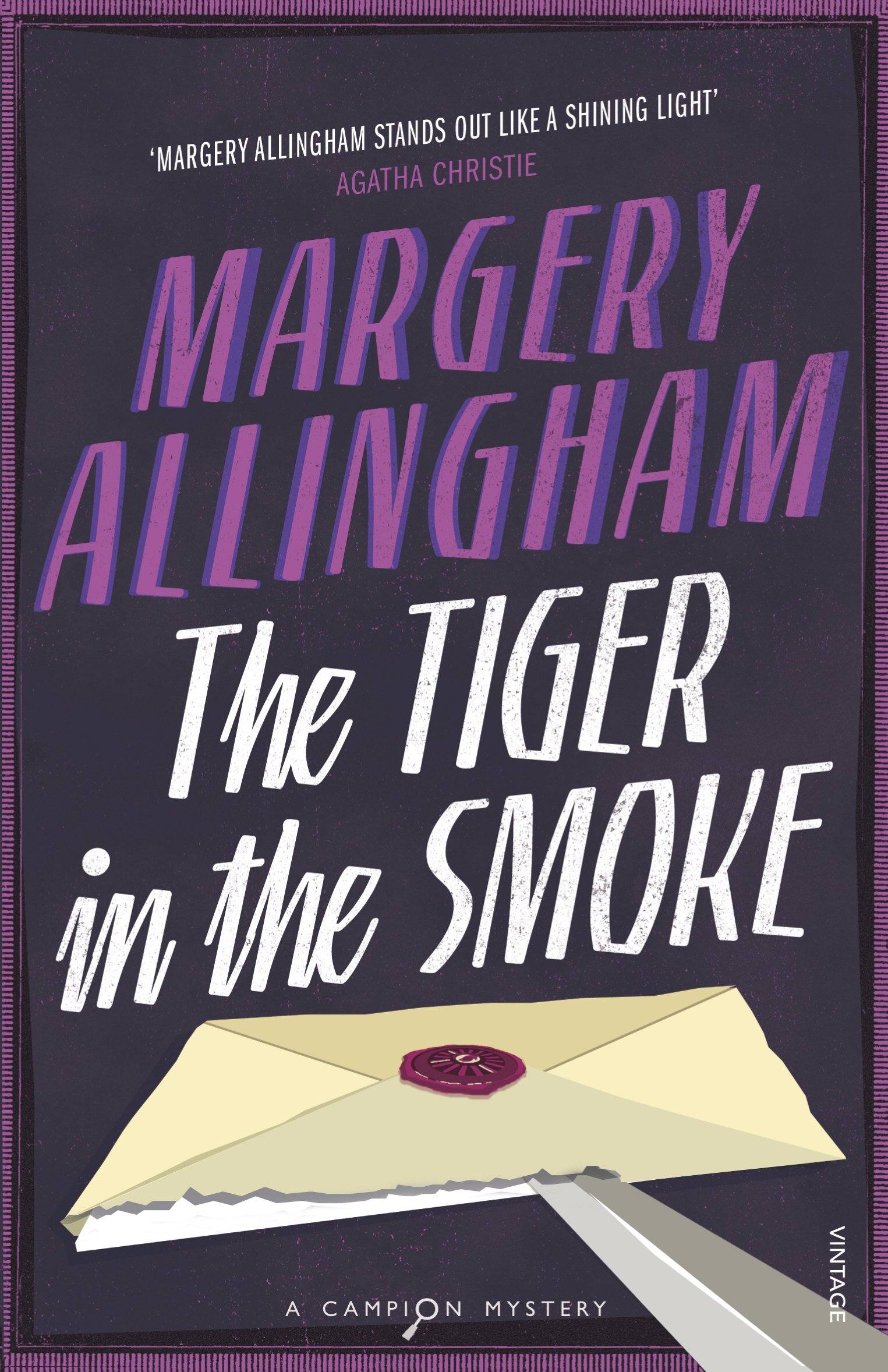
I’ve read a lot of Margery Allingham’s books but, maybe surprisingly, not many of the Albert Campion ones and not the book that is often described as her best, The Tiger in the Smoke. When I saw that it was published in 1952, it seemed an ideal choice for this week’s 1952 Club, hosted by Karen and Simon.

The Tiger in the Smoke is the fourteenth novel in the Albert Campion series – although Campion himself barely appears in it. Despite the exotic title, the Tiger refers to an escaped prisoner, Jack Havoc, and the Smoke is a nickname for London. At the beginning of the book, we meet Meg, who has believed herself to be a war widow since her husband, Major Martin Elginbrodde, was reported dead in Normandy during the D-Day landings. Meg has recently become engaged to another man, Geoffrey Levett, but has started receiving mysterious photographs which seem to show that Martin is still alive. As a thick fog descends on London, Meg asks her cousin Albert Campion and Chief Inspector Charlie Luke to help her find out who is sending the photos and what they mean.

The connection between all of this and the escape of Jack Havoc – whom Campion’s friend Superintendent Oates describes as ‘a truly wicked man’ – is not immediately obvious, but gradually becomes clear as the story progresses. First, though, we meet a gang of ex-Army men trying to make a living as a band of street musicians, all with some kind of disability or war injury. They are also criminals and associates of Havoc, so portraying them all with disabilities is something I’m sure a modern author would avoid, even if Allingham got away with it in the 1950s. Havoc himself is a great villain, surrounded by a real aura of danger due to his unpredictability and ruthlessness.

This book is much more of a thriller than a mystery. In fact, there’s very little mystery at all, beyond the question of who is responsible for the photographs and how Martin Elginbrodde is linked to Havoc and his gang. There’s nothing for the reader to really try to solve, so you just have to sit and watch as the story unfolds. This probably explains why we see so little of Campion, as there’s not much for him to do from an investigative point of view. I have to admit that I was quite happy with his absence as I’ve found so far that I tend to prefer Allingham’s books without Campion to the ones with him – although having said that, this is one of the later books in the series and he seems to have matured a lot since the earliest book I’ve read (Mystery Mile).

I loved the atmospheric descriptions of London in the fog in the first half of the book, with the limited visibility making it easier for the criminals to avoid capture. Allingham finds so many evocative ways to describe the fog and it really adds to the sense of tension and confusion. I’m pleased I decided to read this one for 1952 Club – and I have another Campion novel, The China Governess, on the TBR which I hope to get to soon as well.

Deadly Duo by Margery Allingham

Deadly Duo (also published as Take Two at Bedtime) is a 1949 collection of two novellas by Margery Allingham, neither of which feature her famous detective, Albert Campion. I’ve discovered over the years that I tend to prefer Allingham’s stories without Campion to the ones with him, so I thought I would probably enjoy this book – and I was right, although I found one of the novellas much stronger than the other.

The first of the two novellas is Wanted: Someone Innocent. Twenty-year-old Gillian Brayton is attending a school reunion when she is approached by an older woman, Rita Fayre, whom she barely remembers from her school days. To her surprise, Rita greets her like a close friend and offers her a job in her household. Gillian has been completely alone in the world since the death of her beloved uncle and is struggling financially, so despite her misgivings she finds herself accepting. On arriving at Rita’s house, she learns that her job will involve taking care of Rita’s husband, who was injured in the war – but why do all the other servants seem so suspicious of Gillian? Is there another reason for Rita’s invitation?

I really enjoyed this story and thought it could easily have been developed into a longer novel. Allingham creates a lot of suspense and atmosphere and although we see everything through the eyes of Gillian, who is rather naive and gullible – the ‘someone innocent’ of the title – it’s obvious to the reader from early on that she is going to be used as a pawn in a crime. I guessed some of the solution but not all of it and anyway, part of the fun was in getting to know the various members of the household, as well as the police officer, Superintendent McNaught, who is brought in to investigate. McNaught is a character I particularly liked; I’m sure he could have been the star of his own series!

The second novella, Last Act, is the longer of the two and it didn’t interest me as much as the first. It’s written from the point of view of Margot Robert, a young French actress who has fallen in love with Denis, one of the grandsons of her guardian, Mathilde Zoffany (known as Zoff). Unfortunately for Margot, Zoff doesn’t like or trust her grandson and has accused him of trying to kill her. When Zoff is indeed found dead under unusual circumstances, suspicion naturally falls upon Denis – but there are other people in the house who all have motives for wanting her dead.

This story has a more complex plot than the other one and a larger cast of characters, but it didn’t have the same atmospheric feel to it and I felt that the characters were less well developed. I disliked almost all of them, particularly Zoff, who was so unpleasant I couldn’t understand why everyone seemed to be in thrall to her. The solution is clever and quite surprising, but as I didn’t really care how or why Zoff had died, the revelation was less impactful than it probably should have been. Still, these two novellas together made a light, quick and entertaining read!

Black Plumes by Margery Allingham

Margery Allingham, one of the four Golden Age ‘Queens of Crime’, was best known for her Albert Campion detective series, but she also wrote several standalone crime novels. I have previously read and enjoyed The White Cottage Mystery, so had high hopes for this one, Black Plumes.

First published in 1940, Black Plumes is set almost entirely in the London home of the Ivory family and the art gallery they own in the building next door. The family matriarch is the elderly Mrs Gabrielle Ivory and the story is written from the perspective of her granddaughter, Frances. As the novel opens, Frances’ father, Meyrick, is on business abroad and has left his son-in-law Robert Madrigal (who is married to Frances’ half-sister Phillida) to run the gallery while he is away. In his absence, however, strange things have been happening: a broken vase, a slashed painting – and finally, an argument between Robert Madrigal and the artist David Field, after which Robert disappears.

A few weeks later, Robert’s dead body is discovered and suspicion quickly falls upon David – leaving Frances in a difficult situation, as David is the man she has just agreed to marry. She tells herself that he must be innocent, but how can she be sure?

As I’ve said, there is no Albert Campion to solve the mystery in this book, which could be a good or a bad thing depending on whether you’re a Campion fan. Instead, there’s Detective Inspector Bridie, an elderly Scotsman from Orkney who is brought in to investigate. However, we don’t really get to see any of his investigations and he doesn’t have a large part to play in the story. I didn’t solve the mystery myself – although I had narrowed it down to two suspects and one of them was correct – but since we see everything through Frances’ eyes rather than the detective’s, I think that made it more complicated.

There’s a touch of romance in the story too, particularly at the beginning where Frances and David agree to announce a fake engagement in order to prevent Frances having to marry someone else, but this storyline turned out not to be as much fun as it promised to be at first (Georgette Heyer does that sort of thing much better). It didn’t help that I found David so annoying; in fact, I didn’t like any of the characters much at all, although I enjoyed most of Gabrielle Ivory’s scenes and the contrast between her Victorian values and her granddaughter’s more modern ones.

After finishing this book, I looked at some other reviews and was confused when I saw everyone complaining about the use of a certain racist term to describe one of the suspects. It seems that this word has been edited out of the new edition I read and replaced with a less offensive term, which I think was a good idea in this case. The racist sentiment is still there, but it’s clear that it’s supposed to be the view of one of the characters rather than Allingham herself.

I think Black Plumes is worth reading if you like Allingham’s writing, but if it had been the first book I’d read by her, I’m not sure that I would have wanted to read more.

The Allingham Minibus by Margery Allingham

I have read and enjoyed several of the Margery Allingham short story collections which have been reissued by Agora Books recently; The Allingham Minibus is the latest and my favourite so far.

This collection was first published posthumously in 1973 and has also appeared under the title Mr Campion’s Lucky Day. However, that title would be quite misleading as there are eighteen stories in the book and only three of them actually feature Allingham’s famous detective, Albert Campion. Of these, I have already read the Christmas-themed The Man in the Sack (which was included in Campion at Christmas), but the other two were new to me and I particularly enjoyed The Unseen Door, a locked room mystery with a simple but clever solution.

The rest of the stories in the book cover a range of genres, not just the crime fiction with which Allingham is usually associated. Many of them are ghost stories or have a supernatural element of some sort and all of these were excellent; they were the perfect kind of supernatural stories for me – unsettling and unusual, without being too creepy. I won’t talk about all of them here, but three that stood out for me were Bird Thou Never Wert, about a woman who buys a haunted bird cage, She Heard It On the Radio, in which a lonely old lady develops an obsession with listening to the radio, and He Was Asking After You, where a man who betrays his best friend finds himself unable to escape his friend’s vengeance.

One of my favourite stories in the collection was The Pioneers, the story of a married couple who both meet someone else and decide to get divorced. On their last evening together, while they prepare to go their separate ways forever, some friends come to visit, with unexpected results. I loved this one! Actually, the only story in this book that I didn’t like was A Quarter of a Million, a crime thriller which should really be described as a novella rather than a short story as it was more than twice as long as most of the others. The length, and the fact that it seemed less tightly plotted than the rest, made it feel out of place in this collection.

With the exception of that one novella, then, I really enjoyed The Allingham Minibus – and the introduction by Agatha Christie was a nice little bonus.

Thanks to Agora Books for providing a copy of this book for review via NetGalley.

The Return of Mr Campion by Margery Allingham

This collection of thirteen short stories by Margery Allingham was originally published in 1989 and has been reissued by Agora Books this month. The title is maybe slightly misleading as Allingham’s famous detective Albert Campion only appears in half of the stories, but I actually found that some of the non-Campion stories were amongst my favourites from the collection.

Of the stories featuring Campion, I thought the best were The Black Tent, in which Albert catches a girl stealing a package from a desk during a party and The Case is Altered, where he stumbles upon a case of espionage while spending Christmas with friends. I was less impressed with the other Campion stories in the book, but I thought these two were just the right length, were well plotted and had satisfying conclusions. There’s also an essay, My Friend Mr Campion, where Allingham describes how she created the character of Albert Campion (or rather, how he created himself) and later in the book, in What to Do with an Ageing Detective, she imagines herself coming face to face with an elderly Campion and his servant Magersfontein Lugg. I found the first of these pieces interesting, but I think the second is really just for true Campion fans – which I can’t say that I am yet, having so far only read one full-length novel (Mystery Mile) and a few short stories.

The rest of the stories – the ones which don’t involve Campion and are not necessarily mysteries either – cover a mixture of subjects and genres. I loved Sweet and Low, in which two women who have nothing in common apart from a love of horse riding compete for the attentions of the same man. The horse called ‘Sweet and Low’ has a personality of his own and is the real star of the show in this one! The Wind Glass, about a young girl who rejects a marriage proposal from a Japanese man and receives a rather sinister gift in return, is another one that stood out due to the genuinely eerie atmosphere Allingham creates, although it was difficult to ignore the overt racism which did unfortunately spoil that particular story for me. On a more light-hearted note, I think The Kernel of Truth also deserves a mention. A man prepares a recipe for punch and adds one very special ingredient – but his wife won’t be very pleased if she finds out what it is. This is an entertaining little story that you won’t fully appreciate until you read the final paragraph!

Considering that I’m not usually a lover of the short story format, I enjoyed almost all of the tales in this collection, with only one or two exceptions. I’ll have to try more of the full-length Albert Campion mysteries soon!

Thanks to Agora Books for providing a copy of this book for review via NetGalley.

Margery Allingham writing as Maxwell March: Rogues’ Holiday and The Devil and Her Son

A while ago I read an early novel by Margery Allingham published under the pseudonym Maxwell March. It was called The Man of Dangerous Secrets and, although it was undoubtedly silly and over the top, I enjoyed it so much I knew I would be reading her other two Maxwell March books as soon as the time was right. Well, the time was right this month and I have now read both Rogues’ Holiday (1935) and The Devil and Her Son (1936).

Rogues’ Holiday begins with the death of a young man found dead in a locked room at his London club. Suicide is assumed, but Inspector David Blest of Scotland Yard is not convinced. Having learned that the dead man had been seen arguing with Sir Leo Thyn, an older and highly respected member of the club, shortly before his death, David wonders whether there is a connection. He shares his suspicions with his superior officer, who tells him to keep his opinions to himself and sends him off on his scheduled two-week holiday as planned.

But David has no intention of taking a holiday. Instead, he heads for the Arcadian Hotel in the seaside resort of Westbourne – the same hotel where Sir Leo Thyn is now staying with a friend, a man whom David immediately recognises as a notorious criminal known as The Major. Another guest has also just arrived at the hotel: this is Judy Wellington, a young heiress who claims to be a permanent invalid, but David suspects that she is not in such poor health as she pretends. When another murder takes place, he discovers that he has walked into a whole nest of rogues – but how is Judy mixed up in it all and could she be in danger?

As I’d already read The Man of Dangerous Secrets, I had a good idea of what to expect from this book. I knew it would be more thriller than detective novel, I knew there would be wicked villains, far-fetched plot twists, last-minute escapes and coincidences galore, and I knew there would be a beautiful girl with whom our hero would fall in love at first sight. And yes, Rogues’ Holiday has all of those things. You probably wouldn’t describe it as a fantastic piece of literature and I’m sure it doesn’t represent Margery Allingham at her very best, but accept it for what it is and it’s a lot of fun to read.

I thought The Devil and Her Son (originally published as The Shadow in the House) would be similar and in some ways it is. The ridiculous plot, the coincidences, the villains and the unbelievable plot twists are all here again – but this is a much darker novel than the other two and, I thought, a better written one.

The novel opens with Mary Coleridge feeling very sorry for herself. She has lost her job as a governess, her love interest has left town with no explanation after their first date, and she has no family or friends to turn to. So, when Marie-Elizabeth Mason, another lodger in the boarding house where Mary lives, makes an outlandish suggestion, Mary feels she has nothing to lose. Miss Mason has recently arrived in England from Australia and an elderly aunt whom she has never seen is expecting her to go and visit. Preferring to stay in London to pursue an acting career, Miss Mason’s idea is that she and Mary switch identities and Mary goes to stay with the aunt instead.

This is clearly a ludicrous plan, but somehow it works (and Mary’s lack of Australian accent is not even remarked on). However, she gets more than she’d bargained for when Aunt Eva persuades her to marry her dying son to prevent the house from being lost to the family. Feeling sorry for the old woman, Mary agrees, despite her guilt at marrying under a false name and deceiving everyone. But soon she discovers that she herself is the victim of an even bigger deception and that Eva and her family are not what they appear to be. Can Mary escape from the terrifying situation in which she has placed herself?

Once you’ve accepted the premise of the story, this is a very enjoyable novel. Eva de Liane is a truly chilling and sinister woman and I was genuinely afraid for poor Mary – although I also wanted to scream at Mary for walking blindly into danger over and over again! This is a novel where nobody at all can be trusted, where even a stranger in the street or on a train could be somehow wrapped up in the de Lianes’ nefarious schemes. There’s also a romance which wasn’t quite as obvious as the one in Rogues’ Holiday and rather than being love at first sight, is much more satisfying because it takes longer to develop.

Maxwell March has been a great discovery for me and I’m sorry Margery Allingham only wrote three books under that name!

Campion at Christmas by Margery Allingham

I love Margery Allingham so I was pleased to have the opportunity to read this new collection of four short stories, all with a festive theme. The title is slightly misleading as only three of the four stories feature Albert Campion, but they are all quite enjoyable in their different ways. They are also very short, so perfect for readers with busy Christmas schedules who just want something quick to read!

The first story, On Christmas Day in the Morning, was my favourite and involves Campion investigating the death of a postman hit by a car on Christmas morning. The culprits have been identified, but the evidence provided by local residents is confusing and Campion must decide whether the suspects and the victim really could have been in the right location at the right time for the accident to have taken place. It’s not much of a mystery, but I found it a sad and poignant story which reminded me of how lonely some people feel at Christmas.

Next we have Happy Christmas, probably the weakest story in the book, in which a young couple with a passion for the 19th century decide that they would like to have a traditional Victorian Christmas. Campion doesn’t appear at all in this story and I’m not sure that it really belonged in this collection. I’m not entirely sure what the point of it was, although I do love the idea of a Victorian Christmas.

The Case of the Man with the Sack is a more conventional detective story. Albert Campion is celebrating Christmas with friends at their country house when a theft takes place – and the main suspect is Santa Claus. This is a slightly longer story than the others, so there’s more time to develop the plot. Of course, it can’t compare with a full-length Campion mystery, but it was interesting enough to hold my attention until the end.

Finally, there’s Word In Season, a lovely but unusual tale about Campion and his dog, Poins. Did you know that, according to myth, animals are given the power of speech in the final hour of Christmas Eve? I didn’t, but that’s what this final story is about.

These four Christmas stories were obviously ideal for the time of year and I did find them entertaining, but I thought they were too short to be completely satisfying. I’m looking forward to reading some more of Allingham’s longer novels soon.

Thanks to Agora Books for providing a copy of this book for review via NetGalley.