Persephone Reading Weekend is hosted by Claire and Verity. For those of you who are new to Persephone and wondering what this is all about, they’re a publisher dedicated to printing “mainly neglected fiction and non-fiction by women, for women and about women” and Claire and Verity have organised a weekend of reviews, giveaways and other Persephone-related fun. I’m glad I’m able to participate for the first time, as I hadn’t discovered Persephone Books in time for last year’s event. Since then I’ve read four Persephones – this one, Little Boy Lost, is my fifth. And I’m pleased to say that it has just become my favourite so far.
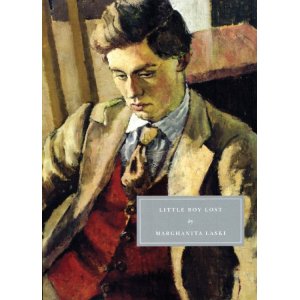
I was originally planning to read Alas, Poor Lady by Rachel Ferguson which I received from my Persephone Secret Santa at Christmas, but due to the length of the book I realised I wasn’t going to be able to read it in time to post about it this weekend. Although I’m still hoping to get to Alas, Poor Lady within the next few weeks (and looking forward to it as I’ve heard some good things about it), I decided that my book for the Reading Weekend would have to be the only other unread Persephone I own, Marghanita Laski’s Little Boy Lost.
And now I feel bad that Little Boy Lost was only my second choice. I can’t believe I’ve let this book sit on my shelf unopened for more than six months; if I’d realised I was going to love it this much I would have read it immediately.
Little Boy Lost is the second book I’ve read by Marghanita Laski – the first was The Victorian Chaise-Longue. However, I found the two books entirely different. Although I did enjoy The Victorian Chaise-Longue, this one was far more emotional and a more gripping, compelling read.
It’s Christmas Day, 1943, when Hilary Wainwright first learns that his son has been lost. He had seen baby John only once – a brief glimpse of a little red face with dark hair poking out of a bundle of blankets. Then, while Hilary was away, his wife, Lisa, was killed by the Gestapo in Paris and their little boy disappeared almost without trace. When the war is over, Hilary goes back to France and with the help of his friend, Pierre, he begins to follow a trail which he hopes will lead him to his lost son.
Laski does an excellent job of portraying the conflicting emotions Hilary experiences, torn between longing to be reunited with his son and worrying that if he does find him he might not want him. All through the book I was guessing what might happen – it wasn’t really obvious what the outcome would be and I could think of several different possibilities, some good and some bad.
The descriptions of post-war France are so vivid: the bomb-damaged buildings, the poverty, the food shortages – unless you were rich enough to take advantage of the black market, of course. And I was shocked by the descriptions of the conditions in the orphanages. As well as there not being enough to eat and drink, and a complete lack of any toys or games, it was chilling to think of children with tuberculosis living alongside the healthy ones.
Although I was trying to avoid hearing too much about this book before I read it, I knew it was supposed to become very nerve-wracking and suspenseful towards the end. Well, I can tell you that this is definitely true! There are so many great books that are let down by a weak ending, but this is certainly not one of them. The tension throughout the final few chapters was nearly unbearable, so much so that I was almost afraid to reach the end. And I imagine most readers, like I did, will have tears in their eyes when they reach the very last sentence.
Nicholas Lezard of The Guardian, who is quoted on the back cover, says it best: “If you like a novel that expertly puts you through the wringer, this is the one.”


 She Reads Novels