Doomed Romances: Strange Tales of Uncanny Love edited by Joanne Ella Parsons – #ReadIndies

This new short story collection, Doomed Romances: Strange Tales of Uncanny Love, is part of the British Library’s Tales of the Weird series. These books have been around for a few years now but I’ve let them pass me by as I’ve had enough to read with their Crime Classics series! I’m glad I’ve finally found time to try one as although this collection is a bit uneven I did find it entertaining.

The book contains twelve stories by different authors and includes an introduction by the editor, Joanne Ella Parsons. The stories were originally published between 1833 and 2022 and appear here in chronological order. All have a ‘doomed romance’ theme, with some being much darker than others. There are two that I’ve actually read before – one of them is Sheridan Le Fanu’s lesbian vampire novella, Carmilla, and the other is Angela Carter’s The Lady of the House of Love, also a vampire story, first published in The Bloody Chamber. I didn’t read Carmilla again as I just read it fairly recently, but I did re-read the Carter and was impressed again by the beautiful imagery and the atmospheric Gothic setting she creates.

The oldest story in the book is Mary Shelley’s The Invisible Girl, in which the narrator, out walking along the coast of Wales, finds a painting of a beautiful woman hanging on the wall inside a ruined tower. It was good to have the opportunity to try more of Shelley’s work, having only read Frankenstein so far, but I didn’t find this a particularly strong story. Two that I did enjoy were The Little Woman in Black by Mary Elizabeth Braddon and One Remained Behind by Marjorie Bowen. These are also authors I’ve read before; Braddon is a favourite Victorian author of mine and has a very readable writing style. Her story seemed as if it was heading in one direction, but then surprised me with an ending I wasn’t expecting at all! Bowen was a very prolific author of historical novels and supernatural tales – the story in this collection is a ghost story from 1936 and one of the highlights of the book for me.

Joanne Ella Parsons has clearly tried to include stories with a wide range of geographical settings, exploring different cultures, rather than just sticking with more traditional Gothic stories. Wilkie Collins, another Victorian author I usually enjoy, is represented here with Mr Captain and the Nymph, in which a ship’s captain lost on an unidentified Pacific island falls in love with the daughter of a local priest. It’s an interesting story, although not a good example of his best work. Alice Perrin’s The Tiger-Charm is set on safari in India, while Nalo Hopkinson’s The Glass Bottle Trick transposes the famous Bluebeard folktale to a Caribbean setting. The latter are two new authors for me and I found both stories entertaining, but I’m not sure if I would search out more of their work based on these.

Another highlight was Could You Wear My Eyes? by Kalamu ya Salaam, where a man whose wife has died agrees to have her eyes inserted into his face after her death, allowing him to see life from her perspective. It’s a strange story but a fascinating one! The collection is completed with another 19th century story, Ella D’Arcy’s White Magic, and two contemporary ones, I’ll Be Your Mirror by Tracy Fahey and Dancehall Devil by V. Castro.

Doomed Romances is a real mixed bag, then – there are some very strong stories and some much weaker ones, and including Carmilla seemed an odd decision to me, as it’s so much longer than any of the other stories and made the book feel unbalanced. I enjoyed the collection overall, though, and will probably consider reading more of them.

British Library Publishing publish a range of fiction and non-fiction including the Tales of the Weird, Crime Classics and Women Writers series. They are an independent publisher, so I’m counting this book towards #ReadIndies month, hosted by Kaggsy’s Bookish Ramblings and Lizzy’s Literary Life.

Aurora Floyd by Mary Elizabeth Braddon

Aurora Floyd When I decided to take part in the recent Classics Club Spin I was delighted when the book chosen for me was Aurora Floyd. I have read two of Mary Elizabeth Braddon’s other books – Lady Audley’s Secret and The Doctor’s Wife – and loved them both, so I had high hopes for this one.

Aurora Floyd, like Lady Audley’s Secret, is a Victorian sensation novel which means you can expect a story filled with mystery, murder and family secrets. Aurora Floyd is a young woman who lost her mother at an early age and was raised by her father, a rich banker. We are told that the lack of a feminine influence has led to Aurora having some unsuitable and unconventional hobbies, including an obsession with dogs and horse racing. It’s this interest in horses that causes Aurora to become involved in a scandal that her father does his best to cover up.

Time passes and Aurora attracts the attentions of two very different men: the handsome, proud Cornishman Talbot Bulstrode and the loyal, loving Yorkshire squire John Mellish (one of my favourite characters). She marries one of them but it’s not long before the secrets of Aurora’s troubled past come back to haunt her. Of course I’m not going to tell you what Aurora’s secret is, and if you really don’t want to know I would also advise not reading the blurb on the back of the Oxford World’s Classics edition. It’s not all that hard to guess, admittedly, but it’s completely unnecessary for the publisher to spoil the story for people in my opinion! Even after the truth about Aurora’s past starts to become obvious, though, there are still more mysteries to be solved and plenty of suspense right until the end of the book.

I’ve mentioned that I liked John Mellish; I also loved Aurora’s uncle, Samuel Prodder, and there are some great villains too, including the governess, Mrs Powell, who is jealous of Aurora, and Steven Hargraves, who is looking for revenge after losing his position as groom for kicking Aurora’s dog. As I’ve already said, Aurora is not a typical Victorian heroine, especially in contrast to the novel’s other main female character, her cousin Lucy, who is portrayed as gentle, feminine and obedient. But while Lucy is presented as the 19th century ideal and Aurora as ‘unwomanly’, the author never sounds disapproving or judgmental of Aurora and she is by far the more interesting and engaging of the two. At first, to maintain the aura of mystery and secrecy surrounding her, we are not allowed into Aurora’s head; everything we learn about her is through either the authorial voice (Braddon, like many Victorian authors, has a habit of talking directly to the reader) or through the eyes of Talbot Bulstrode, John Mellish and various other characters. Later, after her secrets start to be revealed, we get to know her better.

In some ways Aurora Floyd is definitely a product of its time – attitudes towards class, for example, and the offensive terms used to describe Hargraves, who has what we would probably call learning difficulties today – but in other ways, Braddon’s views feel refreshingly modern. I also liked the fact that while many authors would have ended the novel with the heroine’s marriage, in Aurora Floyd the marriage takes place less than a third of the way through the book, when the story is only just beginning rather than ending:

Yet, after all, does the business of the real life drama always end upon the altar-steps? Must the play needs be over when the hero and heroine have signed their names in the register? Does man cease to be, to do, and to suffer when he gets married? And is it necessary that the novelist, after devoting three volumes to the description of a courtship of six weeks duration, should reserve for himself only half a page in which to tell us the events of two-thirds of a lifetime?

It has been a few years since I last read anything by Mary Elizabeth Braddon and I had forgotten how much I like her writing. I still prefer Wilkie Collins’ sensation novels, but Braddon’s are not far behind. I didn’t find Aurora Floyd as exciting and gripping as Lady Audley’s Secret but I think I liked the characters better in this one and am grateful to the Classics Spin for selecting such an enjoyable book for me!

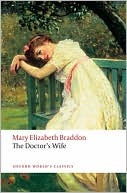
Review: The Doctor’s Wife by Mary Elizabeth Braddon

Isabel Sleaford lives in a dream world filled with characters from novels by Dickens, Scott and Thackeray. She longs to break away from her boring existence as a children’s governess and live the exciting life of one of the heroines in her favourite books. When parish doctor George Gilbert proposes to her, she accepts but quickly finds that her marriage isn’t providing the drama and adventure she’s been dreaming of. George is a good man, but he’s practical, down to earth – and boring, at least in Isabel’s opinion. After meeting Roland Lansdell, the squire of Mordred Priory, she becomes even more discontented. Roland is romantic, poetic and imaginative – in other words, he’s everything that George isn’t…

This is the second Mary Elizabeth Braddon book I’ve read – the first was the book that she’s best known for today, the sensation novel Lady Audley’s Secret. Apparently The Doctor’s Wife was Braddon’s attempt at writing a more serious, literary novel, with a plot inspired by Gustave Flaubert’s Madame Bovary. The Doctor’s Wife is not very ‘sensational’ – apart from maybe the final few chapters – and although it’s interesting and compelling in a different way, if you’re expecting something similar to Lady Audley you might be slightly disappointed. At one point in the book, Braddon even tells us “this is not a sensation novel!”

The focus of The Doctor’s Wife is the development of Isabel Gilbert from a sentimental girl with her head permanently in the clouds into a sensible and mature woman. I didn’t like Isabel much at all, though I’m not really sure if I was supposed to. Throughout most of the book she was just so silly and immature – wishing that she would catch a terrible illness or some other tragedy would befall her, just so she could have some excitement in her life – although as several of the other characters pointed out, she wasn’t a bad person, just childish and foolish. It was sad that her own romantic notions and ideals were preventing her from having any chance of happiness.

I thought some of the minor characters were much more interesting and I would have liked them to have played a bigger part in the story. I particularly loved Sigismund Smith, who was a friend of both George and Isabel, and a ‘sensation author’ – probably a parody of Mary Elizabeth Braddon herself. Sigismund (whose real name is Sam) is a writer of ‘penny numbers’ – cheap, serialised adventure stories. His enthusiasm for his work and his unusual methods of researching his novels provide most of the humour in the book.

Due to Isabel’s reading, almost every page contains allusions to characters and events from various novels, plays and poems – most of which I haven’t read – so I found myself constantly having to turn to the notes at the back of the book (until I decided I could follow the story well enough without understanding all the references to Edith Dombey and Ernest Maltravers).

Overall, this was another great book from Mary Elizabeth Braddon, although not quite what I was expecting.

Highly Recommended

Genre: Classics/Pages: 431/Publisher: Oxford University Press/Year: 2008 – originally published 1864/Source: My own copy purchased new