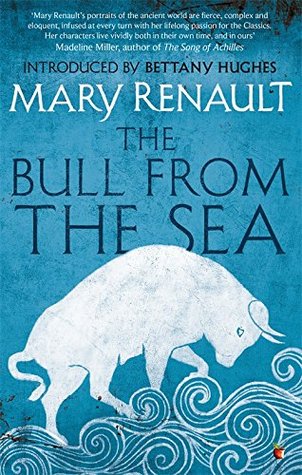
 This is the first in Mary Renault’s trilogy of novels about the life of Alexander the Great. It’s been waiting patiently on my shelf for years, since I finished her two books on Theseus, The King Must Die and The Bull from the Sea, and I picked it up last month as it would count towards both the 20 Books of Summer challenge and my Classics Club list.
First published in 1969, Fire from Heaven tells, in fictional form, the story of Alexander’s life from early childhood up to the moment he comes to power following the death of his father, Philip II of Macedon. His complex relationship with Philip – and also with his mother, Olympias – forms an important part of the novel as both parents are influential in shaping the character of the young Alexander. Philip is portrayed as a brutal, harsh, arrogant man, who can be very unkind to Alexander, but there are also moments when they bond and discover things they have in common. Their relationship is further strained by Olympias’ insinuations that Philip is not Alexander’s biological father, as well as Philip’s various infidelities and insistence on taking additional wives.
Alexander is devoted to Olympias from an early age and is disturbed by his parents’ tempestuous marriage. Like Alexander, I initially found her sympathetic, but as the novel progresses she is shown to have both positive and negative qualities, being passionate, vengeful and manipulative, as well as involving herself in religious rituals, particularly the worship of Dionysus. Alexander finds solace from his difficult relationships with his parents in his very close friendship with Hephaistion, another important character in the novel. Renault suggests that Alexander and Hephaistion are lovers, drawing comparisons with Achilles and Patroclus, although it seems that historians are divided on this.
Away from his personal relationships, a lot of time is also spent on exploring the education and experiences that made Alexander the great military leader he would later become: the tuition he receives from Aristotle; the first time he kills a man; his taming of the horse Bucephalus; and his participation in some of his father’s military campaigns. Because this book only covers the first half of Alexander’s life, Renault is able to go into a lot of depth and detail. I’m looking forward to seeing how his character continues to develop in the second book, The Persian Boy, which covers the remainder of his life.
This is not a particularly easy book to read; it needs a lot of concentration and I read it slowly over the course of a few weeks so I didn’t miss anything. It’s obviously very well written and thoroughly researched, which I knew it would be, having read other Renault books, and like many older historical novels it’s also very immersive, with no inappropriately modern language or attitudes, which can sometimes be a problem with newer books. Purely from an entertainment perspective, I didn’t find this as enjoyable to read as the Theseus novels, but I did get a lot out of it and am pleased to have added to my knowledge of a man and a period of history I previously hadn’t read much about.

Book 16/20 for 20 Books of Summer 2025.
This is also book 48/50 from my second Classics Club list.
 She Reads Novels