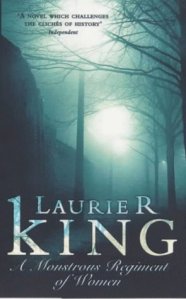
 This is the second in Laurie R. King’s series of novels featuring Mary Russell and Sherlock Holmes. It’s been almost exactly two years since I read the first in the series, The Beekeeper’s Apprentice, and I really didn’t mean to leave it so long before reading the next one. However, when I picked this book up and started reading a few days ago, I was pleased to find that I’d inadvertently chosen the perfect time to read it because the story is set during the Christmas and New Year period of 1920/1921 – although it’s not a typical festive read as Mary makes it clear in the first chapter that she sees Christmas as something to be survived rather than enjoyed!
At the beginning of the book, Mary is awaiting her twenty-first birthday when she will receive her inheritance and her freedom from her aunt. She is also struggling with her feelings for her friend, the detective Sherlock Holmes. While she’s trying to avoid Holmes, she meets another old friend who introduces her to Margery Childe, the charismatic feminist leader of The New Temple of God. Mary herself is a student of theology at Oxford and is instantly drawn to Margery, fascinated by her interpretations of the Bible and impressed by the work she and her church are doing to help women in need. But at the same time, Mary feels uneasy and when she discovers that several young women from the Temple have recently died under suspicious circumstances, she decides to investigate.
Before beginning this book I had been curious to see how the relationship between Mary Russell and Sherlock Holmes was going to develop. I don’t have a problem with the thirty-nine year age difference (they are both adults and Mary has matured a lot since she first met Holmes as a teenager in the previous book) and I love all of their interactions and conversations. My favourite scenes are the ones in which they are both together, so I was disappointed that there weren’t more of them in this book – although I do understand the reasons why they are working separately for such long periods of the story. The focus is on Mary and her personal development as well as on the development of her romance with Holmes.
The actual mystery seemed to take a long time to get started and I didn’t find the plot very exciting until the second half of the book, but it was still interesting to read about 1920s society and the way life had been affected by the end of the Great War, the changing roles of women as a result of the war and the suffrage movement, and the work of Margery’s church. The title of the novel refers to a 16th century pamphlet by John Knox, The First Blast of the Trumpet Against the Monstruous Regiment of Women, an attack on the rule of female monarchs (specifically Mary of Guise, the Queen Dowager of Scotland, and Mary I of England) and the subjects of feminism and religion both form part of the story.
I did enjoy this book, but not as much as The Beekeeper’s Apprentice, which I loved. I’m looking forward to reading the next one in the series – and will try not to wait another two years!

 She Reads Novels