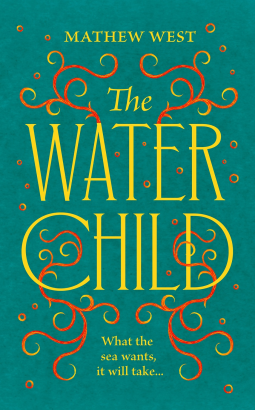
 I enjoyed Mathew West’s first novel, The House of Footsteps, an eerie ghost story set in the 1920s, so I was looking forward to reading his new book, The Water Child. It’s quite different, in both setting and tone, but overall I liked this one as well.
The Water Child is set in Portugal in 1754. Cecilia Lamb is anxiously awaiting the return of her husband John, a Scottish sea captain, who has been away on his latest voyage for much longer than expected. It seems likely that the ship has been wrecked and John is dead, but Cecilia hasn’t given up hope. She spends her days wandering the docks, staring out to sea, certain that her husband is still out there somewhere.
As a young woman alone in an unfamiliar country, this is a difficult time for Cecilia and she struggles to come to terms with John’s absence, beginning to have visions, to hear voices and to suffer from a mysterious sickness. Until she knows for certain that her husband won’t come back, she is unable to mourn or to make arrangements to return to her own family in England – and even if he does come back, will he still be the same person he was when he went away?
Mathew West writes beautifully and creates an almost hypnotic atmosphere as Cecilia moves from one day to the next as if in a dream, watching and waiting, trapped in time until she receives some definite news and can start to move forward. Despite the long absence of her husband (and I’m not going to tell you whether he ever reappears or not), Cecilia does form other relationships – with her maid, Rosalie, and with some other women who understand what it’s like to be the wife of a sailor, while at the same time not fully understanding what is going on inside Cecilia’s mind. West’s previous book had much stronger supernatural elements, but in this one they’re a lot more subtle and it’s open to interpretation whether you think the things Cecilia sees and hears have paranormal explanations or more practical ones.
There are some lovely and vivid descriptions of 1750s Portugal, so I was intrigued by Mathew West’s comments at the end of the book that the Portugal he describes probably never existed and owes as much to fantasy as reality, although he also says that he carried out a lot of research into certain details. I don’t have much knowledge of Portugal in that period (the only other book I’ve read with the same setting is Linda Holeman’s novel, The Devil on Her Tongue), so I would have been interested to hear more about what was real and what was fictional.
There’s one more thing I want to mention; I don’t usually give trigger warnings for books, but there is a brief scene of animal cruelty towards the end of the book which doesn’t really feel necessary and I’m sure the author could have found another way to illustrate the cruelty of the person involved. Otherwise, The Water Child is a dark, unsettling and fascinating novel, slow to begin but picking up pace towards the end. I’ll be interested to see what setting Mathew West chooses next, having written two such different books so far.
Thanks to HarperNorth for providing a copy of this book for review via NetGalley.

This is book 46/50 for the 2023 Historical Fiction Reading Challenge.


 She Reads Novels