A Country Doctor’s Notebook by Mikhail Bulgakov

A Country Doctors Notebook A Country Doctor’s Notebook is the book that was selected for me in the last Classics Club Spin. I was happy when I discovered that I would be reading this one, not only because it’s much shorter than most of the others on my Classics Club list, but also because I loved Bulgakov’s The Master and Margarita which I read four years ago in 2011. I knew this book was going to be very different from The Master and Margarita, but I hoped I would still enjoy it…and I did.

A Country Doctor’s Notebook is a collection of semi-autobiographical short stories originally written in Russian in the 1920s (the edition I read uses Michael Glenny’s English translation from 1975). Like the protagonist of this book, Mikhail Bulgakov was a ‘country doctor’. After graduating from Kiev University he became a physician and from 1916-1918 he worked at a small hospital near a remote village in the province of Smolensk.

The fictional doctor in the book, Vladimir Bomgard, is clearly based on Bulgakov himself and in the first story we see him as a young, newly-qualified doctor of twenty-four arriving at Muryovo Hospital, a full day’s drive from the nearest town. He is pleased to find that the hospital is clean and well equipped, but with no practical experience and nobody to turn to for advice (apart from a feldsher, or partly-qualified assistant, and two midwives) the thought of bearing sole responsibility for the lives of his patients terrifies him.

During his first weeks and months at Muryovo, the country doctor faces all sorts of problems for which his university education had completely failed to prepare him. With no electricity, no telephones, poor roads, the risk of being cut off from the world during snowstorms, and the ignorance of peasants regarding simple medical matters, life at Muryovo is primitive and isolated. Most of all, the young doctor lives in fear of encountering a strangulated hernia, a case of peritonitis or a difficult birth and he comes to dread hearing a knock on the door in the middle of the night.

“It’s not my fault,” I repeated to myself stubbornly and unhappily. “I’ve got my degree and a first class one at that. Didn’t I warn them back in town that I wanted to start off as a junior partner in a practice? But no, they just smiled and said, ‘You’ll get your bearings.’ So now I’ve got to find my bearings. Suppose they bring me a hernia? Just tell me how I’ll find my bearings with that?”

As the book progresses the doctor slowly begins to gain confidence and discovers that true knowledge comes with experience.

It was fascinating to read about conditions in a remote Russian hospital at the start of the twentieth century and the medical procedures and treatments that were used. I had a lot of sympathy for the doctor, being thrown in at the deep end with so little experience and being expected to operate on patients with no supervision and no advice other than illustrations in his textbooks. If you’re squeamish I should probably warn you that some of the operations he performs are described in full, gory detail (the tracheotomy particularly sticks in my mind). But this is also a book with a lot of humour and there are some very funny moments as the doctor panics, guesses and muddles his way through each crisis.

As I mentioned above, I read the Michael Glenny translation which I was quite happy with and found perfectly readable. I enjoyed all of the stories in A Country Doctor’s Notebook and I’m so pleased the Classics Spin motivated me to pick up this book at last.

Three nurses, a ghost and a computer genius

The Nightingale Girls by Donna Douglas / For One More Tomorrow by Elizabeth Bailey / Goodbye for Now by Laurie Frankel

Happy New Year! With a backlog of books read near the end of 2012 still to write about, I am starting 2013 with reviews of not just one book but three. Apologies in advance for the length of this post…I thought these were going to be mini-reviews but they turned out to be longer than I expected!
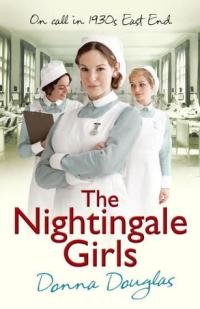
The Nightingale Girls The Nightingale Girls by Donna Douglas

The Nightingale Girls is set in the 1930s and follows the stories of three student nurses at one of London’s top teaching hospitals, the Nightingale.

Life is not easy for Dora Doyle, who comes from a poor, working class family from the East End of London. Dora sometimes feels out of place among the other, richer girls at the Nightingale and is struggling to find money to buy the books she needs, but she is determined to succeed, partly because she’s passionate about nursing but also because she’s desperate to get away from her abusive stepfather. The aristocratic Lady Amelia Benedict, known as Millie, is from a very different social background to Dora, with whom she shares a room. Millie wants to build a life for herself away from her luxurious home and glamorous friends, but as she is constantly finding herself in trouble and has already failed her preliminary training exams once, it’s going to be difficult to prove that she’s serious about her nursing. The third girl we meet is Helen Tremayne, a second year student. Her domineering mother is on the hospital’s board of trustees and her brother is a doctor, so expectations are high. Helen works hard, but has trouble making friends, especially as the other girls don’t trust her because of her mother.

At first it seems that Dora, Helen and Millie have nothing in common but as they get to know each other during their long, hard days at the Nightingale, a bond begins to form between the three of them. I didn’t feel I got to know Helen as well as the other two but I loved both Dora and Millie. Dora was completely inspirational and a perfect example of someone managing to fulfil her dreams through sheer determination and hard work. And the rebellious but warm-hearted Millie was so endearing. Through her story we see that money and possessions are not everything and that true happiness can come through doing something that we love. There are some great secondary characters too, including the spiteful and snobby but bitterly unhappy Lucy Lane, and the Doyles’ neighbour, Nick, who is desperately trying to make enough money to take his little brother to America. Dora’s grandmother, Nanna Winnie, was another favourite.

It was so interesting to see what was involved in being a trainee nurse in the 1930s. The book shows us the hardships of nursing, but there are also lots of moments of fun and humour, including one hilarious scene involving false teeth. As a historical novel, the setting of 1930s London is wonderful, whether we’re reading about the streets in the East End where the Doyle family live or an afternoon eating cakes and drinking tea at Lyons’ Corner House! The Nightingale Girls is the first in a series of novels about the Nightingale Hospital and I will look forward to reading the others.

Thanks to Random House for sending me a review copy of The Nightingale Girls
For One More Tomorrow For One More Tomorrow by Elizabeth Bailey

For One More Tomorrow, currently available as an ebook, tells the story of Sadie Grey, who is directing a production of Shakespeare’s play, Macbeth. Growing frustrated and disillusioned with some of the actors in the play and their inability to inject real passion into their roles, Sadie is stunned when she meets the ghost of Macbeth himself. Soon Mac, as Sadie calls him, seems to be invading her thoughts and taking over her life, and as her relationship with the ghost develops there are some surprises in store for both Sadie and the reader!

At first Sadie wonders whether Macbeth’s ghost has been produced from her own imagination – he looks and sounds exactly as she had pictured him in her mind, even wearing tartan like the characters in Sadie’s play despite the fact that she knows the real Macbeth would not have done so. And yet it seems that Mac does have an existence of his own outside of her imagination, and some sections of the story are seen from his point of view, as he roams the streets alone or watches rehearsals from the shadows at the side of the stage. Through his own thoughts and his conversations with Sadie, we see that he is not very pleased at the way the story of his life has been distorted by Shakespeare; he’s angry and hurt that his reputation has been damaged and history has been altered in the name of entertainment.

I haven’t read all of Shakespeare’s plays but I have read Macbeth more than once and it’s probably the play I’m most familiar with. I could sympathise with Sadie, who clearly has a real understanding and love of the play; she knows how she wants the actors and actresses to play their roles and it annoys her when they do not portray their characters as she wants to see them portrayed…especially Curtis, the man who is playing Macbeth. I did enjoy the parts of the book that deal with the rehearsals for the play and the problems Sadie encounters as director, but my favourite scenes were those in which Sadie is interacting with the ghost. For One More Tomorrow was an unusual and imaginative story and I’m sure the next time I read Macbeth I’ll remember Mac and how he felt about Shakespeare’s words.

Thanks to the author for sending me a review copy of this book
Goodbye for Now Goodbye for Now by Laurie Frankel

Sam Elling is a computer software engineer who works for an online dating company based in Seattle. Sam has created a new computer algorithm to help people find their perfect partner, but it proves to be too successful as people are meeting their soulmates too quickly and don’t need to use the dating agency anymore. As a result he loses his job but it’s not long before he comes up with another invention.

When Sam’s girlfriend Meredith loses her beloved grandmother, Livvie, she tells him she wishes she could speak to Livvie one more time. Wanting to help in any way he can, Sam creates a computer program based on the online presence Livvie has left behind, including emails, texts and videos. Meredith is shocked but overjoyed to discover that she can now continue to chat to Livvie and exchange emails just as she used to when her grandmother was alive. Soon Sam and Meredith decide to give other bereaved people the same opportunity to communicate with loved ones who are no longer with them, but they are not prepared for the number of moral issues they will have to face.

Different people have different ways of dealing with grief and what works for one person will not necessarily work for everyone. I can’t imagine ever wanting to use this type of technology myself and I tend to agree with the characters in the story who found the whole idea creepy and disturbing. However, I still thought it was fascinating to read about. There’s nothing paranormal involved and the software Sam invents sounds completely believable from a scientific point of view.

With death and grief forming such a big part of this book I had expected something very sad and emotional, but the story was actually not as moving as I had thought it might be. That could be because the main characters – Sam, Meredith, her cousin Dashiell and their clients – are all so ‘nice’ that I had difficulty believing in them as real people and didn’t manage to fully connect with them. What I did love about this novel was the number of thought-provoking questions it raises by showing us how the world reacts to Sam’s controversial new technology and telling the stories of the people who decide to use it.

Is chatting to a computer generated image of a friend or relative who has died really a good idea or is it better to let the grieving process take its natural course? Can social media actually be isolating rather than social? Are there things that our loved ones may have said or done online that we would be better off not knowing about? What about privacy? Nobody seemed to have any problems with allowing Sam to access their family member’s emails, blog, internet browsing history or Facebook and Twitter accounts, but I know I wouldn’t feel comfortable with that. Goodbye for Now may not have been a perfect novel but has left me musing on all of these questions and more.

Thanks to Headline for the review copy of Goodbye for Now

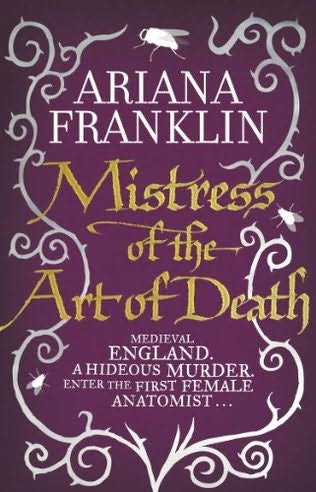
Mistress of the Art of Death by Ariana Franklin

This is my second book for the Great Transworld Crime Caper and is the first in a series of historical mysteries by the late Ariana Franklin. I knew nothing about this series but Mistress of the Art of Death appealed to me because of the medieval setting (I love books set in medieval England).

This book has an unusual heroine. Her name is Adelia Aguilar and she is a trained doctor, very rare in the year 1171. Adelia is from Salerno, where women are allowed to attend medical school. Her speciality, however, is as a ‘doctor of the dead’ – in other words, she is skilled in performing autopsies and finding out the causes of death. When several young children go missing in Cambridge and the city’s Jews are blamed for the disappearances, Adelia is sent to England to investigate.

As I said, I love reading about medieval history and Franklin touches on many different aspects of the period – from the big things, such as the relationship between the church and the monarchy, to the small, such as the clothes people wore and the food they ate. Adelia, being Italian, is unfamiliar with the politics and customs of 12th century England, which allows the reader to learn along with her – so no need to worry if you don’t have much knowledge of the period. Despite some very modern dialogue and Adelia’s distinctly 21st century thought processes, everything else felt suitably ‘medieval’. Setting and atmosphere are so important in fiction and this is an area in which I thought Franklin excelled. It wouldn’t really be fair for me to comment on the historical accuracy as I haven’t studied the 12th century in any detail but I would say that if you’re looking for a serious piece of historical fiction which is correct in every detail then you need to look elsewhere. Accept this book for what it is though, and it’s an enjoyable read.

The writing in the prologue and opening chapters feels quite light and humorous and I expected the whole book to have the same tone, but when Adelia begins to investigate the mystery things start to feel a lot darker. I should point out that the story does revolve around the abduction and murder of children which isn’t nice to read about; it’s quite graphic in places and a bit disturbing. As for the mystery itself, I didn’t guess who the murderer was, but then I wasn’t really trying to guess. Sometimes I prefer not to attempt to work things out and just enjoy the story – and this was one of those occasions.

I found Adelia a fascinating and engaging character although, as I mentioned earlier, she thought, spoke and behaved more like a woman from the 21st century than the 12th. She’s a strong, independent person who is constantly questioning the role of women in society and has a very modern outlook on medicine, the law and life in general; I liked her but she wasn’t a believable medieval woman. Most of the secondary characters are well-rounded and interesting, particularly Adelia’s housekeeper, Gyltha, and her surly but endearing grandson, Ulf – and I loved the depiction of Henry II.

I enjoyed Mistress of the Art of Death and I look forward to being reacquainted with Adelia Aguilar in the other three books in the series. Sadly, Ariana Franklin (Diana Norman) died in January this year aged 77.

I received a copy of this book from Transworld for review.

Cutting for Stone by Abraham Verghese

“I will not cut for stone, even for patients in whom the disease is manifest; I will leave this operation to be performed by practitioners, specialists in this art.” ~ the Hippocratic Oath

We’re in the middle of Virago Reading Week at the moment (I posted my thoughts on Rebecca West’s The Return of the Soldier on Tuesday and will be posting on The Enchanted April by Elizabeth von Arnim at the weekend) but today I want to talk about a non-Virago book I read earlier this month. It’s taken me a while to put this post together as I’ve had trouble finding the words to convey how wonderful the book was.

Cutting for Stone is the story of Marion and Shiva, the identical twin sons of Sister Mary Joseph Praise, an Indian nun, and Thomas Stone, a British surgeon, who are both working at Missing Hospital in Addis Ababa, Ethiopia. When Mary Joseph Praise dies in childbirth, Thomas Stone is unable to cope and, refusing to take responsibility for his children, disappears from the hospital. It falls to two of Missing’s other doctors, Hema and Ghosh, to give the twins a loving home and ensure their safety amid the political instability and military coups that affected life in Ethiopia in the second half of the twentieth century.

Cutting for Stone has an epic feel, spanning several continents and several decades. Through the eyes of our narrator, Marion Stone, we meet the people who live in and around Missing Hospital from the Matron and the Staff Probationer to Thomas Stone’s former maid, Rosina, and her daughter, Genet, the girl Marion loves. All of the characters, even the less likeable ones, have a lot of depth and as we learn more about them, we are able to understand what makes them behave the way they do. But at the heart of the story is the relationship between Marion and Shiva. Conjoined twins, born attached at the head, they have a very special bond which is put to the test several times throughout the novel.

There are some very detailed and graphic descriptions of surgical procedures throughout the whole book. This didn’t really bother me, and a lot of it was very interesting, but I feel I should warn you so that those of you who are squeamish can be prepared! Without even reading the author bio, it was obvious that Abraham Verghese must be a doctor himself because the language he uses is very technical. The fact that the book was written by a physician gives it a real authenticity and the author’s own passion for medicine and healing shines through. Medical care in 1950s Ethiopia was very basic and I had a lot of sympathy for the Matron of Missing Hospital, who did her best for the patients under her care despite the limited resources available to her. I could really feel her frustration as the hospital patrons gave her Bibles in place of the medicine and food she so desperately needed.

I think this is the first book I’ve read that is set in Ethiopia. Before I started reading I knew almost nothing about the country and its political history, but this didn’t matter at all as everything was explained in a way that was both informative and easy to understand. Little facts and details were dropped into the story, building up a clear picture of Marion’s life in Ethiopia. I love books like this one that leave me feeling that I’ve really learned something new while being entertained by a great story at the same time!

Although I’ve had a copy of Cutting for Stone since last summer I wasn’t sure I would enjoy it and hadn’t felt like reading it until I saw how many people had named it as one of their top books of 2010 and I finally decided I’d better read it as soon as possible, in the hope that it might become one of my own top books of 2011. Well, even though it’s still only January, I can’t imagine I’ll be reading a lot of books this year that are better than this one.

Highly recommended.