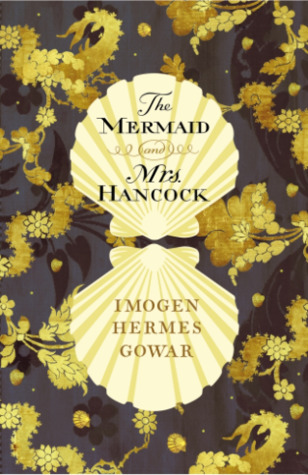
 The Mermaid and Mrs Hancock opens in 1785 with merchant Jonah Hancock sitting in his London counting house waiting for his ship to return. Imagine his horror when his captain arrives at the door and confesses that he has sold the ship in exchange for a mermaid. The captain assures him that people will come from all over the world to see the mermaid and that it will make him a fortune, but Mr Hancock is not at all convinced…
Angelica Neal has been living in comfort as the mistress of a rich duke. When the duke dies, leaving her with nothing, Angelica needs to find another way to support herself. The obvious solution is to return to her former employment in Mrs Chappell’s brothel, but Angelica is more ambitious these days and decides to make her own way in the world instead. Her path crosses with Mr Hancock’s when his mermaid is exhibited at a party she is attending and an unlikely friendship begins to form between these two very different people.
The first thing to say about The Mermaid and Mrs Hancock is that although mermaids and the legends surrounding them are symbolically important to the story, the part they play in the novel is relatively small. This could be a good or a bad thing depending on how you feel about magical realism, but be aware that the mermaid element of the story might not be what you are expecting. Their role is similar, in some ways, to the role of the serpent in Sarah Perry’s The Essex Serpent, one of several books to which this one has been compared.
As for the humans, I thought Angelica and Mr Hancock were both interesting, well drawn characters. Whenever the ambitious, strong-willed Angelica appeared on the page I was reminded of Becky Sharp from Vanity Fair and Sugar from The Crimson Petal and the White. It took me a while to warm to her and I still can’t say whether I actually liked her, but I did have some sympathy for her and, by the end, some admiration as well. Jonah Hancock is a very different type of character – a quiet, humble, middle-aged widower who is haunted by memories of his wife and son. Since their deaths, he has allowed his sister Hester and niece Sukie to take charge of his life, but his relationship with Angelica introduces another dynamic into the household.
There’s a colourful cast of secondary characters too, particularly the girls from the ‘nunnery’ as they ironically call it, and their grotesque ‘abbess’, Mrs Chappell, but I found that I was less interested in finding out what would happen to these characters than I was in reading about Mr Hancock and Angelica. One of them, Polly – a prostitute from a mixed race background who finds herself, like the mermaid, viewed as a sort of curiosity by the men who visit the brothel – had a lot of potential but her storyline was not really developed until late in the book.
The novel’s setting (Georgian England) is one I usually like and I was quite impressed by the author’s attention to detail and her attempts to recreate an 18th century world. The language and dialogue generally feels suited to the period, although I think Francis Spufford’s wonderful Golden Hill does this more effectively. Actually, it’s difficult to read this book without drawing comparisons with Golden Hill and if you enjoy one of them I think there’s a good chance you’ll enjoy the other!
The Mermaid and Mrs Hancock will be published in the UK on Thursday and although I didn’t love it as unreservedly as I’d hoped, I predict it will be a big success for Imogen Hermes Gowar.
Thanks to Harvill Secker for providing a copy of this book for review via NetGalley.
 She Reads Novels