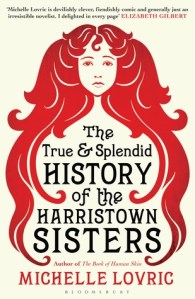
 I loved Michelle Lovric’s The True and Splendid History of the Harristown Sisters – it was one of my books of the year in 2014, the year it was published – and I’ve always intended to read more of her work. I finally picked up her 2010 novel, The Book of Human Skin, in the summer, but when I saw how long it was (512 pages) I decided to save it for Laura’s Doorstoppers in December event instead!
I didn’t love this book quite as much as Harristown Sisters, but it’s still a fascinating story. Set in Venice and Peru around the turn of the 19th century, it has five very different narrators. The character around whom everything else revolves is Marcella Fasan, a young woman from an aristocratic Venetian family. From birth, Marcella has been the subject of her brother’s hatred and envy – being twelve years older, Minguillo has always expected to be the sole heir to the family fortune and he resents the arrival of a baby sister who poses a threat to his inheritance.
As the years go by, Minguillo’s treatment of Marcella becomes increasingly cruel and brutal, until her friends decide it’s time to intervene. One of these is Gianni, a servant in the Fasan household. Minguillo believes him to be stupid and illiterate, but this is far from the truth and Gianni uses Minguillo’s misconceptions to his advantage. There’s also Santo Aldobrandini, a young surgeon who develops his skills treating the wounded in Napoleon’s army before making his way to Venice where he falls in love with Marcella. When he hears of what Marcella has suffered at her brother’s hands he’s determined to do whatever he can to rescue her.
The perspective switches between these four characters – and a fifth I haven’t mentioned yet – as they take turns to tell the story. The strongest and most unusual narrative voice is Gianni’s; although he’s far more intelligent than Minguillo assumes and has learned to read and write, his grasp of the written language is still not very good and he spells words phonetically or uses the wrong word in place of the right one. I found this annoying and distracting at first, but eventually got used to it – and it does result in some amusing spelling mistakes, such as hair for heir, aunts for ants or storks for stalks. Minguillo’s narration is also very distinctive due to him being so malicious, spiteful and sadistic. Despite this, as a storyteller he’s clever and charming, which makes his parts of the novel very compelling as well as horribly disturbing.
The fifth narrator is Sor Loreta, a nun at the convent of Santa Catalina in Arequipa, Peru. Sor Loreta is a religious fanatic, convinced that she has been chosen by God and that she is on the path to sainthood. She despises anyone who stands in her way or tries to reason with her – and this includes the prioress, who believes Sor Loreta is deluded and insane. This storyline seems very separate from the others, particularly as it’s taking place in a completely different country, but they do all come together in the end!
You may be wondering about the title of the novel. Well, one of Minguillo’s interests is collecting books bound in human skin. Gruesome as it may sound, there really was a demand for these books, which peaked in the 19th century, and it’s not surprising that a character as wicked and cold-blooded as Minguillo would be drawn to a hobby like this.
Finally, I need to mention the historical note at the back of the book. It’s so long it’s practically a whole non-fiction book in its own right! Lovric tells us which characters were fictional and which were based on real people, before going into a lot of depth on various historical aspects of the book, particularly the history of Venetian and Peruvian nuns and what it was like to live in a convent. It’s much more detailed than you would usually expect an author’s note to be and it was very interesting to read.
As it turns out, this was the perfect time for me to read this book because a sequel, The Puffin, has recently been announced for publication in 2026. I was also interested to learn that one of the characters in the book, the painter Cecilia Cornaro, is the subject of one of Lovric’s earlier novels, Carnevale, so I’ll have to look for that one as well.

 She Reads Novels