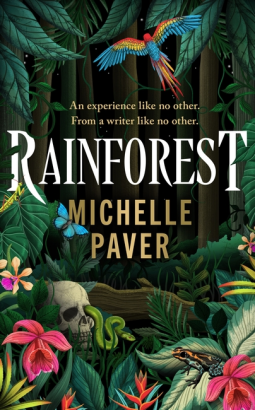
 When Dr Simon Corbett, a British entomologist, arrives in the Mexican rainforest in 1973 he has two goals in mind: first, to study the rare mantids that live there – and also to try to make contact with Penelope, the woman he loved. However, both of these things prove very difficult. The mantids live in the sacred ceiba trees and Simon’s guide is reluctant to let him touch them. As for Penelope, she’s dead and Simon is hoping to obtain a special Mayan drug that will allow him to summon her spirit. No one seems prepared to cooperate with him on this either, but Simon is determined to get what he wants, one way or another.
Rainforest is written entirely from Simon’s perspective in the form of diary entries. He tells us that his doctor has advised him to keep a journal to help him cope with the ‘thoughts going round and round like angry wasps’ – although this doesn’t seem to work, as Simon’s thoughts simply become more and more unstable and obsessive as the book progresses. Simon is a man consumed by grief, remorse and guilt, yet he’s such an unlikeable narrator I found it impossible to feel any real sympathy for him. He’s also not being completely honest with the reader, even in his own journal, because the impression he initially gives of his relationship with Penelope is very different from the truth that emerges later in the novel.
This is the second book I’ve read by Michelle Paver, the first being Wakenhyrst, a Gothic novel set in the Suffolk Fens. Although I enjoyed Wakenhyrst, I remember being surprised that it wasn’t scarier, having heard her previous novels Dark Matter and Thin Air described as very creepy horror novels. Rainforest is also not a particularly scary book, despite the cover claiming that it’s a ‘terrifying supernatural tale’. I think it’s best to know that going into it, as some people may be disappointed that it’s not more terrifying, while others will be pleased! Like Wakenhyrst, though, it is still very atmospheric; the rainforest is beautifully described – Paver mentions in her author’s note that she has visited rainforests herself – but, seen through Simon’s eyes, it becomes an oppressive, claustrophobic, menacing place.
Rainforest is a fascinating novel in many ways. As well as the setting which I’ve already mentioned, Paver also explores the arrogance of the white explorer and the lack of respect for the environment and the indigenous people – referred to specifically as the Yachikel, a term Paver says she made up and based on other Mayan peoples. I also learned more about Simon’s beloved mantids than I ever knew I needed to know! Simon being such an unpleasant character, though, meant that I struggled to care about what happened to him and this stopped me from engaging with his story as much as I would have liked. Despite this, I did enjoy the book overall and will catch up with her earlier ones at some point.
Thanks to Orion for providing a copy of this book for review via NetGalley.

 She Reads Novels