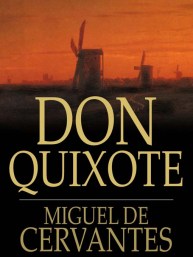
 Reading Don Quixote has been a year-long project for me in 2014. After reading Clarissa over a twelve month period as part of a readalong in 2012 and then War and Peace in 2013 I decided to tackle another of the very long, intimidating classics on my Classics Club list, this time on my own. Now that I’ve finished I don’t know why I had ever been intimidated by it. Yes, it’s long (over 1,000 pages in most editions) and old (originally published in two parts in 1605 and 1615) and a translation, but I didn’t find it difficult to read at all. It’s fun and imaginative and entertaining – and I loved it.
Don Quixote is the story of a gentleman of La Mancha who has spent so many years reading books of chivalry and romance that he has come to believe the tales they tell are true. Inspired by the heroes of his favourite books, he decides to become a knight errant and go out into the world in search of adventures. Renaming himself Don Quixote and his horse Rocinante, he convinces a neighbouring peasant, Sancho Panza, to join him as his squire. With Sancho at his side, Don Quixote sets out to right wrongs, fight duels and rescue damsels in distress, in the hope that his valiant deeds will win him the love of the beautiful (and largely imaginary) Dulcinea del Toboso.
As Don Quixote and Sancho travel across Spain they have one adventure after another, each one headed with a long and intriguing chapter title such as “Of the strange adventure which befell the valiant Don Quixote with the bold Knight of the Mirrors” or “Which deals with the adventure of the enchanted head, together with other trivial matters which cannot be left untold”. As you read on, however, it soon becomes obvious that these ‘adventures’ are not quite as amazing as they sound and usually have a logical explanation.
Many people, even without reading the book, will have heard of the famous ‘tilting at windmills’ episode. There are many, many other similar episodes in the novel but this one appears near the beginning which is probably why it’s the best known. If you’re not familiar with it, on approaching some windmills in a field Don Quixote becomes convinced they are giants and attacks them with his sword:
“What giants?” said Sancho Panza.
“Those thou seest there,” answered his master, “with the long arms, and some have them nearly two leagues long.”
“Look, your worship,” said Sancho; “what we see there are not giants but windmills, and what seem to be their arms are the sails that, turned by the wind, make the millstone go.”
“It is easy to see,” replied Don Quixote, “that thou art not used to this business of adventures; those are giants; and if thou art afraid, away with thee out of this and betake thyself to prayer while I engage them in fierce and unequal combat.”
This is a pattern that is repeated over and over again throughout the novel: Don Quixote mistakes inns for castles and flocks of sheep for armies – and even when Sancho points out the truth he still insists that he is right. The castles and the armies must have been enchanted by great wizards, he says, so that they appear to be inns and sheep. As the story progresses, Don Quixote’s fame spreads and he is thought of as insane and Sancho as an idiot. The response of some of the people they meet can be very cruel and it’s quite sad to see how Don Quixote and Sancho are ridiculed, scorned and made the target of elaborate practical jokes. I wouldn’t describe this as a sad book, though; in fact, it’s a very funny one. The humour doesn’t always work (being four hundred years old and in translation, maybe that’s not surprising) but at times it’s hilarious!
As well as the adventures and the humour, there are lots of songs, poems and ballads interspersed with the prose. There are also lots of stories-within-stories – almost everyone they meet on their journey has a long and tragic story of their own to tell – and many of these have no relevance to the rest of the novel. For example, a lot of time is devoted to the tale of a Christian who was held captive by Moors in Algiers and has escaped back to Spain – nothing to do with Don Quixote, but apparently based on Cervantes’ own experiences. This is why the novel is so long and why you need to have some patience with it! Reading this book over a period of several months was the perfect strategy for me as the episodic nature of the story meant that I could leave it for a few weeks and still get straight back into it when I picked it up again. Breaking it up into small sections kept it feeling fresh and interesting so that I never felt bored or overwhelmed.
A quick note on the translation now. There have been many English translations of Don Quixote over the years but not really having any idea which to choose, I started reading the 1885 John Ormsby translation (in the public domain so free to download from Project Gutenberg and other websites) and I found it perfectly readable so decided just to stick with it. I wouldn’t necessarily recommend that translation to everyone as it does use some archaic terms and feels ‘old’ but that’s what I prefer when I’m reading an old book so it wasn’t a problem for me. Whichever may be closest to the literal translation, Ormsby’s description of Don Quixote as “Knight of the Rueful Countenance” just sounds better to me than, for example, Edith Grossman’s “Knight of the Sorrowful Face”. It’s a matter of personal taste, though, so it’s probably a good idea to look at a few different translations and find one that suits you before you embark on such a long novel!
Much as I enjoyed this book it did sometimes feel as if I was never going to finish it, so I was pleased to reach the end. I’m going to miss Don Quixote and Sancho, though, after spending so much time with them this year!






 She Reads Novels